
We read your photo as:
Define the term "transitional fossil". Explain THREE characteristics of a skeleton which are adaptations for bipedalism. Give possible reasons why there was a change to smaller teeth in modern humans.
Biology
ScanSolve AI Answer
Here are the answers to your questions:
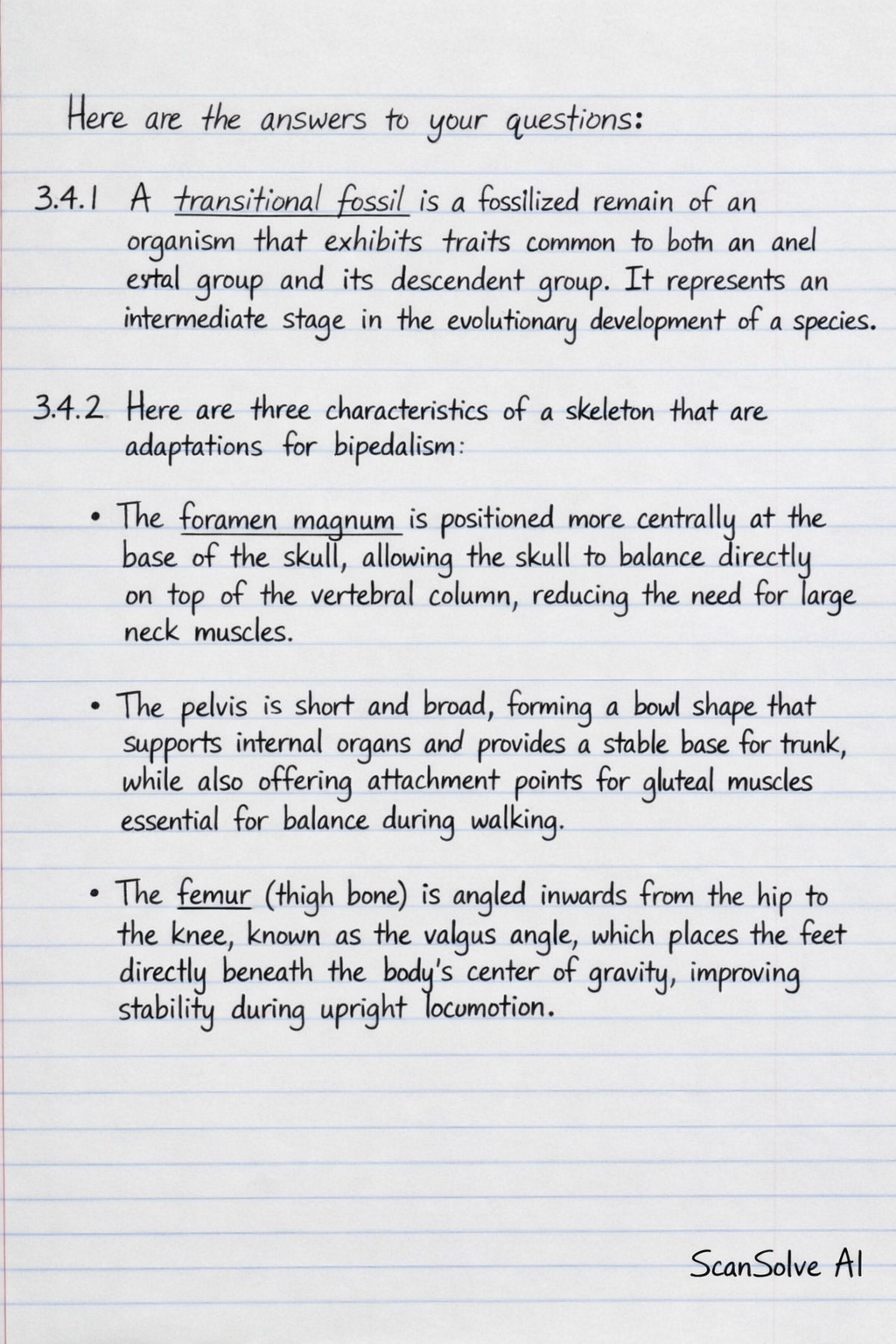
3.4.1 A transitional fossil is a fossilized remain of an organism that exhibits traits common to both an ancestral group and its descendant group. It represents an intermediate stage in the evolutionary development of a species.
3.4.2 Here are three characteristics of a skeleton that are adaptations for bipedalism:
- The foramen magnum is positioned more centrally at the base of the skull, allowing the skull to balance directly on top of the vertebral column, reducing the need for large neck muscles.
- The pelvis is short and broad, forming a bowl shape that supports internal organs and provides a stable base for the trunk, while also offering attachment points for gluteal muscles essential for balance during walking.
- The femur (thigh bone) is angled inwards from the hip to the knee, known as the valgus angle, which places the feet directly beneath the body's center of gravity, improving stability during upright locomotion.
3.4.3 The change to smaller teeth in modern humans can be attributed to several factors:
- A shift in diet towards softer, more easily digestible foods, including those processed by cooking, reduced the need for large, robust teeth for chewing tough raw foods.
- The development and use of tools for cutting, tearing, and processing food externally diminished the selective pressure for large teeth to perform these functions.
- Changes in social behavior, such as food sharing and communal preparation, also contributed to a reduced reliance on individual dental strength.
Was this helpful?
Still stuck on this one?
Ask a follow-up, and the answer starts from this question.
Got a different question?Ask your own question
More Biology Questions
QList FOUR characteristics from the list above that are similar to that of Australopithecus…QWhich pelvis, 1 or 2, belongs to hominid? List TWO characteristics of the pelvis that supports your…QDescribe and identify fossil A and B. State with reason the mode of life of specimen A and B.QStudy the two fossils (Diagram A and Diagram B) which were discovered and classified as transitional…QSummarize the types, structure, and importance of human teeth.
Browse by topic:Anatomy
Handwritten Step-by-Step Solution
Get this as a handwritten image on WhatsApp — like a tutor wrote it for you.
Try on WhatsApp