
We read your photo as:
Describe the tests for reducing sugars and starch, and outline the functions of key nutrients. Also, calculate the volume of air escaped from different soil samples.
ScanSolve AI Answer
Step-by-step solution
6 stepshere's the solution to questions 1 and 2:
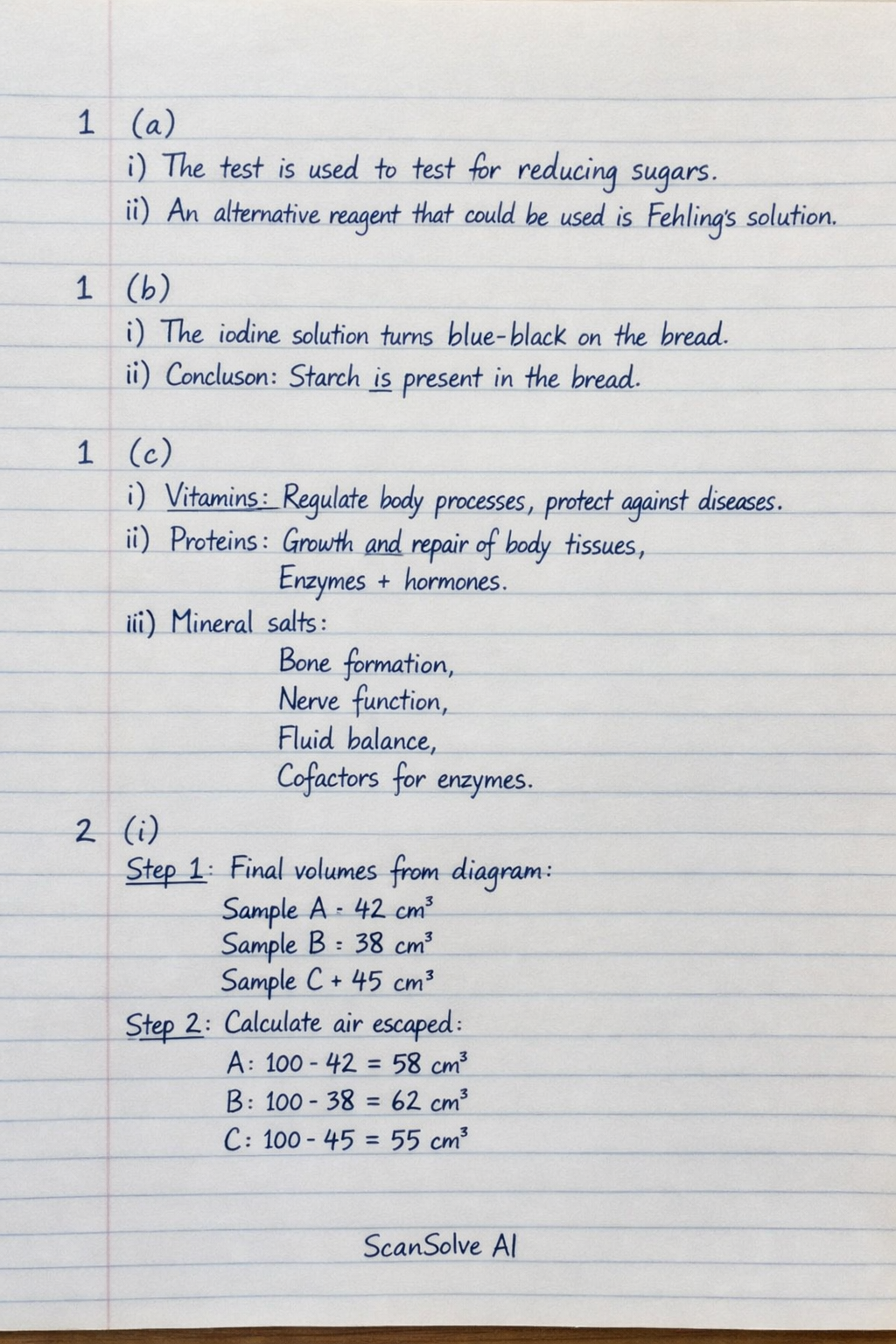
1 (a)
i) The test described (Benedict's solution, heating, brick-red precipitate) is used to test for reducing sugars.
ii) An alternative reagent that could be used in place of Benedict's solution is Fehling's solution.
1 (b)
i) The student is likely to observe that the iodine solution turns blue-black on the piece of bread.
ii) The conclusion drawn is that starch is present in the bread.
1 (c)
i) Vitamins: Regulate body processes and protect against diseases.
ii) Proteins: Essential for growth and repair of body tissues, and form enzymes and hormones.
iii) Mineral salts: Important for bone formation, nerve function, fluid balance, and act as cofactors for enzymes.
2 (i)
Read the final volume for each soil sample from the diagram.
Calculate the volume of air escaped by subtracting the final volume from the initial volume (100 cm).
Soil sample Final volume/cm Volume of air escaped/cm Soil A 70 30 Soil B 80 20 Soil C 60 40 Soil D 90 10 Soil E 50 50 2 (ii)
Identify the volume of air escaped from soil sample A.
From the table above, the volume of air escaped from Soil A is .
Calculate the percentage of air content.
2 (iii)
Compare the volume of air escaped for each soil sample.
The volume of air escaped represents the pore space in the soil. A larger pore space means the soil can retain more water.
- Soil A:
- Soil B:
- Soil C:
- Soil D:
- Soil E:
Identify the soil sample with the largest volume of air escaped.
Soil E has the largest volume of air escaped ().
Therefore, Soil E will retain the largest amount of water if more water is added to each.
Still stuck on this one?
Ask a follow-up, and the answer starts from this question.
More Biology Questions
Handwritten Step-by-Step Solution
Get this as a handwritten image on WhatsApp — like a tutor wrote it for you.
Try on WhatsApp