
We read your photo as:
Describe the procedure, observation/result, and explanation for the reducing sugars test using filtrate from non-germinating maize seeds.
Biology
ScanSolve AI Answer
Here is the procedure, observation/result, and explanation for the reducing sugars test using the filtrate from non-germinating maize seeds:
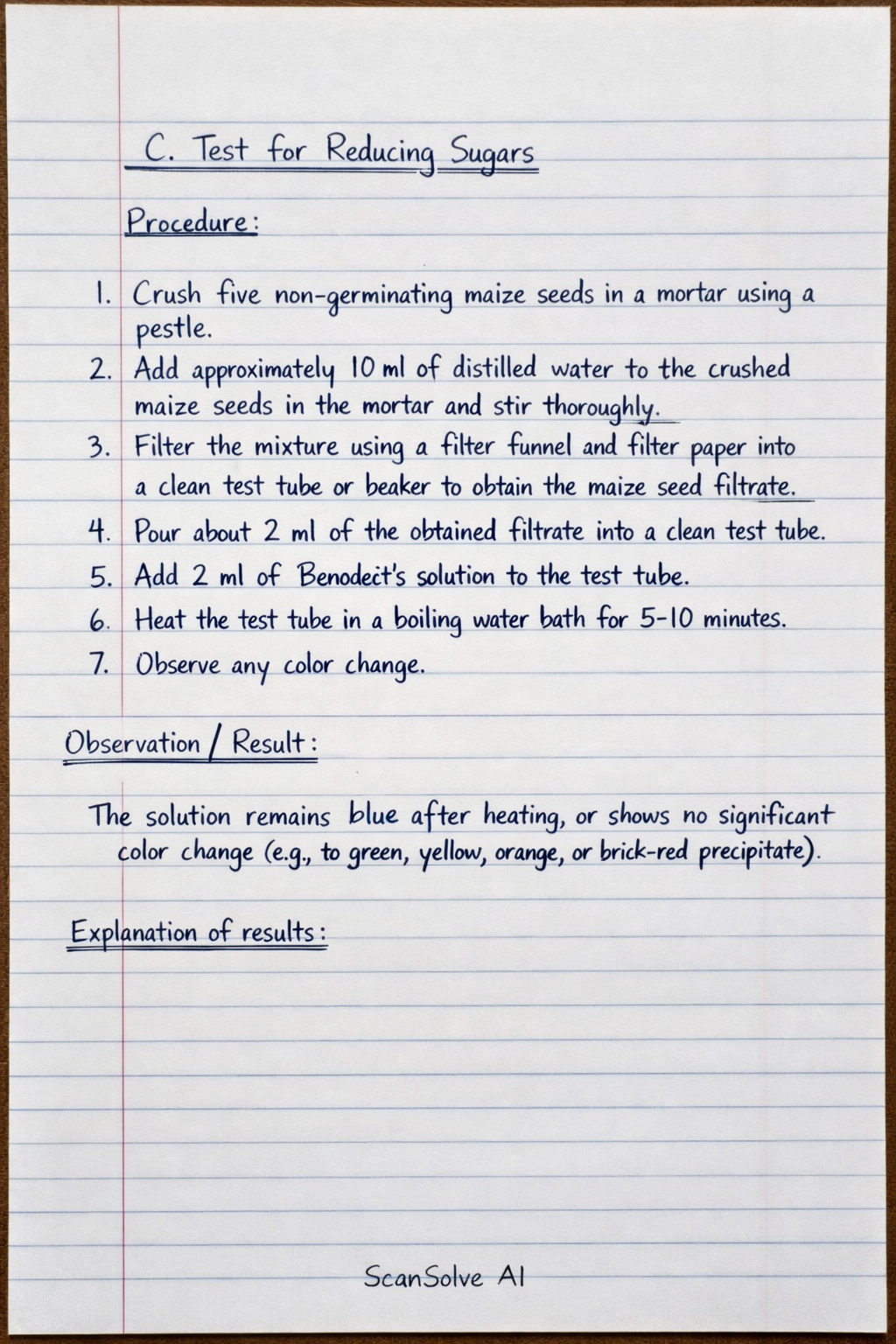
C. Test for Reducing Sugars
Procedure:
- Crush five non-germinating maize seeds in a mortar using a pestle.
- Add approximately 10 ml of distilled water to the crushed maize seeds in the mortar and stir thoroughly.
- Filter the mixture using a filter funnel and filter paper into a clean test tube or beaker to obtain the maize seed filtrate.
- Pour about 2 ml of the obtained filtrate into a clean test tube.
- Add 2 ml of Benedict's solution to the test tube.
- Heat the test tube in a boiling water bath for 5-10 minutes.
- Observe any color change.
Observation / Result:
- The solution remains blue after heating, or shows no significant color change (e.g., no green, yellow, orange, or brick-red precipitate).
Explanation of results:
- The Benedict's test is used to detect the presence of reducing sugars.
- Reducing sugars, when heated with Benedict's solution, reduce the blue copper(II) ions to brick-red copper(I) oxide precipitate.
- Non-germinating maize seeds primarily store starch as their main food reserve, not reducing sugars. Reducing sugars are typically produced during germination when starch is broken down.
- The absence of a color change (remaining blue) indicates a negative test for reducing sugars, confirming that reducing sugars are absent or present in negligible amounts in the non-germinating maize seed filtrate.
Was this helpful?
Still stuck on this one?
Ask a follow-up, and the answer starts from this question.
Got a different question?Ask your own question
More Biology Questions
QDescribe the procedure, observation, and explanation for testing proteins in non-germinating maize…QDescribe the procedure, observation, and explanation for testing non-germinating maize seeds for…QDescribe an experiment to show how reducing sugar can be tested in a germinating bean seedQDescribe the procedure, expected observations, and explanation for testing the presence of starch in…QDescribe the results and explain the observations of an iodine test on a non-germinating maize…
Handwritten Step-by-Step Solution
Get this as a handwritten image on WhatsApp — like a tutor wrote it for you.
Try on WhatsApp