
We read your photo as:
What are the answers to questions 15-20 about biological terms?
ScanSolve AI Answer
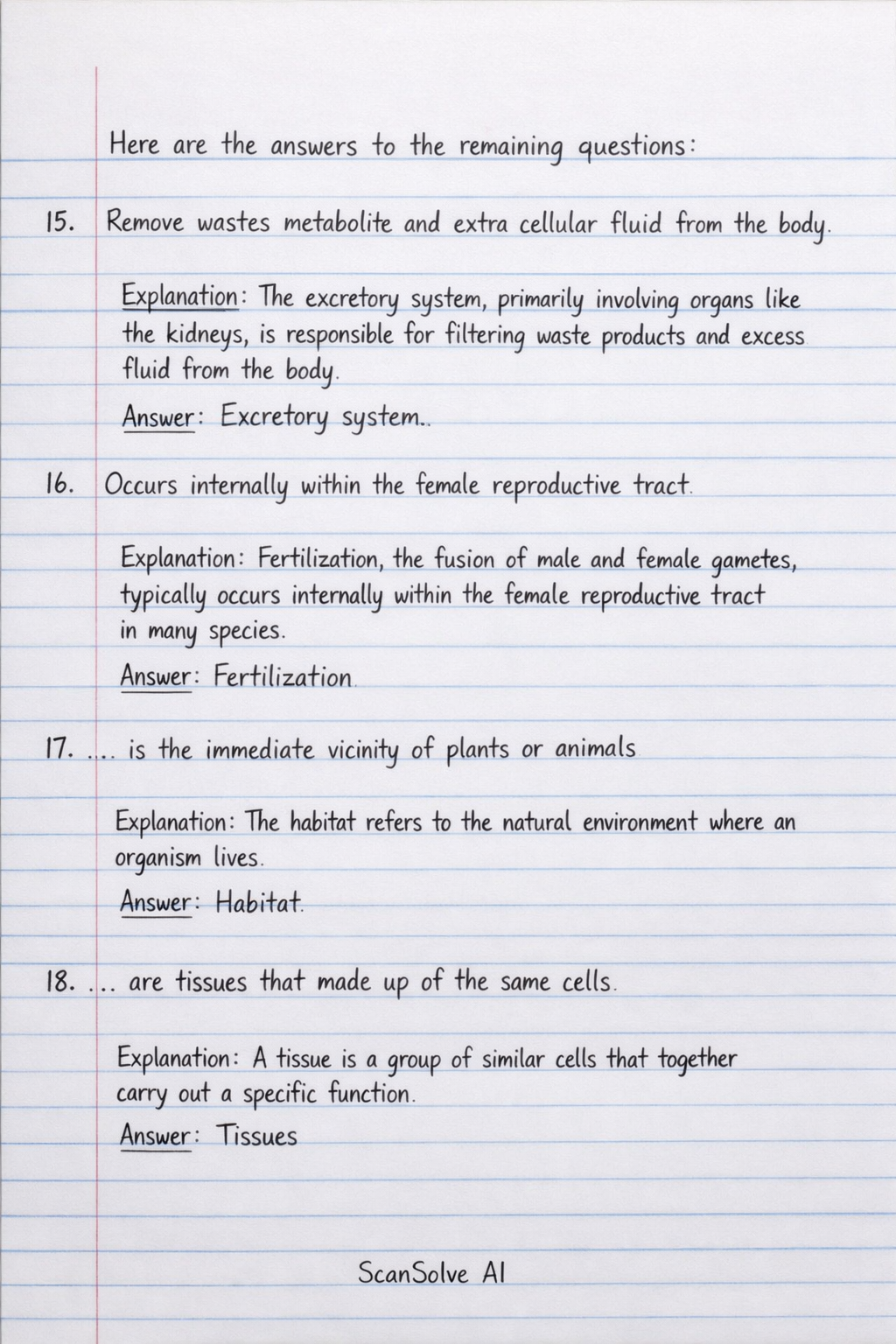
Here are the answers to the remaining questions:
-
.................... Remove wastes metabolite and extra cellular fluid from the body
- Explanation: The excretory system, primarily involving organs like the kidneys, is responsible for filtering waste products and excess fluid from the body.
- Answer: Excretory system
-
.................... Occurs internally within the female reproductive tract
- Explanation: Fertilization, the fusion of male and female gametes, typically occurs internally within the female reproductive tract in many species.
- Answer: Fertilization
-
.................... is the immediate vicinity of plants or animals
- Explanation: The habitat refers to the natural environment where an organism lives.
- Answer: Habitat
-
.................... are tissues that made up of the same cells
- Explanation: A tissue is a group of similar cells that together carry out a specific function.
- Answer: Tissues
-
The difference between offspring and its parents is ....................
- Explanation: Variation refers to the differences in characteristics between individuals of the same species, including between parents and their offspring.
- Answer: Variation
-
Nerve tissue is made up of specialized cells called .................... which conducts and transmits electrochemical impulses between neurons
- Explanation: Neurons are the specialized cells of the nervous system that transmit electrical and chemical signals.
- Answer: Neurons
-
The largest external organ of the body is called....................
- Explanation: The skin is the largest organ of the human body, covering its entire external surface.
- Answer: Skin
-
Meristematic tissues are distinguished from permanent tissues by a process called....................
- Explanation: Meristematic tissues are undifferentiated cells capable of division, while permanent tissues are differentiated cells that have lost the ability to divide. The process of meristematic cells becoming permanent tissues is called differentiation.
- Answer: Differentiation
-
Which of the following statements is correct A. Animal cells contain plastids. B. Procaryotic does not contain a nuclear bound membrane.
- Explanation: Animal cells do not contain plastids (like chloroplasts). Prokaryotic cells are characterized by the absence of a membrane-bound nucleus and other membrane-bound organelles.
- Answer: B. Procaryotic does not contain a nuclear bound membrane.
-
A fusion of sperm and egg occurs at a stage of reproduction called....................
- Explanation: The fusion of male and female gametes (sperm and egg) is called fertilization.
- Answer: Fertilization
-
Which of the following is majorly found in plants A. Lysosomes. B. Golgi complex. C. Plastids. D. Endoplasmic reticulum
- Explanation: Plastids (e.g., chloroplasts, chromoplasts, leucoplasts) are organelles characteristic of plant cells. Lysosomes, Golgi complex, and endoplasmic reticulum are found in both plant and animal cells.
- Answer: C. Plastids
-
Which of these does not undergoes hydrolysis A. Glucose, fructose and Galactose. B. Maltose, Sucrose and lactose. C. Starch, Cellulose and Glycogen D. All of the above
- Explanation: Hydrolysis is the breakdown of a compound by reaction with water. Monosaccharides like glucose, fructose, and galactose are simple sugars and cannot be broken down further by hydrolysis into smaller carbohydrate units. Disaccharides (maltose, sucrose, lactose) and polysaccharides (starch, cellulose, glycogen) can be hydrolyzed into monosaccharides.
- Answer: A. Glucose, fructose and Galactose
-
Photosynthesis is carried out majorly in the ....................
- Explanation: Photosynthesis, the process by which plants convert light energy into chemical energy, primarily occurs in the chloroplasts within plant cells.
- Answer: Chloroplasts
-
Water and Nutrients in plants are transported by the....................
- Explanation: The xylem and phloem are the vascular tissues in plants responsible for transporting water and nutrients. Xylem transports water and minerals from roots to leaves, while phloem transports sugars from leaves to other parts of the plant.
- Answer: Vascular tissues (xylem and phloem)
-
The visible physical features transferred from parents to progeny are called....................
- Explanation: These observable characteristics are known as phenotypes.
- Answer: Phenotypes
-
The father of Taxonomy is a Swedish Scientist named....................
- Explanation: Carl Linnaeus is widely regarded as the "father of taxonomy" for his work in developing the system of binomial nomenclature.
- Answer: Carl Linnaeus
-
What's broken down during respiration A. Protein. B. Lipid. C. Nucleic acid. D. Carbohydrates
- Explanation: During cellular respiration, carbohydrates (primarily glucose) are broken down to release energy in the form of ATP. While proteins and lipids can also be used as energy sources, carbohydrates are the primary and most readily utilized substrate.
- Answer: D. Carbohydrates
-
Which year was cell discovered A. 1667. B. 1668. C. 1665. D. 1669
- Explanation: Robert Hooke observed and named "cells" in cork tissue in the year 1665.
- Answer: C. 1665
-
The existence of life from non- living matter is referred to as A. Abiogenesis. B. Spontaneous generation. C. Biogenesis. D. Artificial generation
- Explanation: Abiogenesis is the natural process by which life arises from non-living matter, such as simple organic compounds. Spontaneous generation is an older, disproven theory that life could arise from non-living matter. While related, abiogenesis is the modern scientific concept.
- Answer: A. Abiogenesis
-
When two parents (opposite sex) participate in the reproductive process and also involve fusion of male and female gametes, it is called ...
- Explanation: This describes sexual reproduction, which involves the fusion of gametes from two parents to form a new organism.
- Answer: Sexual reproduction
-
....................systems are used as the basis for dichotomous keys that biologists use to identify organisms.
- Explanation: Classification systems, which organize organisms based on shared characteristics, form the basis for dichotomous keys.
- Answer: Classification
Still stuck on this one?
Ask a follow-up, and the answer starts from this question.
More Biology Questions
Handwritten Step-by-Step Solution
Get this as a handwritten image on WhatsApp — like a tutor wrote it for you.
Try on WhatsApp