
We read your photo as:
What are the answers to questions 30-34 regarding uterine contractions and labor?
Biology
ScanSolve AI Answer
Answer
D
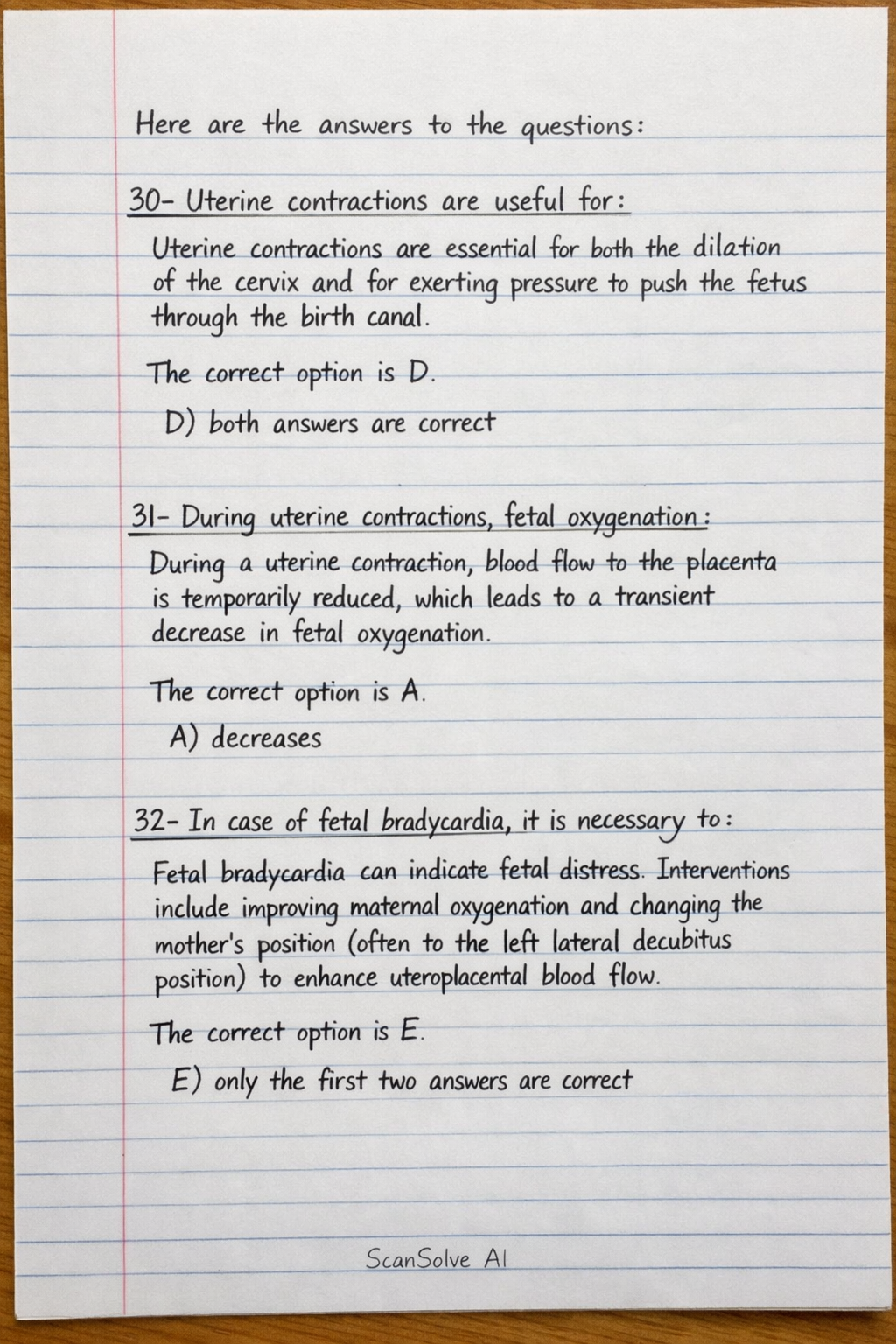
Here are the answers to the questions:
30-Uterine contractions are useful for:
- Uterine contractions are essential for both the dilation of the cervix and for exerting pressure to push the fetus through the birth canal.
- The correct option is D.
- D) both answers are correct
31-During uterine contractions, fetal oxygenation:
- During a uterine contraction, blood flow to the placenta is temporarily reduced, which leads to a transient decrease in fetal oxygenation.
- The correct option is A.
- A) decreases
32-In case of fetal bradycardia, it is necessary to:
- Fetal bradycardia can indicate fetal distress. Interventions include improving maternal oxygenation and changing the mother's position (often to the left lateral decubitus position) to enhance uteroplacental blood flow.
- The correct option is E.
- E) only the first two answers are correct
33-In case of normal labor, in a multiparous woman, the cervix dilates at a rate of at least:
- In multiparous women, the active phase of labor typically progresses at a faster rate than in primiparous women. A rate of at least 1.5 cm/h to 2 cm/h is generally expected.
- The correct option is C.
- C) 2 cm/h
34- The signs of imminent labor are:
- The urge to defecate can indicate significant fetal descent and pressure on the rectum. Increasingly strong contractions are a hallmark of true labor. Opening of the anus can occur with advanced fetal descent. All these are signs of progressing or imminent labor.
- The correct option is D.
- D) all of the above are correct
35- Normal uterine contractions last:
- During the active phase of labor, effective uterine contractions typically last between 40 and 60 seconds.
- The correct option is A.
- A) between 40 and 60 seconds
36- After the birth of the fetus, there is often:
- After the birth of the fetus, uterine contractions continue to facilitate the separation and expulsion of the placenta (third stage of labor). There is no period of rest where contractions subside, nor do they necessarily intensify compared to the second stage. Uterine atony is a complication, not a normal occurrence.
- The correct option is E.
- E) none of the answers are correct
37-After delivery, the uterine fundus is usually located:
- Immediately after the delivery of the placenta, the uterine fundus is typically firm and located midway between the navel (umbilicus) and the pubic symphysis. It then rises to the level of the umbilicus within 6-12 hours postpartum.
- The correct option is D.
- D) midway between the navel and the pubic symphysis
Was this helpful?
Try one yourself
A new problem that tests the same skill.
Still stuck on this one?
Ask a follow-up, and the answer starts from this question.
Got a different question?Ask your own question
More Biology Questions
QWhat are the functions of uterine contractions and the changes occurring during labor? (Questions…QWhat are the answers to the following multiple-choice questions regarding pregnancy and labor?QAnswer these quiz questions about female reproductive physiology during pregnancy and labor.QDescribe the cardinal movements of labor.Q1- List 3 elements to look for during a perineal examination at the beginning of labor.
Handwritten Step-by-Step Solution
Get this as a handwritten image on WhatsApp — like a tutor wrote it for you.
Try on WhatsApp