
We read your photo as:
What are the answers to these multiple-choice questions about the menstrual cycle?
ScanSolve AI Answer
Here are the answers to the multiple-choice questions:
1. The progesterone level is the highest during which stage of the menstrual cycle?
The progesterone level is highest during the luteal phase, which is typically considered Stage 4 or the post-ovulatory phase.
- Answer: D. Stage 4
2. What is the main role of the progesterone?
Progesterone's main role is to prepare and maintain the uterine lining for a potential pregnancy.
- Answer: D. Ensures that the uterus lining is maintained.
3. Which of the following is NOT a hormone associated with the menstrual cycle?
Testosterone is primarily a male sex hormone and is not a key regulator of the menstrual cycle.
- Answer: A. Testosterone
4. What is the path that blood travels during menstruation?
During menstruation, blood flows from the uterus, through the cervix, and out through the vagina.
- Answer: B. Uterus, cervix, vagina
5. How many days are in an average menstrual cycle?
An average menstrual cycle is typically 28 days long.
- Answer: A. 28
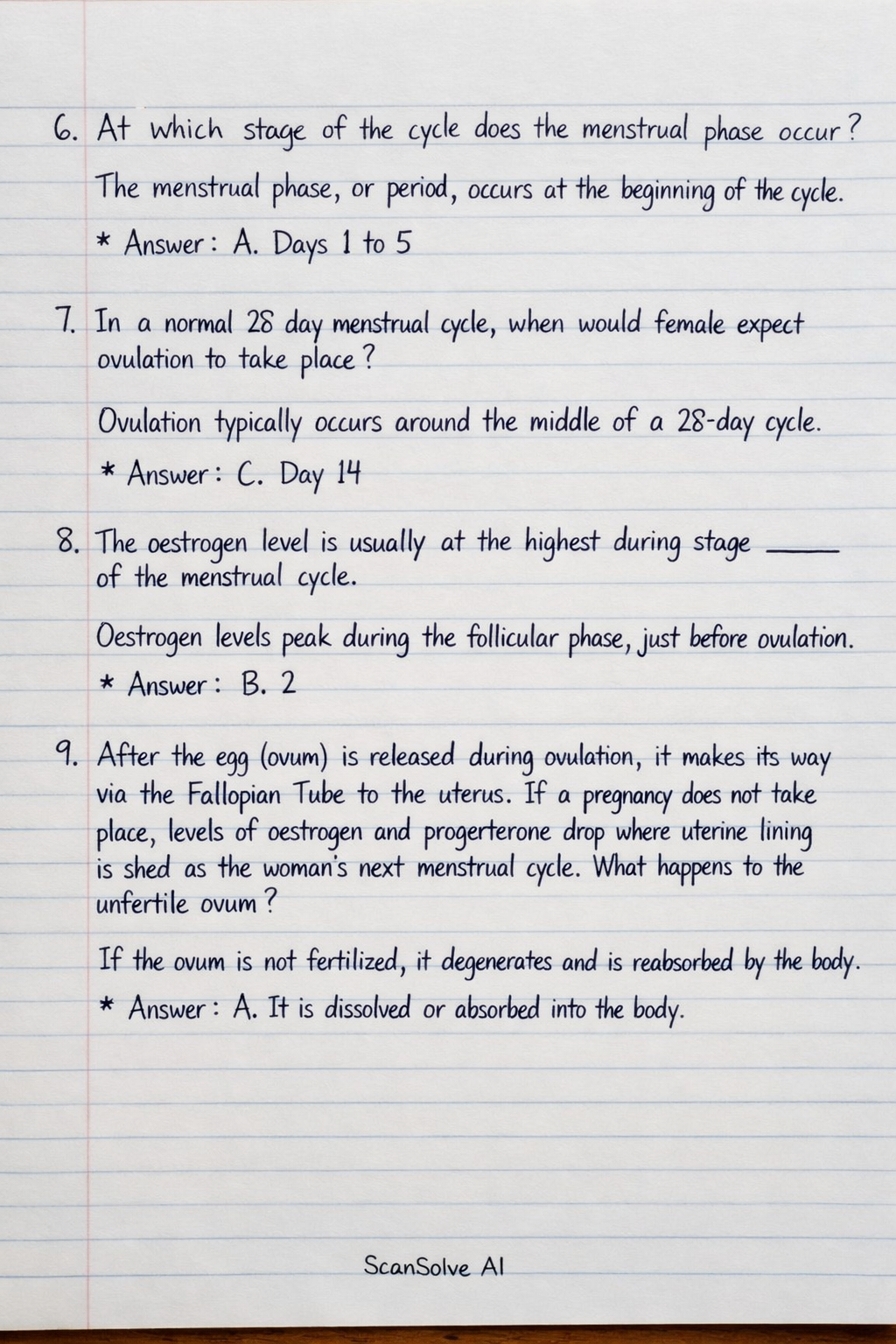
6. At which stage of the cycle does the menstrual phase occur?
The menstrual phase, or period, occurs at the beginning of the cycle.
- Answer: A. Days 1 to 5
7. In a normal 28 day menstrual cycle, when would female expect ovulation to take place?
Ovulation typically occurs around the middle of a 28-day cycle.
- Answer: C. Day 14
8. The oestrogen level is usually at the highest during stage ____ of the menstrual cycle.
Oestrogen levels peak during the follicular phase, just before ovulation.
- Answer: B. 2
9. After the egg (ovum) is released during ovulation, it makes its way via the Fallopian Tube to the uterus. If a pregnancy does not take place, levels of oestrogen and progesterone drop where uterine lining is shed as the woman's next menstrual cycle. What happens to the unfertile ovum?
If the ovum is not fertilized, it degenerates and is reabsorbed by the body.
- Answer: A. It is dissolved or absorbed into the body.
10. The layer of the uterine wall that is shed during menstruation is _____.
The endometrium is the inner lining of the uterus that is shed during menstruation.
- Answer: A. Endometrium
11. Eggs are produced in the _____.
Eggs are produced and stored in the ovaries.
- Answer: D. Ovaries
12. In a typical menstrual cycle of 28 days, when is the most likely the fertile period?
The fertile period includes the days leading up to and including ovulation (around Day 14).
- Answer: A. Days 11 to 14
13. This usually occurs between days 6 and 12 of the menstrual cycle.
Between days 6 and 12, the uterine lining rebuilds and thickens.
- Answer: D. The lining of the uterus builds up.
14. During ovulation, the _____ and _____ hormones are at their highest levels.
Ovulation is triggered by a surge in Luteinizing Hormone (LH), and Follicle-Stimulating Hormone (FSH) also peaks around this time. Oestrogen peaks just before the LH surge.
- Answer: A. FSH and LH
15. Which of the following would indicate a trip for a female to physician?
All the listed scenarios (not starting menstruation by 16, very frequent periods, or stopping periods when not pregnant) are reasons to consult a physician.
- Answer: D. All of the above.
Still stuck on this one?
Ask a follow-up, and the answer starts from this question.
More Biology Questions
Handwritten Step-by-Step Solution
Get this as a handwritten image on WhatsApp — like a tutor wrote it for you.
Try on WhatsApp