
We read your photo as:
What are the characteristic features of birds and mammals, the functions of the vagina, breast, and testis, adaptations of Tilapia fish to water, and the economic importance of insects?
ScanSolve AI Answer
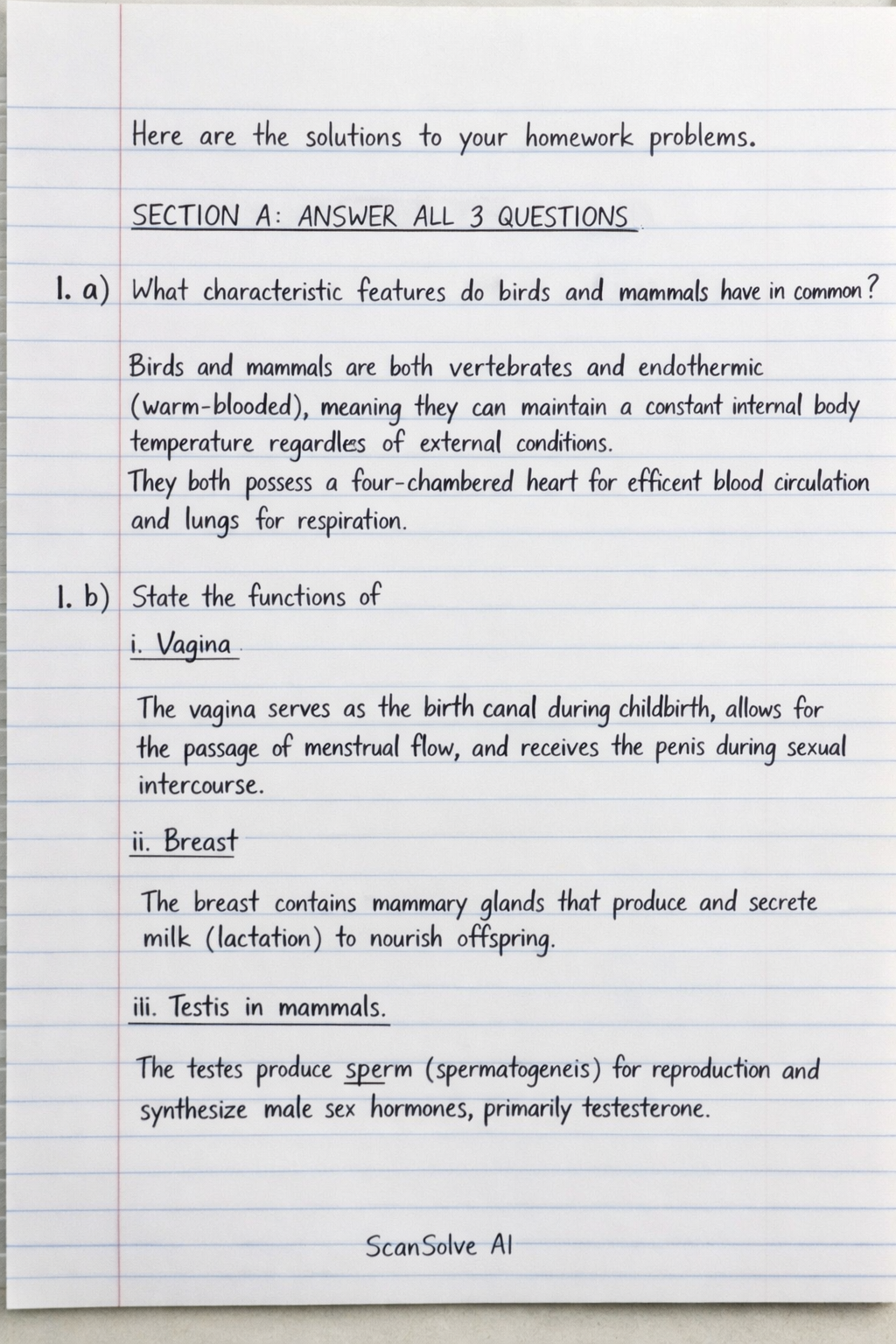
Here are the solutions to your homework problems.
SECTION A: ANSWER ALL 3 QUESTIONS
1. a) What characteristic features do birds and mammals have in common?
Birds and mammals are both vertebrates and endothermic (warm-blooded), meaning they can maintain a constant internal body temperature regardless of external conditions. They both possess a four-chambered heart for efficient blood circulation and lungs for respiration.
1. b) State the functions of
i. Vagina
The vagina serves as the birth canal during childbirth, allows for the passage of menstrual flow, and receives the penis during sexual intercourse.
ii. Breast
The breast contains mammary glands that produce and secrete milk (lactation) to nourish offspring.
iii. Testis in mammals.
The testes produce sperm (spermatogenesis) for reproduction and synthesize male sex hormones, primarily testosterone.
1. c) How is the Tilapia fish adapted to life in water?
Tilapia fish are adapted to aquatic life with a streamlined body shape to reduce drag, gills for efficient gaseous exchange, and fins for propulsion, steering, and balance. They also possess a lateral line system to detect vibrations and pressure changes in the water, and a swim bladder to regulate buoyancy.
1. d) Describe the economic importance of insects.
Insects are economically important as pollinators for many agricultural crops, contributing significantly to food production. Some insects are a food source for humans and animals, while others are used in pest control as natural predators. Insects like silkworms produce silk, and bees produce honey and beeswax, all valuable commodities. They also play a role in decomposition, recycling nutrients in ecosystems.
2. a) Define the following:
i. Excretion
Excretion is the biological process by which an organism eliminates metabolic waste products and excess substances from its body.
ii. Homeostasis
Homeostasis is the ability of an organism to maintain a stable internal environment despite changes in external conditions.
2. b) What are the adaptations of the mammalian skin in the protection of the body?
Mammalian skin provides protection through its epidermis, which acts as a physical barrier against pathogens, UV radiation, and water loss. Hair or fur provides insulation and physical protection. Melanin pigment protects against UV damage, while sebaceous glands secrete sebum for lubrication and antimicrobial action. Sensory receptors detect harmful stimuli, acting as an early warning system.
2. c) Describe the role of the kidney in the regulation of water content of the body.
The kidneys regulate the body's water content through osmoregulation, primarily controlled by Antidiuretic Hormone (ADH). When the body is dehydrated, ADH is released, increasing the permeability of the kidney's collecting ducts and distal tubules to water, leading to more water reabsorption and concentrated urine. Conversely, when overhydrated, less ADH is released, reducing water reabsorption and producing dilute urine.
2. d) Imagine that Insulin and Glucagon are like two players in a team that work together to keep blood sugar level just right. Which of these two players do you think is the most important? Explain your answer, saying what would happen if that player was not there.
Both insulin and glucagon are equally vital for maintaining blood glucose homeostasis, as they perform opposing but complementary roles. However, if forced to choose, insulin could be considered "most important" due to the severe and immediate consequences of its absence. If insulin were not present, blood glucose levels would rise dangerously high (hyperglycemia), as cells would be unable to take up glucose for energy. This leads to conditions like Type 1 diabetes, characterized by symptoms such as excessive thirst, frequent urination, and weight loss, eventually progressing to diabetic ketoacidosis, coma, and death if untreated.
3. a) What do you understand by the following terms as used in ecology:
i. Ecosystem
An ecosystem is a biological community of interacting organisms (biotic components) and their physical environment (abiotic components) in a specific area.
ii. Conservation
Conservation refers to the protection, preservation, management, or restoration of natural environments, ecosystems, and wildlife to ensure their long-term sustainability and biodiversity.
3. b) Differentiate between a food chain and a food web.
A food chain is a linear sequence illustrating the flow of energy from one organism to another through feeding, typically starting with a producer. A food web is a more complex and realistic representation, consisting of multiple interconnected food chains within an ecosystem, showing the diverse feeding relationships among organisms.
3. c) How may the extinction of species of organisms in an ecosystem be reduced?
The extinction of species can be reduced through habitat preservation and restoration, establishing protected areas like national parks, and implementing sustainable resource management practices. Controlling pollution, combating climate change, and managing invasive species are also crucial. Additionally, enforcing conservation laws and initiating captive breeding programs can help protect endangered species.
Still stuck on this one?
Ask a follow-up, and the answer starts from this question.
More Biology Questions
Handwritten Step-by-Step Solution
Get this as a handwritten image on WhatsApp — like a tutor wrote it for you.
Try on WhatsApp