
We read your photo as:
What are the common characteristics of birds and mammals, and what are the functions of the vagina, breast, and testis? Also, describe the adaptations of the Tilapia fish to aquatic life.
ScanSolve AI Answer
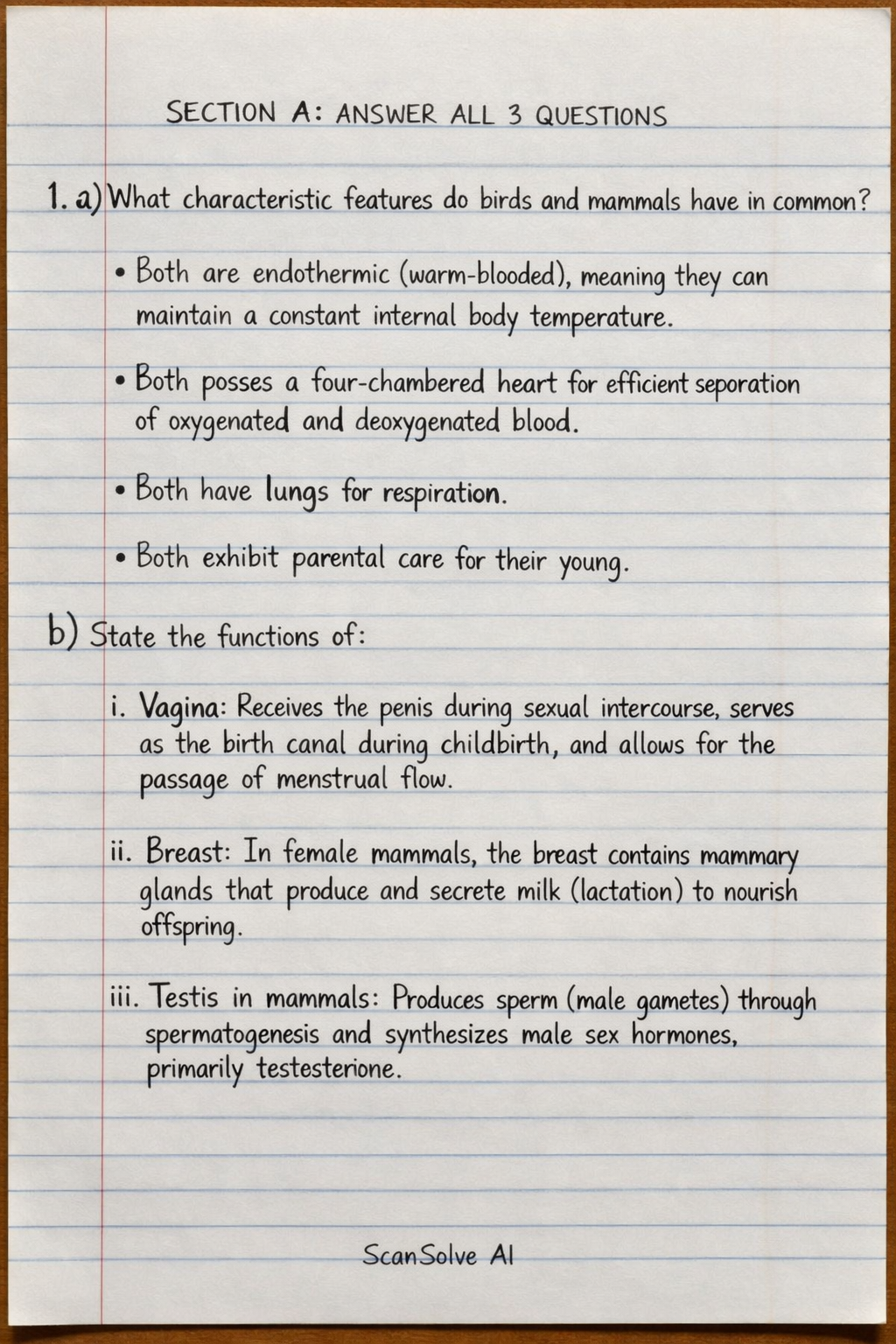
SECTION A: ANSWER ALL 3 QUESTIONS
1. a) What characteristic features do birds and mammals have in common?
- Both are endothermic (warm-blooded), meaning they can maintain a constant internal body temperature.
- Both possess a four-chambered heart for efficient separation of oxygenated and deoxygenated blood.
- Both have lungs for respiration.
- Both exhibit parental care for their young.
b) State the functions of:
- i. Vagina: Receives the penis during sexual intercourse, serves as the birth canal during childbirth, and allows for the passage of menstrual flow.
- ii. Breast: In female mammals, the breast contains mammary glands that produce and secrete milk (lactation) to nourish offspring.
- iii. Testis in mammals: Produces sperm (male gametes) through spermatogenesis and synthesizes male sex hormones, primarily testosterone.
c) How is the Tilapia fish adapted to life in water?
- Streamlined body shape to reduce drag and allow efficient movement through water.
- Gills for efficient gaseous exchange, extracting oxygen from the water.
- Fins for propulsion, steering, and maintaining balance.
- Scales provide protection against injury and pathogens.
- Lateral line system detects vibrations and pressure changes in the water, aiding in navigation and predator/prey detection.
d) Describe the economic importance of insects.
- Pollination: Many insects, like bees and butterflies, are crucial for pollinating crops, which is vital for food production.
- Food source: In some cultures, insects are consumed as a protein-rich food source.
- Useful products: Insects produce valuable products such as honey, silk, and shellac.
- Pest control: Some insects are natural predators of agricultural pests, reducing the need for chemical pesticides.
- Decomposition: Insects contribute to the decomposition of organic matter, recycling nutrients in ecosystems.
2. a) Define the following:
- i. Excretion: The biological process by which metabolic waste products and excess substances are removed from an organism's body.
- ii. Homeostasis: The ability of an organism to maintain a stable internal environment despite changes in external conditions.
b) What are the adaptations of the mammalian skin in the protection of the body?
- The epidermis forms a physical barrier against pathogens, UV radiation, and water loss.
- Hair or fur provides insulation against temperature fluctuations and protection from UV rays.
- Sweat glands help regulate body temperature through evaporative cooling.
- Sebaceous glands secrete sebum, an oily substance that lubricates the skin and hair and has antimicrobial properties.
- Melanin pigment protects against harmful UV radiation.
c) Describe the role of the kidney in the regulation of water content of the body.
The kidneys play a central role in regulating the body's water content by controlling the amount of water reabsorbed from the filtrate back into the blood. When the body is dehydrated, the kidneys reabsorb more water, producing concentrated urine. Conversely, when there is excess water, the kidneys reabsorb less water, leading to the production of dilute urine. This process is primarily regulated by the hormone ADH (Antidiuretic Hormone).
d) Imagine that Insulin and Glucagon are like two players in a team that work together to keep blood sugar level just right. Which of these two players do you think is the most important? Explain your answer, saying what would happen if that player was not there.
Both insulin and glucagon are essential for maintaining blood glucose homeostasis, and neither is truly "more important" as they perform complementary, antagonistic roles. However, if forced to choose, Insulin is often considered more critical for immediate survival in the context of high blood sugar.
- If Insulin was not there: Blood glucose levels would rise uncontrollably (hyperglycemia) after meals because cells would be unable to take up glucose from the blood. This leads to conditions like Type 1 Diabetes Mellitus, where cells starve despite high blood sugar. Without insulin, severe complications such as diabetic ketoacidosis, organ damage, and eventually death would occur.
3. a) What do you understand by the following terms as used in ecology:
- i. Ecosystem: A community of living organisms (biotic components) interacting with their non-living physical environment (abiotic components) within a specific area.
- ii. Conservation: The protection, preservation, management, and restoration of natural environments, ecosystems, and wildlife to ensure their long-term sustainability and biodiversity.
b) Differentiate between a food chain and a food web.
A food chain is a linear sequence showing the flow of energy from one organism to another through feeding relationships, typically starting with a producer. For example, grass rabbit fox. A food web, on the other hand, consists of multiple interconnected food chains within an ecosystem, illustrating the complex and diverse feeding relationships among all organisms. It shows that most organisms consume and are consumed by more than one type of organism.
c) How may the extinction of species of organisms in an ecosystem be reduced?
- Habitat preservation and restoration: Protecting and restoring natural habitats to provide suitable living conditions for species.
- Establishing protected areas: Creating national parks, wildlife reserves, and marine protected areas to safeguard biodiversity.
- Controlling pollution: Reducing air, water, and soil pollution that harms ecosystems and species.
- Sustainable resource management: Implementing sustainable practices in forestry, fishing, and agriculture to prevent overexploitation.
- Combating illegal wildlife trade and poaching: Enforcing laws and international agreements to stop the illegal trade of endangered species.
- Addressing climate change: Reducing greenhouse gas emissions to mitigate global warming and its impacts on ecosystems.
Still stuck on this one?
Ask a follow-up, and the answer starts from this question.
More Biology Questions
Handwritten Step-by-Step Solution
Get this as a handwritten image on WhatsApp — like a tutor wrote it for you.
Try on WhatsApp