
We read your photo as:
What are the characteristics of living things? (Fill in the blanks, True/False, Short Answer, Very Short Answer)
Biology
ScanSolve AI Answer
here are all the answers from the page:
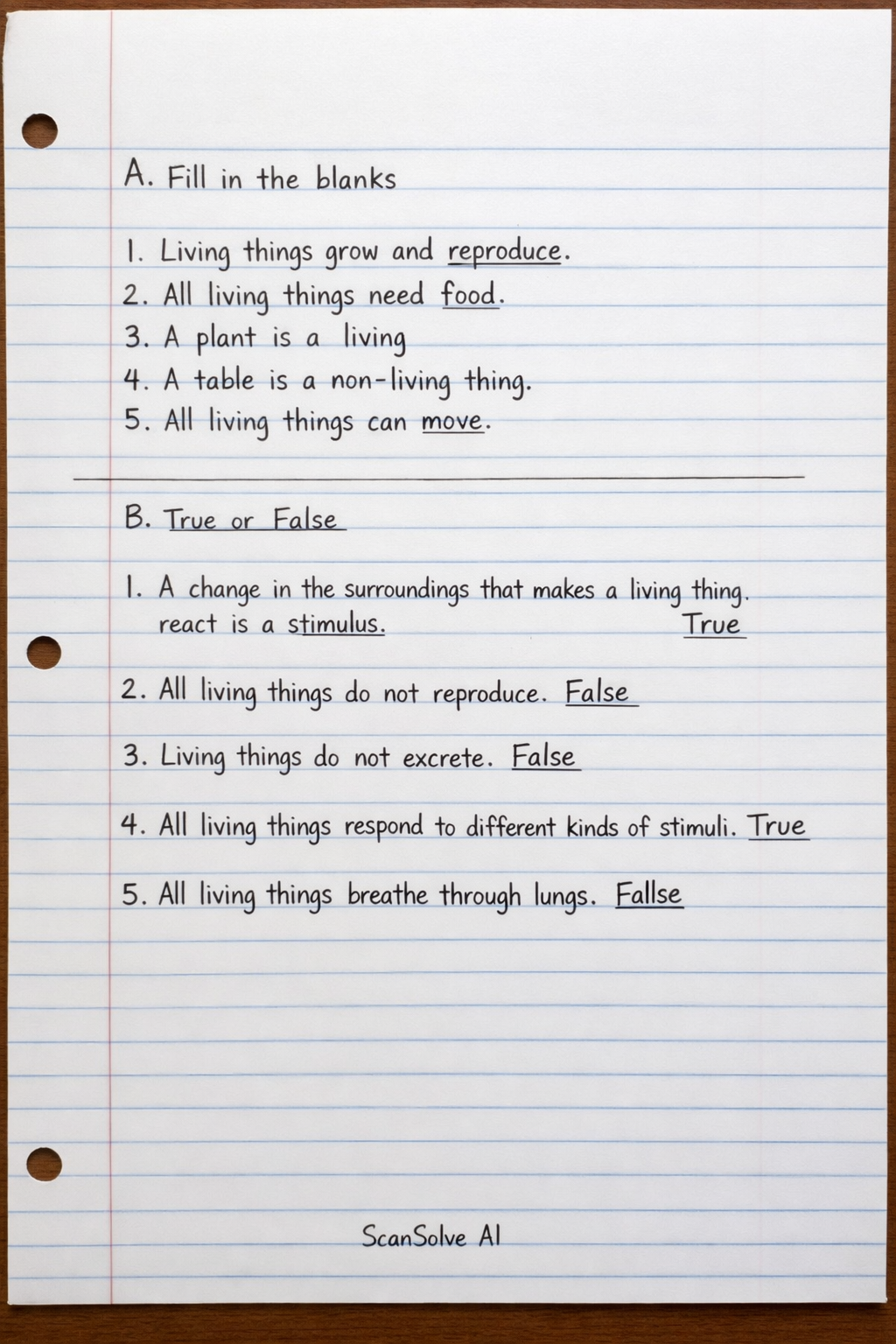
A. Fill in the blanks
- Living things grow and reproduce.
- All living things need food.
- A plant is a living thing.
- A table is a non-living thing.
- All living things can move.
B. True or False
- A change in the surroundings that makes a living thing react is a stimulus. True
- All living things do not reproduce. False
- Living things do not excrete. False
- All living things respond to different kinds of stimuli. True
- All living things breathe through lungs. False
C. Give short answer type questions.
- A stimulus is any detectable change in the internal or external environment that causes a living organism to react.
- Photosynthesis is the process by which green plants and some other organisms use sunlight to synthesize foods from carbon dioxide and water.
- Plants breathe through tiny pores called stomata on their leaves, and through lenticels on stems, exchanging gases like oxygen and carbon dioxide.
- Living things need food for energy to carry out life processes, for growth, and for the repair of worn-out cells and tissues.
D. Very short answer type questions.
- Growth is the irreversible increase in the size, mass, and complexity of an organism, involving cell division, enlargement, and differentiation.
- Respiration is the process by which living organisms exchange gases with their environment and release energy from food molecules.
- Geotropism (or gravitropism) is the growth of a plant in response to gravity, where roots grow downwards (positive) and shoots grow upwards (negative).
- Plants excrete waste materials as gases through stomata and lenticels, or store solid/liquid wastes in vacuoles, which are then shed with falling leaves or released as gums and resins.
- Living things need food for energy to perform life processes, for growth to build new cells, and for repair to replace damaged tissues.
E. Long answer type questions.
- The statement "All living things are made up of cells" is justified by the Cell Theory, which states that the cell is the fundamental structural and functional unit of all known living organisms. All life processes occur within cells, and new cells arise from pre-existing cells.
- A stimulus is a detectable change in the environment that causes a reaction, such as light or temperature. A response is the organism's reaction to that stimulus; for example, a plant growing towards light is a response to the stimulus of light.
- Light has several effects on living things:
- Photosynthesis: Plants use light energy to produce food.
- Vision: Animals use light to see and navigate.
- Circadian Rhythms: Light-dark cycles regulate biological rhythms like sleep.
- Growth and Development: Light influences plant growth patterns (e.g., phototropism) and animal development.
Was this helpful?
Still stuck on this one?
Ask a follow-up, and the answer starts from this question.
Got a different question?Ask your own question
More Biology Questions
QWhat are the characteristics of living things? Provide answers for fill-in-the-blanks, true/false…QCan you provide the answers to the fill-in-the-blanks and short answer questions about the…QAnswer the following questions about living and non-living things: A. Fill in the blanks. B. True or…QCharacteristics of living thingsQList 5 characteristics of living things.
Handwritten Step-by-Step Solution
Get this as a handwritten image on WhatsApp — like a tutor wrote it for you.
Try on WhatsApp