
We read your photo as:
Why is the collection and preservation of specimens important?
Biology
ScanSolve AI Answer
The question asks about the importance of collection and preservation of specimens.
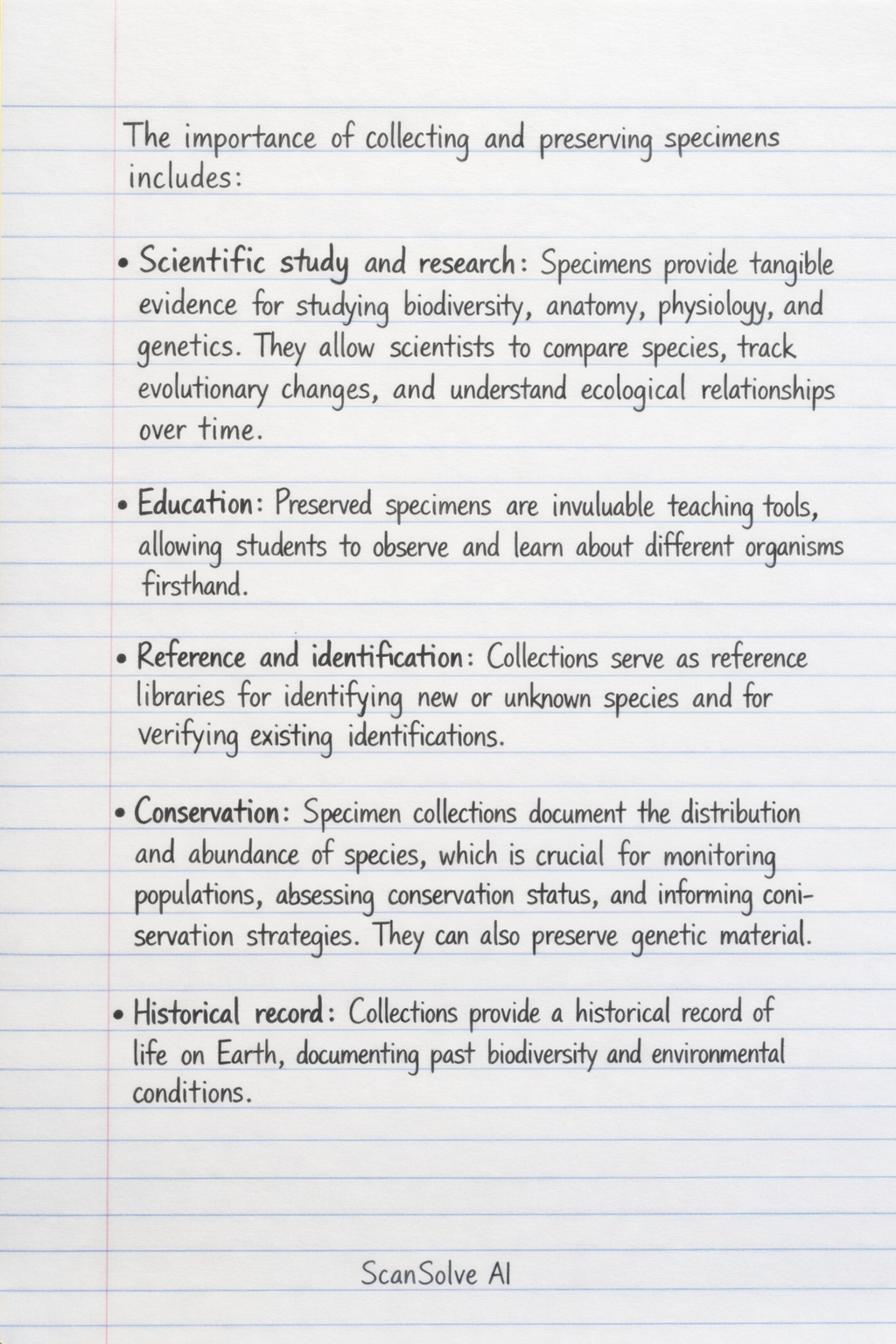
The importance of collecting and preserving specimens includes:
- Scientific study and research: Specimens provide tangible evidence for studying biodiversity, anatomy, physiology, and genetics. They allow scientists to compare species, track evolutionary changes, and understand ecological relationships over time.
- Education: Preserved specimens are invaluable teaching tools, allowing students to observe and learn about different organisms firsthand.
- Reference and identification: Collections serve as reference libraries for identifying new or unknown species and for verifying existing identifications.
- Conservation: Specimen collections document the distribution and abundance of species, which is crucial for monitoring populations, assessing conservation status, and informing conservation strategies. They can also preserve genetic material.
- Historical record: Collections provide a historical record of life on Earth, documenting past biodiversity and environmental conditions.
Was this helpful?
Still stuck on this one?
Ask a follow-up, and the answer starts from this question.
Got a different question?Ask your own question
More Biology Questions
QMention three uses of specimens in animal husbandryQMeseno school grade 10 learners planned to collect animal specimens. Why would it be necessary for…QExplain specimen preservation methods and identify a herbarium.QGiven the provided list of specimens (A-N), what is the next step or the purpose of this list in an…QI) Which of the following place preserves and displays plant and animal specimens of scientific…
Handwritten Step-by-Step Solution
Get this as a handwritten image on WhatsApp — like a tutor wrote it for you.
Try on WhatsApp