
We read your photo as:
What are the common sites for IM and IV injections, the best vein for IV injection, the medical term for a heart attack, and the layers of the skin related to injections?
ScanSolve AI Answer
Here are the answers to your questions:
-
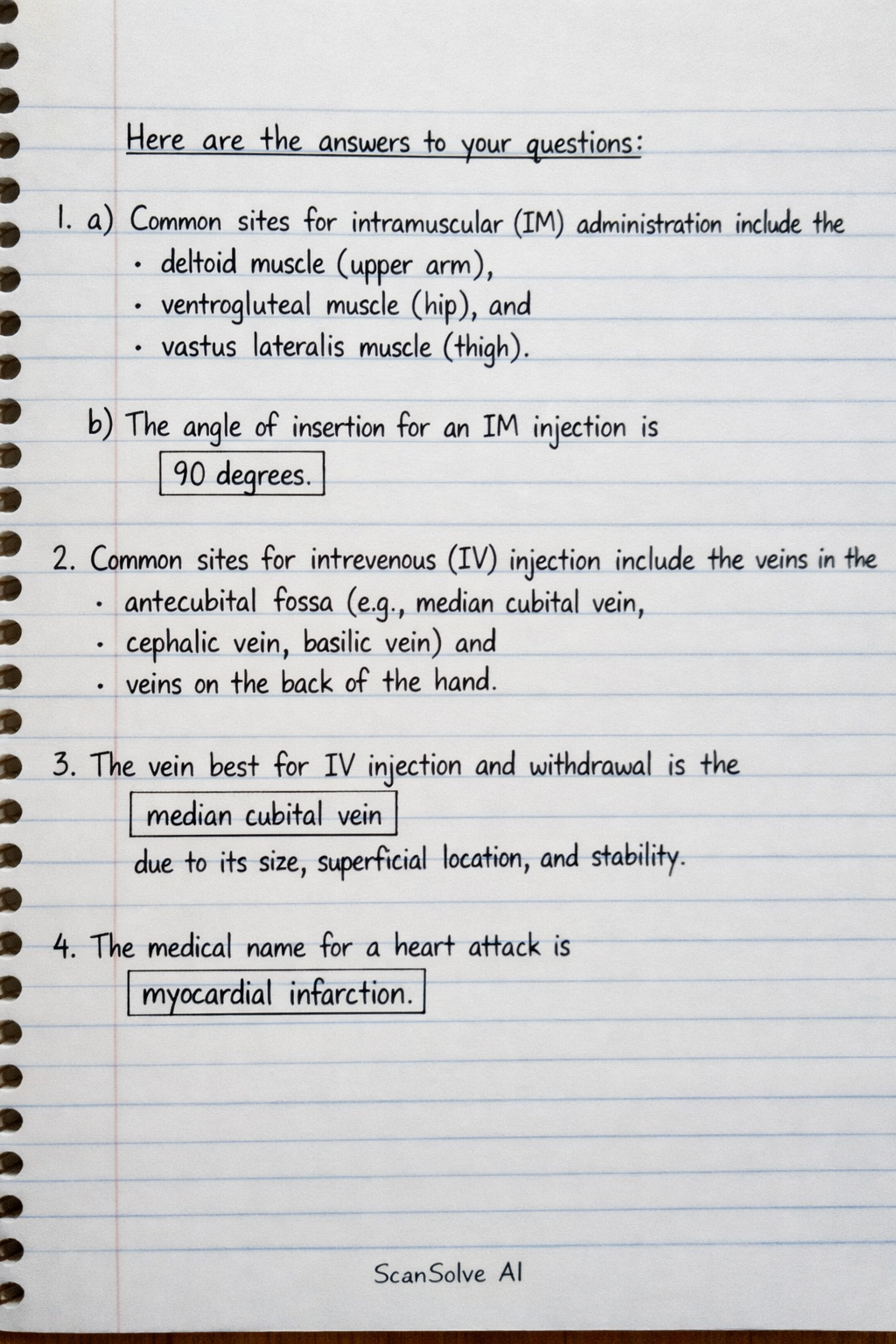
a) Common sites for intramuscular (IM) administration include the deltoid muscle (upper arm), ventrogluteal muscle (hip), and vastus lateralis muscle (thigh). b) The angle of insertion for an IM injection is .
-
Common sites for intravenous (IV) injection include the veins in the antecubital fossa (e.g., median cubital vein, cephalic vein, basilic vein) and the veins on the back of the hand.
-
The vein best for IV injection and withdrawal is the due to its size, superficial location, and stability.
-
The medical name for a heart attack is .
-
To draw the skin and label it according to injection sites, you would typically show three main layers:
- Epidermis: The outermost layer.
- Dermis: The layer beneath the epidermis, containing nerves, blood vessels, and hair follicles.
- Subcutaneous tissue (hypodermis): The deepest layer, composed mainly of fat and connective tissue. Different injections target different layers:
- Intradermal (ID): Into the dermis (e.g., TB test).
- Subcutaneous (SC): Into the subcutaneous tissue (e.g., insulin).
- Intramuscular (IM): Into the muscle layer below the subcutaneous tissue (e.g., vaccines).
-
To draw and label a syringe, you would include the following parts:
- Plunger: The part pushed to expel fluid.
- Barrel: The cylindrical part that holds the fluid, with measurement markings.
- Flange: The rim at the end of the barrel where fingers rest.
- Tip: The end where the needle attaches.
- Needle: The sharp, hollow tube that pierces the skin.
- Hub: The part of the needle that attaches to the syringe tip.
- Shaft: The length of the needle.
- Bevel: The slanted tip of the needle.
Still stuck on this one?
Ask a follow-up, and the answer starts from this question.
More Biology Questions
Handwritten Step-by-Step Solution
Get this as a handwritten image on WhatsApp — like a tutor wrote it for you.
Try on WhatsApp