
We read your photo as:
What are the definitions and characteristics of common pregnancy and postpartum complications and procedures?
ScanSolve AI Answer
-
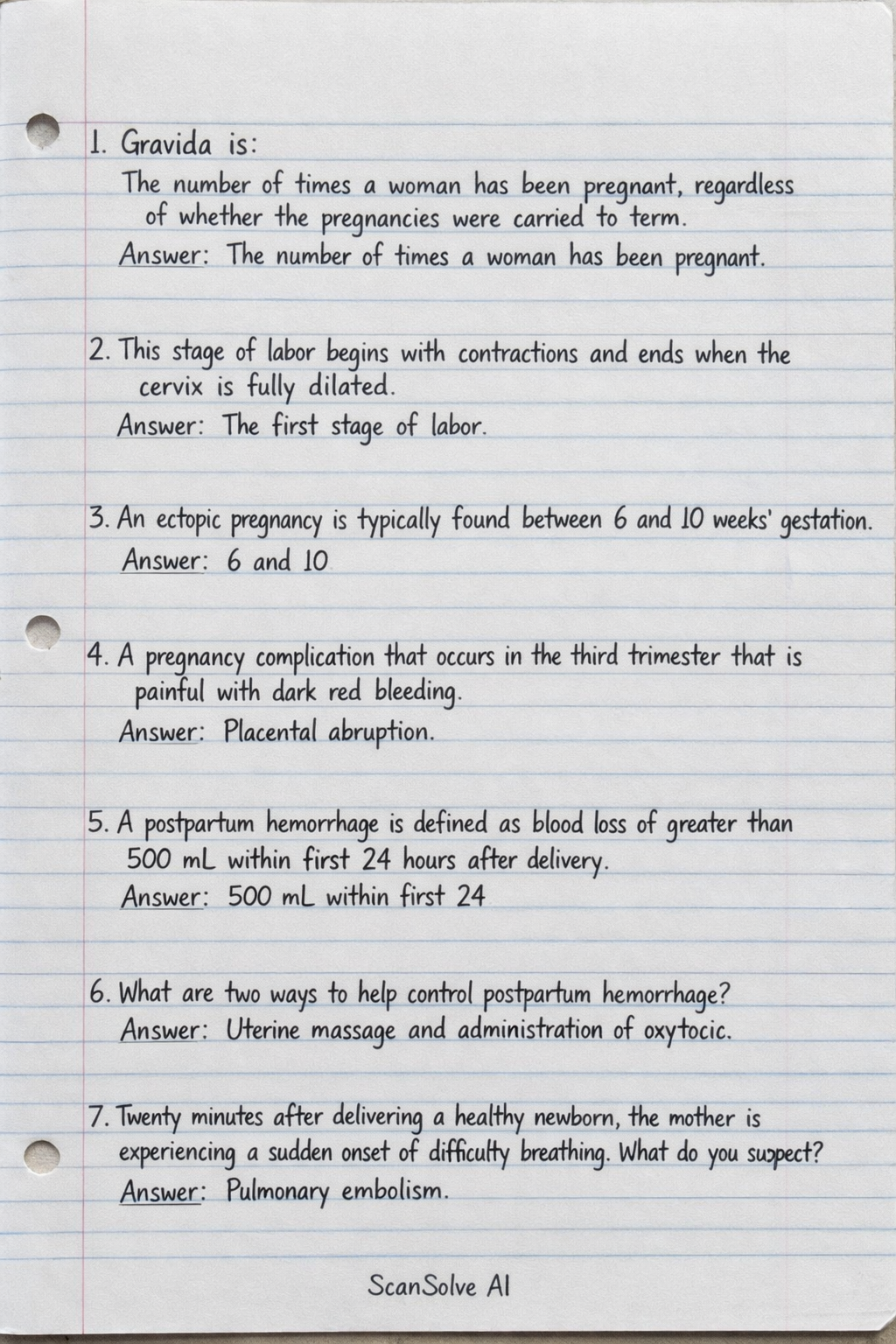
Gravida is: The number of times a woman has been pregnant, regardless of whether the pregnancies were carried to term. Answer: The number of times a woman has been pregnant.
-
This stage of labor begins with contractions and ends when the cervix is fully dilated. Answer: The first stage of labor.
-
An ectopic pregnancy is typically found between 6 and 10 weeks' gestation. Answer: 6 and 10
-
A pregnancy complication that occurs in the third trimester that is painful with dark red bleeding. Answer: Placental abruption.
-
A postpartum hemorrhage is defined as blood loss of greater than 500 mL within first 24 hours after delivery. Answer: 500 mL within first 24
-
What are two ways to help control postpartum hemorrhage? Answer: Uterine massage and administration of oxytocin.
-
Twenty minutes after delivering a healthy newborn, the mother is experiencing a sudden onset of difficulty breathing. What do you suspect? Answer: Pulmonary embolism.
-
An APGAR score should be assigned at 1 and 5 minutes after birth. Answer: 1 and 5
-
The most common surgical emergency seen in the field that starts as periumbilical pain. Answer: Appendicitis.
-
When a newborn's head is too large to pass through the birth canal. Answer: Cephalopelvic disproportion.
-
When the umbilical cord is wrapped around the fetus' neck during delivery, it is termed: Answer: Nuchal cord.
-
Petechiae and purpura are characteristic findings of thrombocytopenia or bleeding disorders. Answer: Bleeding disorders.
-
This respiratory condition typically occurs in kids between 6 months and 4 years of age and produces a stridorous sound. Answer: Croup (Laryngotracheobronchitis).
-
Laryngotracheobronchitis is another term for croup. Answer: Croup.
-
Endocrine glands are ductless and secrete hormones directly into circulation. Answer: Ductless.
-
Type I Diabetes can develop into which hyperglycemic condition? Answer: Diabetic ketoacidosis (DKA).
-
Which is more common, Type I or Type II diabetes? Answer: Type II diabetes.
-
Which thyroid condition is associated with cold intolerance? Answer: Hypothyroidism.
Still stuck on this one?
Ask a follow-up, and the answer starts from this question.
More Biology Questions
Handwritten Step-by-Step Solution
Get this as a handwritten image on WhatsApp — like a tutor wrote it for you.
Try on WhatsApp