
We read your photo as:
What are the normal birth weight ranges, routine placental examination, factors favoring uterine rupture, and subsequent treatment for uterine rupture and causes of cervical tears?
Biology
ScanSolve AI Answer
Answer
A
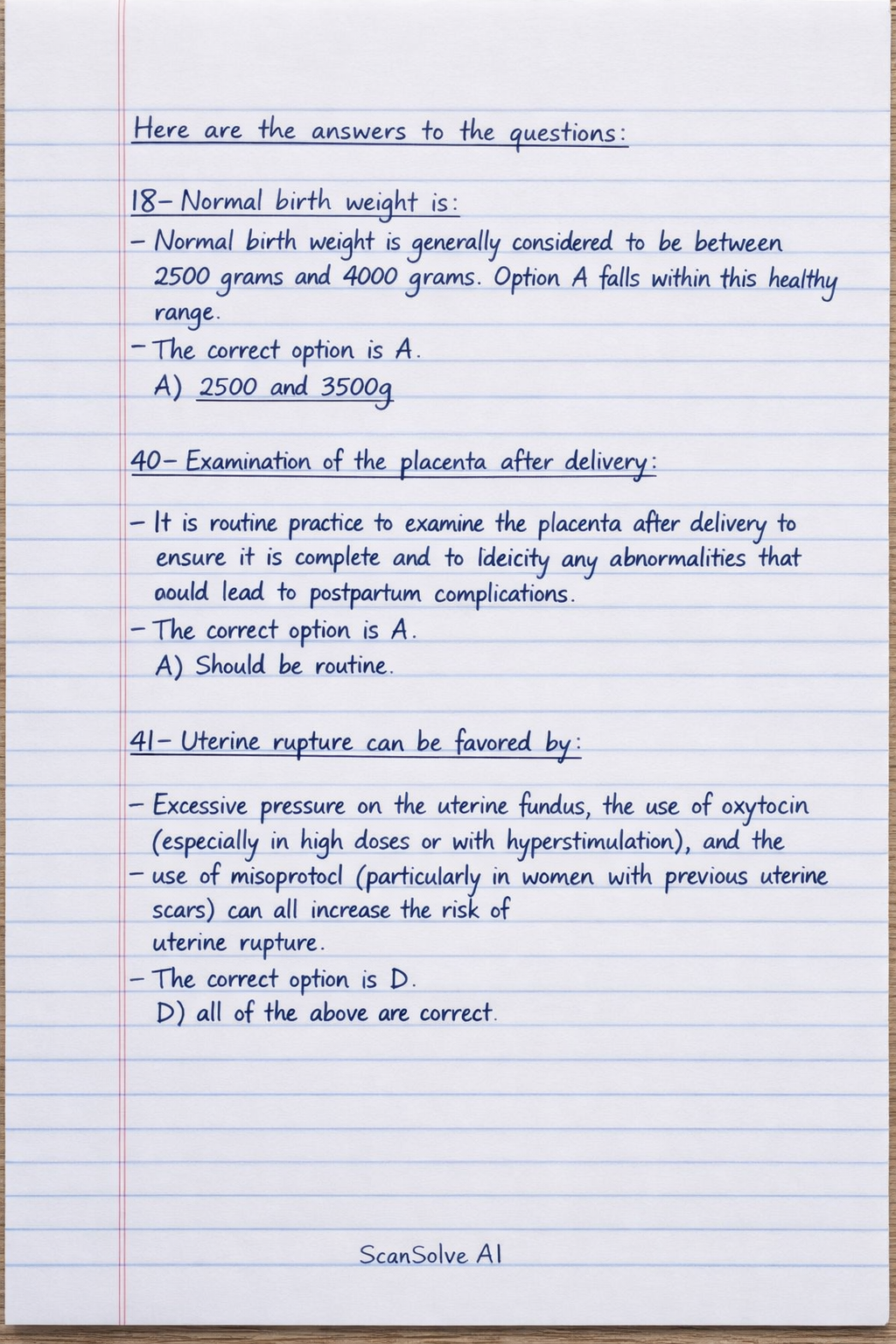
Here are the answers to the questions:
18-Normal birth weight is:
- Normal birth weight is generally considered to be between 2500 grams and 4000 grams. Option A falls within this healthy range.
- The correct option is A.
- A) 2500 and 3500g
40-Examination of the placenta after delivery:
- It is routine practice to examine the placenta after delivery to ensure it is complete and to identify any abnormalities that could lead to postpartum complications.
- The correct option is A.
- A) Should be routine
41-Uterine rupture can be favored by:
- Excessive pressure on the uterine fundus, the use of oxytocin (especially in high doses or with hyperstimulation), and the use of misoprostol (particularly in women with previous uterine scars) can all increase the risk of uterine rupture.
- The correct option is D.
- D) all of the above are correct
42-In case of uterine rupture, subsequent treatment is carried out:
- Uterine rupture is an obstetric emergency that requires immediate surgical intervention to control bleeding and repair the uterus. This is a form of hemostasis surgery.
- The correct option is C.
- C) by hemostasis surgery
43-Cervical tears usually occur when:
- Cervical tears are most commonly caused by the parturient pushing forcefully before the cervix is fully dilated, leading to the cervix being trapped and torn by the descending fetal head.
- The correct option is B.
- B) when the parturient pushes before full dilation
44-Perineal tears are favored by:
- Factors such as a large fetus, a rigid (less elastic) perineum, and malposition of the fetal head (which can cause uneven pressure) all increase the risk of perineal tears during delivery.
- The correct option is D.
- D) all of the above are correct
45-In case of cervical or perineal tear, repair should be performed:
- Cervical and perineal tears should be repaired immediately after delivery to control bleeding, prevent infection, and promote proper healing.
- The correct option is A.
- A) Immediately
Was this helpful?
Try one yourself
A new problem that tests the same skill.
Still stuck on this one?
Ask a follow-up, and the answer starts from this question.
Got a different question?Ask your own question
More Biology Questions
QPOSTPARTUM HEMORRHAGE Question Mrs. Bupe Phiri aged 38 para 9, has just delivered a baby boy with…QCalculate the maternal mortality rate and define the listed types of hernias.QWhat symptoms indicate excessive bleeding after a caesarean section, and what methods are used to…QWhat are the definitions and characteristics of common pregnancy and postpartum complications and…QOutline the causes and management of bleeding in early pregnancy, and list causes of bleeding in…
Handwritten Step-by-Step Solution
Get this as a handwritten image on WhatsApp — like a tutor wrote it for you.
Try on WhatsApp