
We read your photo as:
What are the definitions of different types of skin lesions like macules, papules, pustules, vesicles, erythema, nodules, blebs/bullae, and ecchymosis?
Biology
ScanSolve AI Answer
here are the definitions for the different types of lesions:
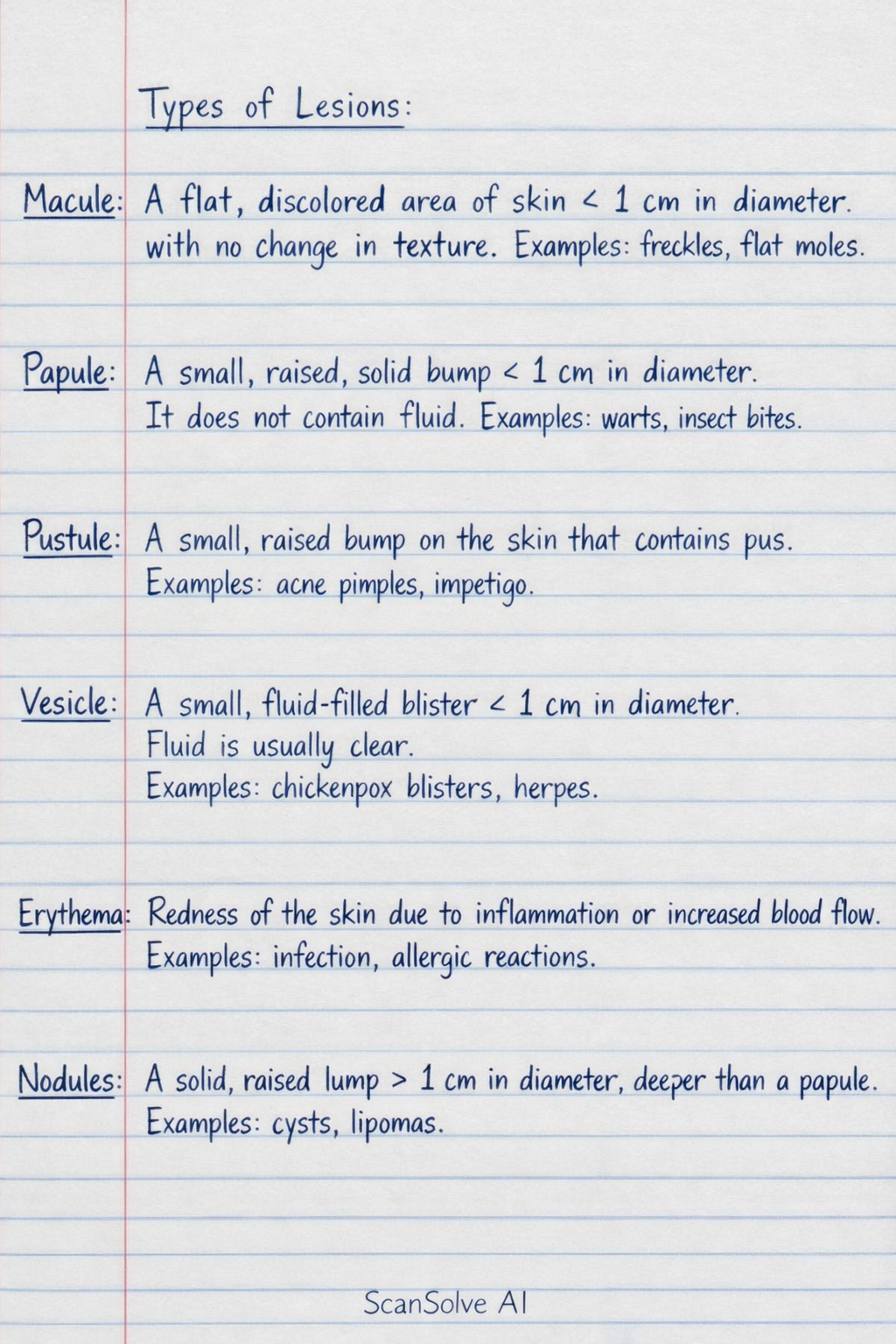
- Macule: A flat, distinct, discolored area of skin that is less than 1 cm in diameter and does not involve any change in skin texture or thickness. Examples include freckles or flat moles.
- Papule: A small, raised, solid bump on the skin, typically less than 1 cm in diameter. It does not contain fluid. Examples include warts or insect bites.
- Pustule: A small, raised bump on the skin that contains pus. Examples include acne pimples or impetigo.
- Vesicle: A small, fluid-filled blister on the skin, typically less than 1 cm in diameter. The fluid is usually clear. Examples include blisters from chickenpox or herpes.
- Erythema: Redness of the skin, often caused by inflammation or increased blood flow. It can be a symptom of various conditions, such as infection or allergic reactions.
- Nodules: A solid, raised lump in or under the skin, usually larger than 1 cm in diameter. They can be felt and are often deeper than papules. Examples include cysts or lipomas.
- Blebs of Bullae: A bulla (plural: bullae) is a large, fluid-filled blister, typically greater than 1 cm in diameter. A bleb is a small blister, often used interchangeably with vesicle, but can also refer to a small, air-filled blister.
- Ecchymosis: A discoloration of the skin resulting from bleeding underneath, typically caused by bruising. It is larger than a petechia (small pinpoint bruise) and often purplish in color.
- Miliary rash: A rash characterized by numerous small, red, pinpoint lesions, often resembling millet seeds. It can be seen in conditions like heat rash (miliaria) or certain viral infections.
- Crust: A dried collection of serum, pus, or blood on the surface of the skin, often forming over a healing wound or lesion. Commonly known as a scab.
- Enanthem: A rash or eruption that occurs on the mucous membranes inside the body, such as in the mouth. It is often associated with viral infections like measles (Koplik's spots).
Was this helpful?
Still stuck on this one?
Ask a follow-up, and the answer starts from this question.
Got a different question?Ask your own question
More Biology Questions
QState three (3) disorder of Skin: Acne, Eczema, PsoriasisQEverything about the skinQCan you define these anatomical terms: Dorsum, Dorsal surface, Palmar surface, Plantar surface…QEnumerate the various types of epithelial tissues in the body. Describe each type and give examples…QWhat skin disease is this?
Handwritten Step-by-Step Solution
Get this as a handwritten image on WhatsApp — like a tutor wrote it for you.
Try on WhatsApp