

This biology question covers important biological concepts and processes. The step-by-step explanation below helps you understand the underlying mechanisms and reasoning.
ScanSolve AI Answer
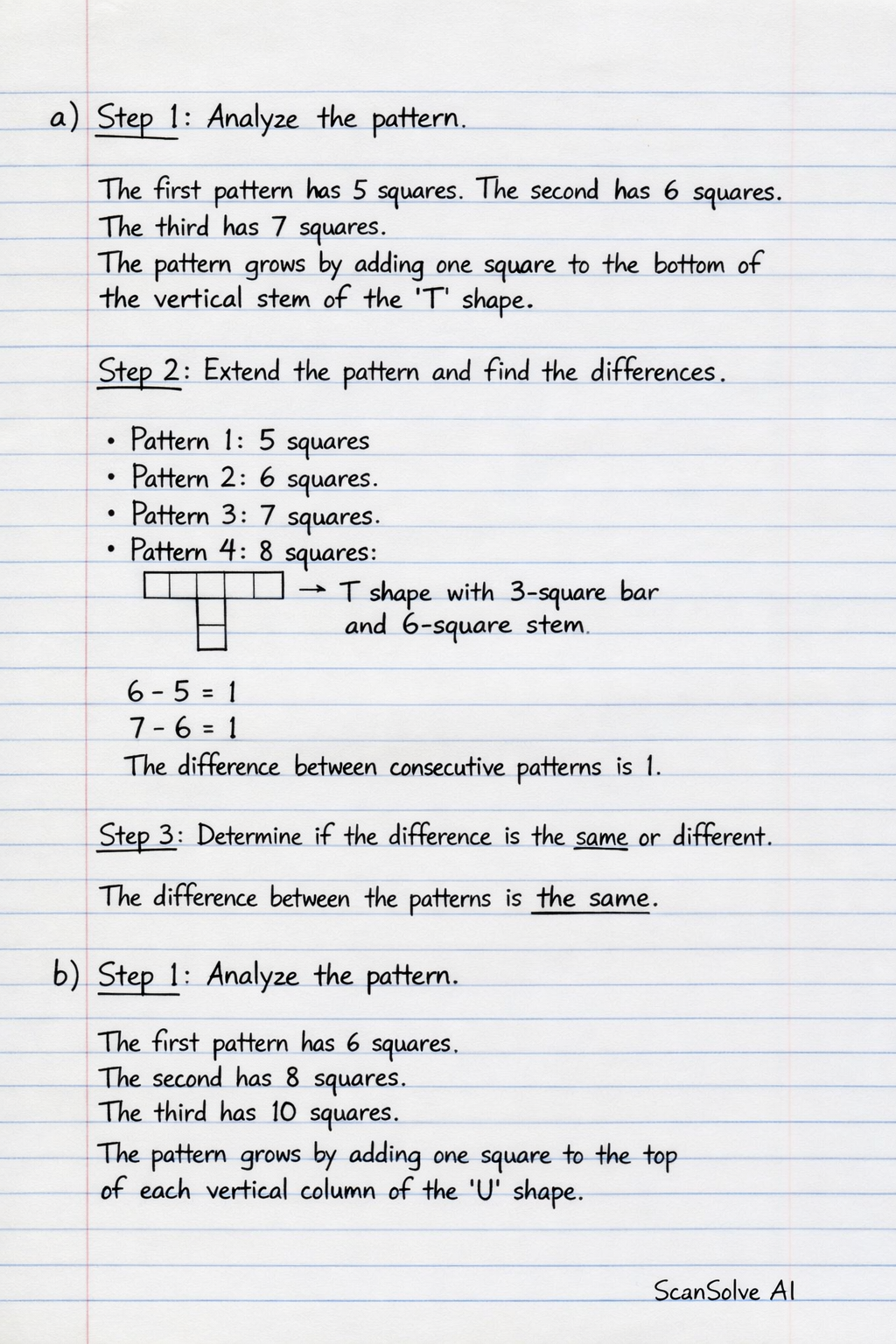
Here are the extended patterns and their differences: a) Step 1: Analyze the pattern. The first pattern has 5 squares. The second has 6 squares. The third has 7 squares. The pattern grows by adding one square to the bottom of the vertical stem of the 'T' shape. Step 2: Extend the pattern and find the differences. • Pattern 1: 5 squares • Pattern 2: 6 squares • Pattern 3: 7 squares • Pattern 4: The next pattern will have 8 squares. It will be a 'T' shape with a 3-square horizontal bar and a 6-square vertical stem (including the shared square). The differences between consecutive patterns are: 6 - 5 = 1 7 - 6 = 1 The difference between the patterns is 1. Step 3: Determine if the difference is the same or different. The difference between the patterns is the same. b) Step 1: Analyze the pattern. The first pattern has 6 squares. The second has 8 squares. The third has 10 squares. The pattern grows by adding one square to the top of each vertical column of the 'U' shape. Step 2: Extend the pattern and find the differences. • Pattern 1: 6 squares • Pattern 2: 8 squares • Pattern 3: 10 squares • Pattern 4: The next pattern will have 12 squares. It will be a 'U' shape with two vertical columns of 5 squares each, connected by 2 squares at the bottom. The differences between consecutive patterns are: 8 - 6 = 2 10 - 8 = 2 The difference between the patterns is 2. Step 3: Determine if the difference is the same or different. The difference between the patterns is the same. c) Step 1: Analyze the pattern. The first pattern has 4 small triangles (1 shaded, 3 unshaded). The second has 7 small triangles (1 shaded, 6 unshaded). The third has 10 small triangles (1 shaded, 9 unshaded). The pattern grows by adding 3 unshaded triangles around the central shaded triangle. Step 2: Extend the pattern and find the differences. • Pattern 1: 4 triangles • Pattern 2: 7 triangles • Pattern 3: 10 triangles • Pattern 4: The next pattern will have 13 triangles. It will be a central shaded triangle surrounded by 12 unshaded triangles. The differences between consecutive patterns are: 7 - 4 = 3 10 - 7 = 3 The difference between the patterns is 3. Step 3: Determine if the difference is the same or different. The difference between the patterns is the same. Send me the next one 📸