
We read your photo as:
The flow chart below shows the evolution of the modern day elephant
ScanSolve AI Answer
Answers
5 partsHere are the answers based on the provided flowchart:
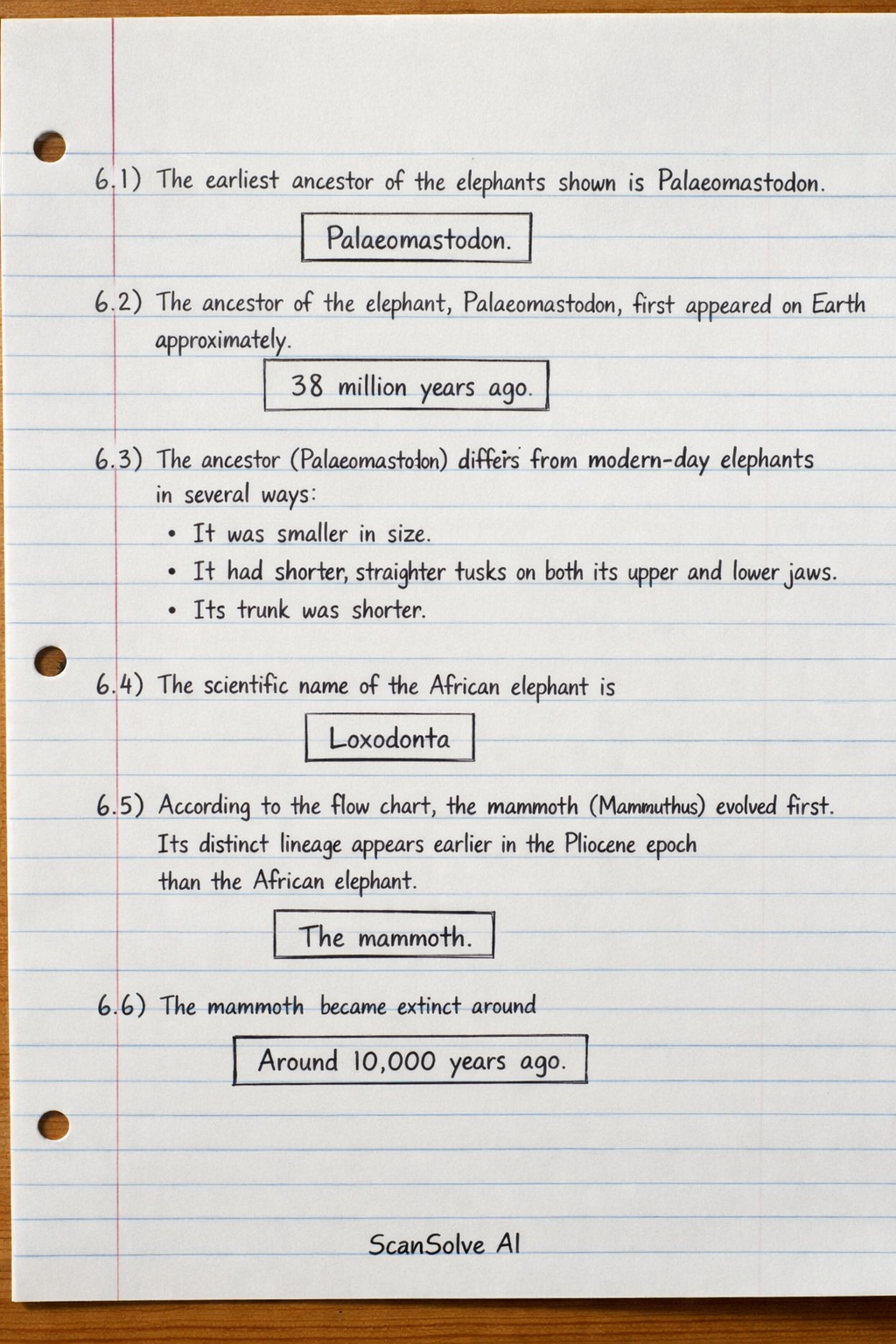
6.1 The earliest ancestor of the elephants shown is Palaeomastodon.
6.2 The ancestor of the elephant, Palaeomastodon, first appeared on Earth approximately 38 million years ago.
6.3 The ancestor (Palaeomastodon) differs from modern-day elephants in several ways:
- It was smaller in size.
- It had shorter, straighter tusks on both its upper and lower jaws, unlike modern elephants which primarily have long, curved upper tusks.
- Its trunk was shorter.
6.4 The scientific name of the African elephant is Loxodonta.
6.5 According to the flow chart, the mammoth (Mammuthus) evolved first, as its distinct lineage appears earlier within the Pliocene epoch compared to the African elephant (Loxodonta).
6.6 The mammoth became extinct around 10,000 years ago, at the end of the Pleistocene epoch.
6.7 Yes, the African elephant is under threat of becoming extinct.
Reason: African elephants face significant threats from poaching for their ivory and habitat loss due to human activities.
Try one yourself
A new problem that tests the same skill.
Still stuck on this one?
Ask a follow-up, and the answer starts from this question.
More Biology Questions
Handwritten Step-by-Step Solution
Get this as a handwritten image on WhatsApp — like a tutor wrote it for you.
Try on WhatsApp