
We read your photo as:
The following test is used to differentiate Streptococcus from Staphylococcus
ScanSolve AI Answer
Answer
Here are the answers to the multiple-choice questions:
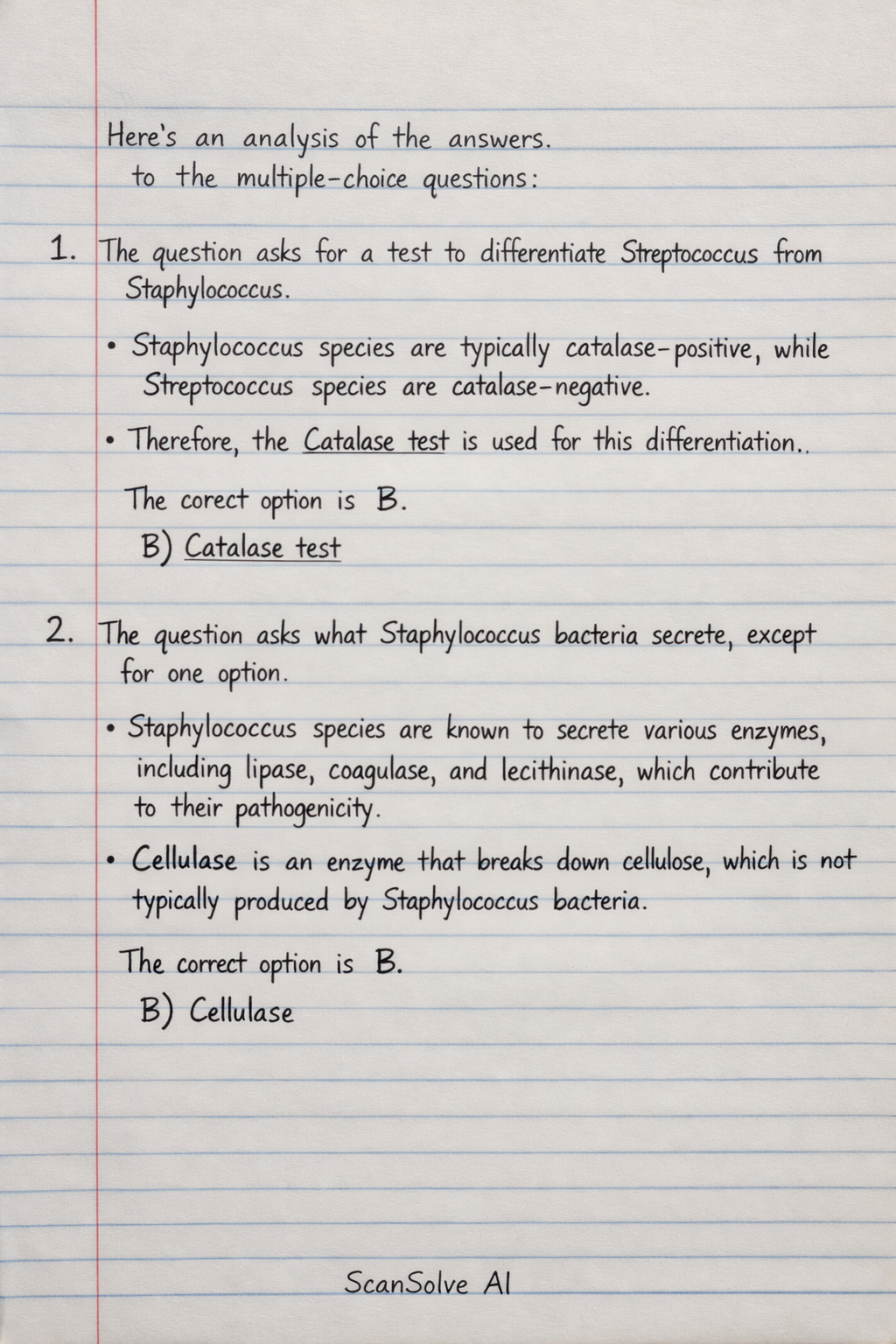
1. The question asks for a test to differentiate Streptococcus from Staphylococcus.
- Staphylococcus species are typically catalase-positive, while Streptococcus species are catalase-negative.
- Therefore, the Catalase test is used for this differentiation.
The correct option is B.
- B) Catalase test
2. The question asks what Staphylococcus bacteria secrete, except for one option.
- Staphylococcus species are known to secrete various enzymes, including lipase, coagulase, and lecithinase, which contribute to their pathogenicity.
- Cellulase is an enzyme that breaks down cellulose, which is not typically produced by Staphylococcus bacteria.
The correct option is B.
- B) Cellulase
3. The question asks to identify a Gram-negative coccus.
- Staphylococcus and Streptococcus are Gram-positive cocci.
- Salmonella is a Gram-negative rod.
- Neisseria species (e.g., Neisseria gonorrhoeae, Neisseria meningitidis) are characteristic Gram-negative cocci, often appearing in pairs (diplococci).
The correct option is C.
- C) Neisseria
4. The question asks what bacteria can be classified by, except for one option.
- Bacteria are commonly classified by their Gram reaction (Gram-positive or Gram-negative), whether they are spore-forming or non-spore-forming, and their shape/morphology (cocci, bacilli, spirilla).
- "Biological cabinet class" is not a standard method for classifying bacteria. Biological safety cabinets are equipment used for safe handling of microorganisms.
The correct option is C.
- C) Biological cabinet class
5. The question describes a motile spirochete acquired by sexual contact and transmissible to a fetus transplacentally, causing infection in later stages of pregnancy.
- This description perfectly matches Treponema pallidum, the causative agent of syphilis. Syphilis is a sexually transmitted infection that can be congenitally transmitted.
- Corynebacterium diphtheriae causes diphtheria and is a Gram-positive rod.
- Streptococcus species are Gram-positive cocci and cause various infections, but not typically described this way.
The correct option is A.
- A) Treponema pallidum
Try one yourself
A new problem that tests the same skill.
Still stuck on this one?
Ask a follow-up, and the answer starts from this question.
More Biology Questions
Handwritten Step-by-Step Solution
Get this as a handwritten image on WhatsApp — like a tutor wrote it for you.
Try on WhatsApp