
We read your photo as:
What are the functions of different plant parts and types of plants? (Fill in the blanks, MCQs, True/False, Short Answers)
ScanSolve AI Answer
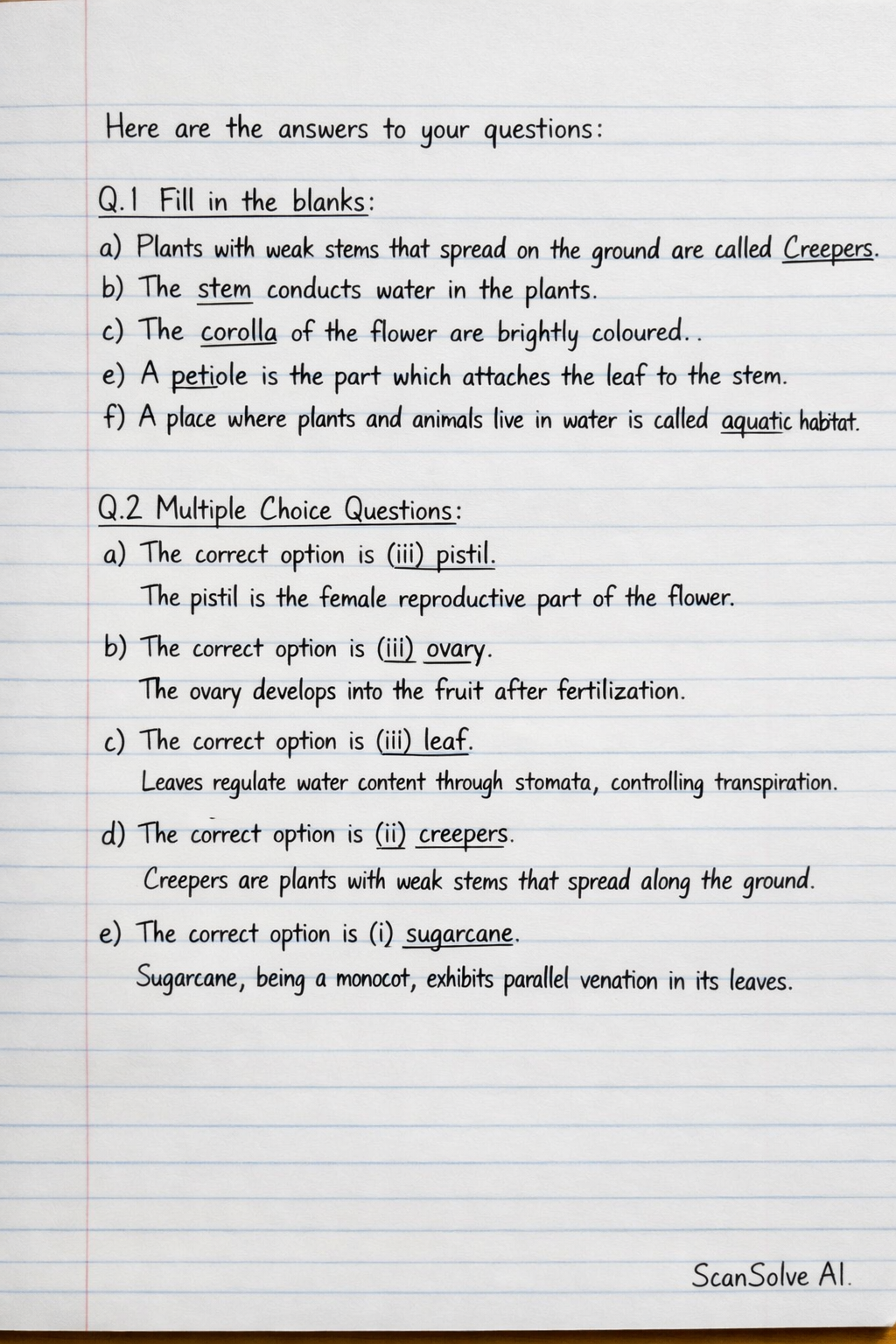
Here are the answers to your questions:
Q.1 Fill in the blanks:
a) Plants with weak stems that spread on the ground are called Creepers.
b) The stem conducts water in the plants.
c) The corolla of the flower are brightly coloured.
e) A petiole is the part which attaches the leaf to the stem.
f) A place where plants and animals live in water is called aquatic habitat.
Q.2 Multiple Choice Questions:
a) The correct option is (iii) pistil.
The pistil is the female reproductive part of the flower.
b) The correct option is (iii) ovary.
The ovary develops into the fruit after fertilization.
c) The correct option is (iii) leaf.
Leaves regulate water content through stomata, controlling transpiration.
d) The correct option is (ii) creepers.
Creepers are plants with weak stems that spread along the ground.
e) The correct option is (i) sugarcane.
Sugarcane, being a monocot, exhibits parallel venation in its leaves.
Q.3 State whether the following statement is true or false.
a. Stem transport the food from leaves to the other parts of the plants.
True.
b. Herbs are plants with strong stems.
False.
c. Leaves absorb oxygen in the process of photosynthesis.
False.
d. Lemon plant is a shrub plant.
True.
e. Male reproductive part of plant is pistil.
False.
Q.4 Answer the following questions:
a) Camel is called the 'ship of the desert' because it has several adaptations for desert survival, such as storing water and fat, wide feet for walking on sand, and the ability to close its nostrils to keep out sand, making it an efficient mode of transport across deserts.
b) Dolphins are mammals, not fish, and therefore do not have gills. They survive in water by breathing air through a blowhole located on top of their head, surfacing regularly to inhale and exhale. They possess lungs, similar to land mammals.
c) Two characteristics of pine trees that help them adapt to mountain regions are:
- Needle-like leaves: These reduce the surface area for water loss through transpiration and are resistant to cold and snow.
- Conical shape: This allows snow to slide off easily, preventing damage to branches from heavy snow accumulation.
d) Deer have specific features to detect predators like lions:
- Large ears: Provide acute hearing to pick up faint sounds of approaching predators.
- Eyes on the sides of the head: Offer a wide field of vision, allowing them to spot predators from various angles without turning their head.
e) Two adaptations of cactus are:
- Thick, waxy stems: These store water and have a waxy coating to reduce water loss through evaporation.
- Spines instead of leaves: Spines minimize water loss (as they have less surface area than leaves) and protect the plant from herbivores.
Still stuck on this one?
Ask a follow-up, and the answer starts from this question.
More Biology Questions
Handwritten Step-by-Step Solution
Get this as a handwritten image on WhatsApp — like a tutor wrote it for you.
Try on WhatsApp