
We read your photo as:
The initial cross of yellow flowers with red flowers produced all orange offspring. This indicates that neither allele is completely dominant over the other, and the heterozygous genotype results in a
ScanSolve AI Answer
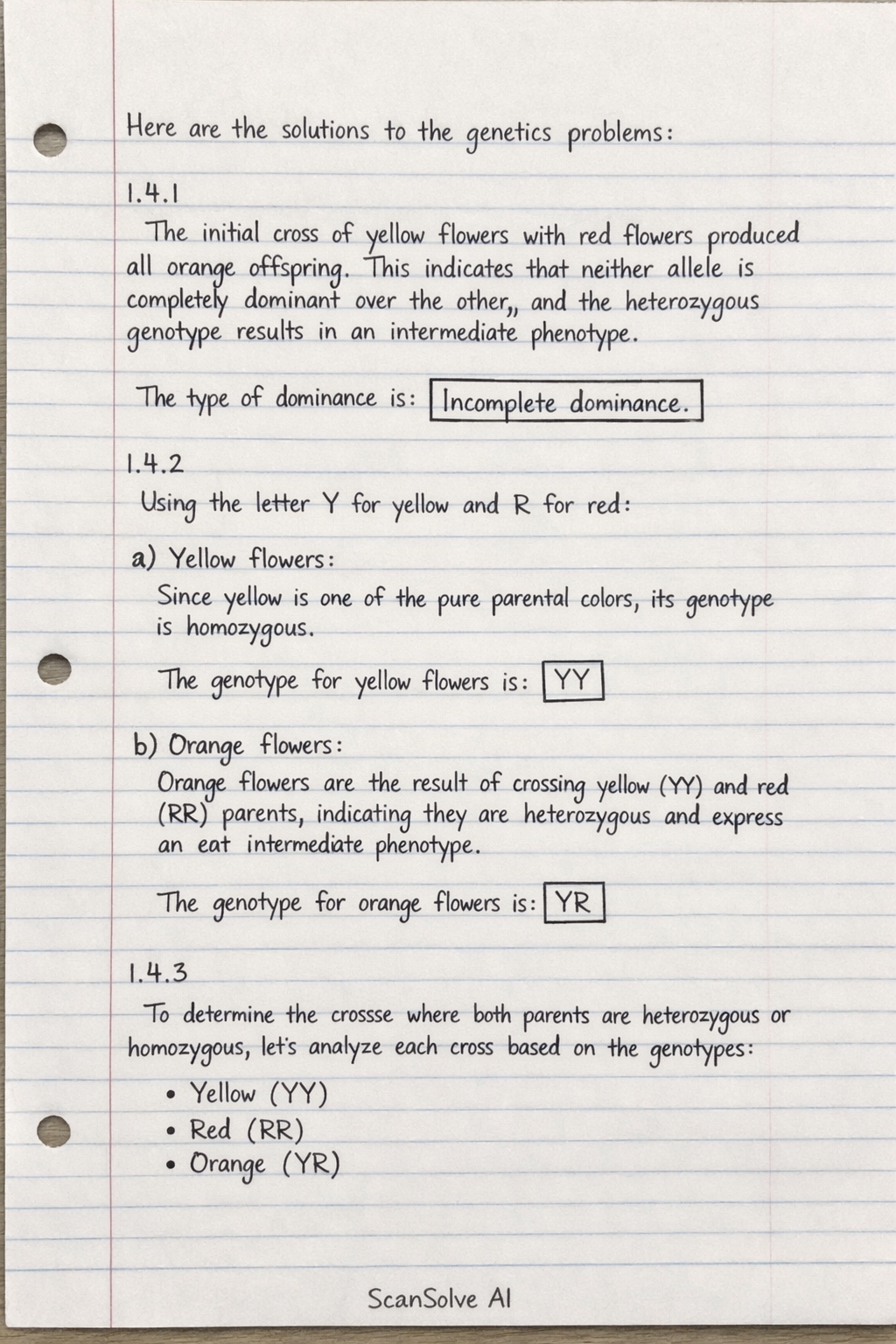
Here are the solutions to the genetics problems:
1.4.1
The initial cross of yellow flowers with red flowers produced all orange offspring. This indicates that neither allele is completely dominant over the other, and the heterozygous genotype results in an intermediate phenotype.
The type of dominance is .
1.4.2
Using the letter Y for yellow and R for red:
a) Yellow flowers:
Since yellow is one of the pure parental colors, its genotype is homozygous.
The genotype for yellow flowers is .
b) Orange flowers:
Orange flowers are the result of crossing yellow (YY) and red (RR) parents, indicating they are heterozygous and express an intermediate phenotype.
The genotype for orange flowers is .
1.4.3
To determine the crosses where both parents are heterozygous or homozygous, let's analyze each cross based on the genotypes:
-
Yellow (YY)
-
Red (RR)
-
Orange (YR)
-
Cross 1: All red offspring (RR) This result can only be achieved by crossing two red parents: RR x RR. Both parents are homozygous.
-
Cross 2: All orange offspring (YR) This result can only be achieved by crossing a yellow parent with a red parent: YY x RR. Both parents are homozygous.
-
Cross 3: 52 orange (YR) and 51 red (RR) offspring (approx. 1:1 ratio) This ratio is characteristic of a cross between an orange parent and a red parent: YR x RR. One parent is heterozygous (YR), and the other is homozygous (RR).
-
Cross 4: 22 yellow (YY), 55 orange (YR), 24 red (RR) offspring (approx. 1:2:1 ratio) This ratio is characteristic of a cross between two orange parents: YR x YR. Both parents are heterozygous.
a) Both parents are heterozygous:
Based on the analysis, Cross 4 (YR x YR) has both parents heterozygous.
The number of the cross is .
b) Both parents are homozygous:
Based on the analysis, Cross 1 (RR x RR) and Cross 2 (YY x RR) both have parents that are homozygous.
The numbers of the crosses are .
Still stuck on this one?
Ask a follow-up, and the answer starts from this question.
More Biology Questions
Handwritten Step-by-Step Solution
Get this as a handwritten image on WhatsApp — like a tutor wrote it for you.
Try on WhatsApp