
We read your photo as:
SECTION V Questions 31-40 Directions: Each question consists of four lettered headings A, B, C, D. Select the heading which is closely related to the description which follows.
ScanSolve AI Answer
Answer
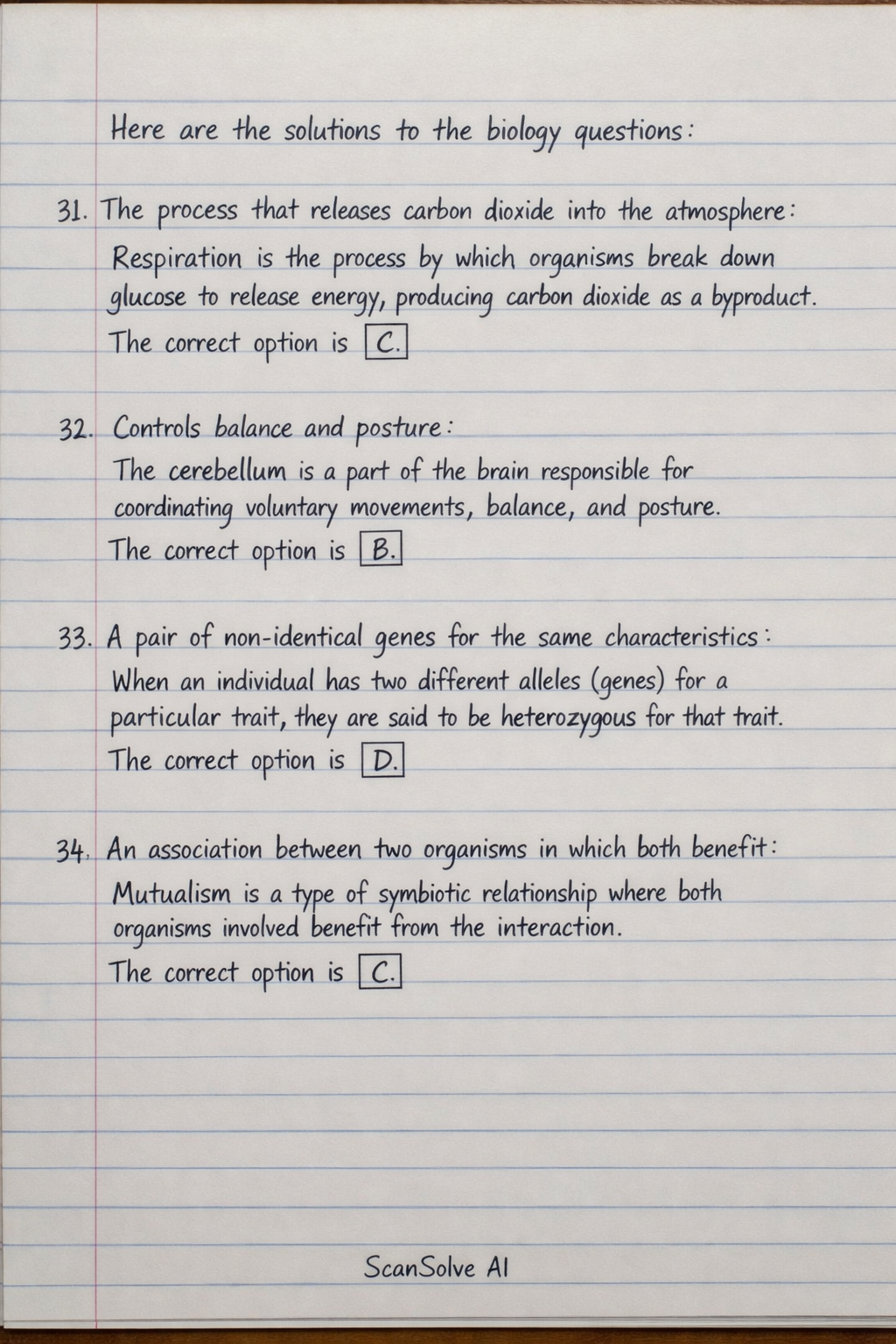
Here are the solutions to the biology questions:
31. The process that releases carbon dioxide into the atmosphere:
Respiration is the process by which organisms break down glucose to release energy, producing carbon dioxide as a byproduct.
The correct option is C.
32. Controls balance and posture:
The cerebellum is a part of the brain responsible for coordinating voluntary movements, balance, and posture.
The correct option is B.
33. A pair of non-identical genes for the same characteristics:
When an individual has two different alleles (genes) for a particular trait, they are said to be heterozygous for that trait.
The correct option is D.
34. An association between two organisms in which both benefit:
Mutualism is a type of symbiotic relationship where both organisms involved benefit from the interaction.
The correct option is C.
35. A natural self-sustaining unit:
An ecosystem is a community of living organisms interacting with their non-living environment, forming a self-sustaining unit.
The correct option is D.
36. Produced during fright:
Adrenaline (also known as epinephrine) is a hormone produced by the adrenal glands in response to stress, fear, or excitement, preparing the body for a "fight or flight" response.
The correct option is D.
37. Causes malaria:
Plasmodium is a genus of parasitic protozoa that causes malaria in humans and other animals. The female Anopheles mosquito acts as a vector.
The correct option is A.
38. Its deficiency will lead to anaemia:
Iron is a crucial component of hemoglobin in red blood cells. A deficiency in iron can lead to iron-deficiency anemia.
The correct option is C.
39. Used for tearing of flesh:
Canine teeth are pointed and sharp, adapted for tearing and piercing food, especially flesh.
The correct option is B.
40. Is an air pollutant:
Lead particles are a known air pollutant, often released from industrial processes and, historically, from leaded gasoline.
The correct option is A.
41. When red blood corpuscles were mounted in distilled water for 20 minutes, only cell fragments remained in solution. This is due to:
Red blood cells placed in distilled water (a hypotonic solution) will absorb water by osmosis, swell, and burst (hemolysis) because they lack a cell wall to prevent over-expansion. The fragments are the remnants of the burst cells.
The correct option is B.
42. In many perennial plants, soluble products of photosynthesis are transported from the leaves to underground storage organs. This is possible through:
The process of transporting sugars (products of photosynthesis) from the leaves to other parts of the plant, such as storage organs, is called translocation, which occurs in the phloem.
The correct option is C.
Try one yourself
A new problem that tests the same skill.
Still stuck on this one?
Ask a follow-up, and the answer starts from this question.
More Biology Questions
Handwritten Step-by-Step Solution
Get this as a handwritten image on WhatsApp — like a tutor wrote it for you.
Try on WhatsApp