
We read your photo as:
The irregular and difficult passage of faeces is known as
ScanSolve AI Answer
Answer
Step-by-step solution
2 stepsHere are the solutions to the questions from the image:
-
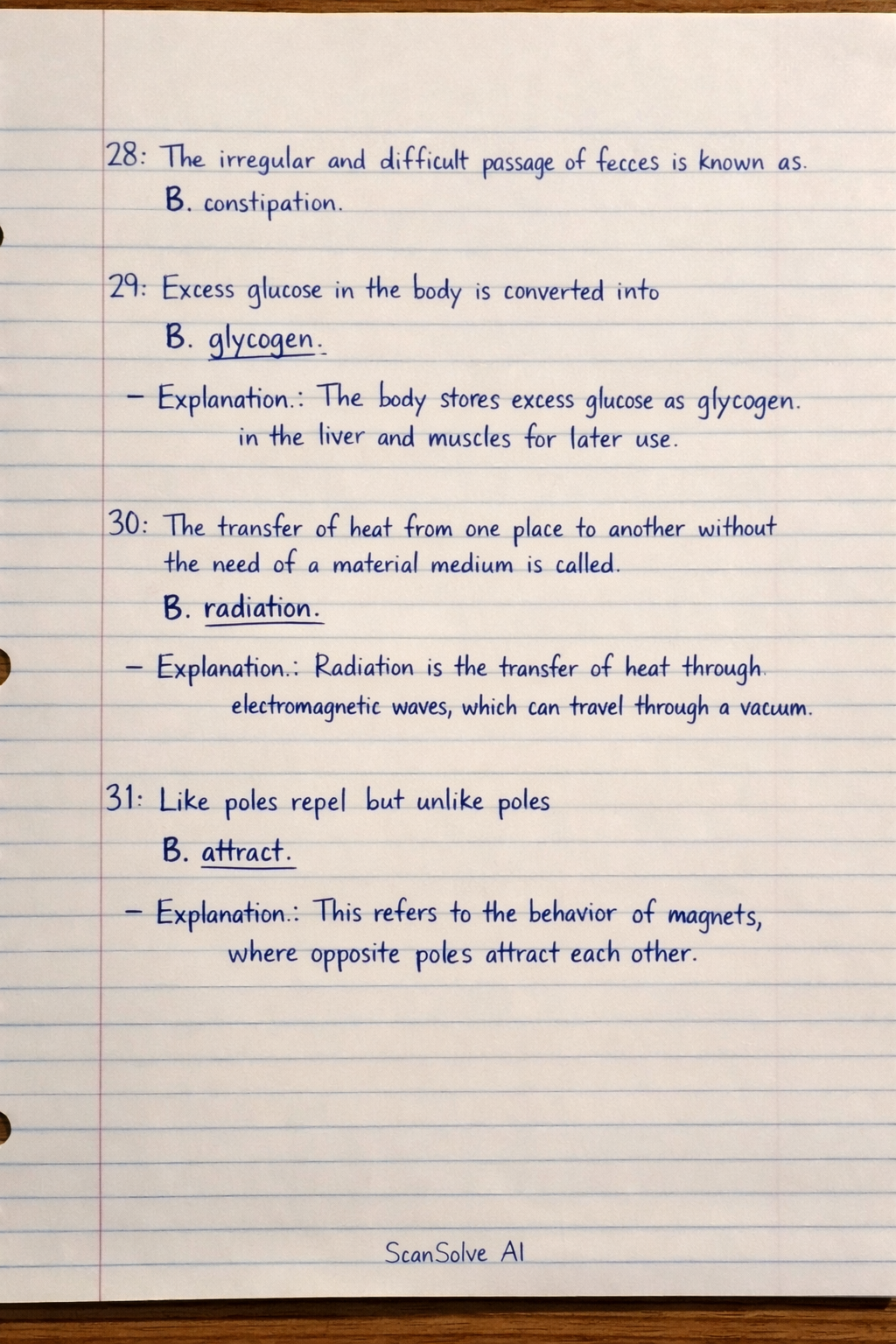
The irregular and difficult passage of faeces is known as B. constipation.
-
Excess glucose in the body is converted into B. glycogen.
- Explanation: The body stores excess glucose as glycogen in the liver and muscles for later use.
-
The transfer of heat from one place to another without the need of a material medium is called B. radiation.
- Explanation: Radiation is the transfer of heat through electromagnetic waves, which can travel through a vacuum.
-
Like poles repel but unlike poles B. attract.
- Explanation: This refers to the behavior of magnets, where opposite poles attract each other.
-
An atom is represented as [missing symbol]. Determine the number of neutrons in the atom.
- Explanation: The symbol for the atom is missing from the question. To determine the number of neutrons, you would typically subtract the atomic number (number of protons) from the mass number (protons + neutrons). Without the atomic and mass numbers, the number of neutrons cannot be determined.
-
When equal and opposite forces act on a block of wood, they are A. Balanced.
- Explanation: Balanced forces result in no change in the object's motion (either remaining at rest or continuing at a constant velocity).
-
Isotopes of the same element are likely to have C. similar chemical properties.
- Explanation: Isotopes have the same number of protons and electrons, which determine chemical properties. They differ only in the number of neutrons.
-
Particles present in steam C. move fast and are far apart.
- Explanation: Steam is water in its gaseous state. Gas particles have high kinetic energy, move rapidly, and are widely spaced.
-
The part of the brain which is responsible for balance and co-ordination is the A. Cerebellum.
- Explanation: The cerebellum plays a key role in motor control, including coordination, precision, and accurate timing.
-
The colorless and odorless gas produced at the cathode during the electrolysis of acidified water is B. hydrogen.
- Explanation: During the electrolysis of water, hydrogen gas () is produced at the cathode (negative electrode), and oxygen gas () is produced at the anode (positive electrode).
-
The distance between the successive compressions of a sound wave is called D. wave length.
- Explanation: Wavelength is the spatial period of a periodic wave, the distance over which the wave's shape repeats.
-
Red light and blue light add together to produce D. magenta light.
- Explanation: In additive color mixing (mixing light), red and blue light combine to form magenta.
-
A load of is lifted from the ground onto a table high. Determine the power generated if the load was lifted in .
Calculate the work done ().
$$ W = \text{Force} \times \text{distance} $$ $$ W = 150\,\text{N} \times 0.8\,\text{m} $$ $$ W = 120\,\text{J} $$Calculate the power generated ().
    $$
    P = \frac{\text{Work done}}{\text{time}}
    $$
    $$
    P = \frac{120\,\text{J}}{5.0\,\text{s}}
    $$
    $$
    P = 24\,\text{W}
    $$
*   The correct answer is **B. $24.0\,\text{W}$**.
Try one yourself
A new problem that tests the same skill.
Still stuck on this one?
Ask a follow-up, and the answer starts from this question.
More Biology Questions
Handwritten Step-by-Step Solution
Get this as a handwritten image on WhatsApp — like a tutor wrote it for you.
Try on WhatsApp