
We read your photo as:
What are the key processes and definitions related to digestion and nutrition, including mechanical and chemical digestion, types of nutrition, and the fate of water during digestion?
ScanSolve AI Answer
Here are the solutions to the questions you sent:
1. Mechanical digestion involves the physical breakdown of food into smaller pieces, increasing its surface area. Chemical digestion involves the breakdown of complex food molecules into simpler ones by the action of enzymes.
2. Holozoic nutrition involves ingesting solid or liquid organic matter, digesting it internally, and then absorbing the nutrients. Parasitic nutrition involves an organism living on or in another organism (the host) and obtaining nutrients directly from the host, often without killing it.
3. The type of food that is not digested before being absorbed by the body is d) Water. Water is absorbed directly without needing to be broken down further.
4. The processes are:
a) The process by which solid food is converted into a paste in the mouth is called mastication (chewing).
b) The process where paste swallowed is mixed with stomach (gastric) juices and enzymes and liquefied further is called churning and chemical digestion.
c) The process where liquefied food from the stomach is broken further by enzymes into simple molecules or compounds is called chemical digestion.
d) The process where simple molecules diffuse across the intestinal lining into the blood capillaries is called absorption.
e) The process where complex food compounds are eliminated from the alimentary canal is called egestion or defecation.
5. Three types of food substances in a balanced diet that do not undergo digestion in humans are:
- Water
- Vitamins
- Minerals
6. The small intestine's main functions in animals are:
- Digestion: It completes the chemical digestion of carbohydrates, proteins, and fats using enzymes from the intestinal wall and pancreas.
- Absorption: It is the primary site for the absorption of digested nutrients (amino acids, glucose, fatty acids, glycerol, vitamins, minerals, and water) into the bloodstream and lymphatic system.
7. Five adaptations of the ileum to its functions are:
- Long length: Provides a large surface area and sufficient time for digestion and absorption.
- Folded inner surface: Contains numerous folds (plicae circulares) that increase the surface area.
- Villi: Finger-like projections on the folds that further increase the surface area for absorption.
- Microvilli: Tiny projections on the epithelial cells of the villi, forming a "brush border" that maximizes surface area.
- Rich blood supply: Each villus contains a network of capillaries to efficiently transport absorbed nutrients away.
- Thin walls: The epithelial lining is only one cell thick, allowing for rapid diffusion of nutrients.
8. Ingestion is the process of taking food into the body (e.g., eating). Egestion is the process of eliminating undigested waste materials from the body (e.g., defecation).
9. The end products are:
a) Carbohydrates: Glucose (and other monosaccharides like fructose, galactose).
b) Proteins: Amino acids.
c) Fats: Fatty acids and glycerol.
10. Peristalsis is the wave-like muscular contractions that move food through the digestive tract. These involuntary contractions of the smooth muscles in the walls of the esophagus, stomach, and intestines push the food along.
11. The enzyme present in saliva is salivary amylase (also known as ptyalin). It acts on carbohydrates (specifically starch), beginning their chemical digestion.
12. Bile from the liver is stored in the gallbladder.
13. The correct order for food travel through the alimentary canal is:
Mouth Oesophagus Stomach Small intestines Large intestines Rectum Anus.
Still stuck on this one?
Ask a follow-up, and the answer starts from this question.
More Biology Questions
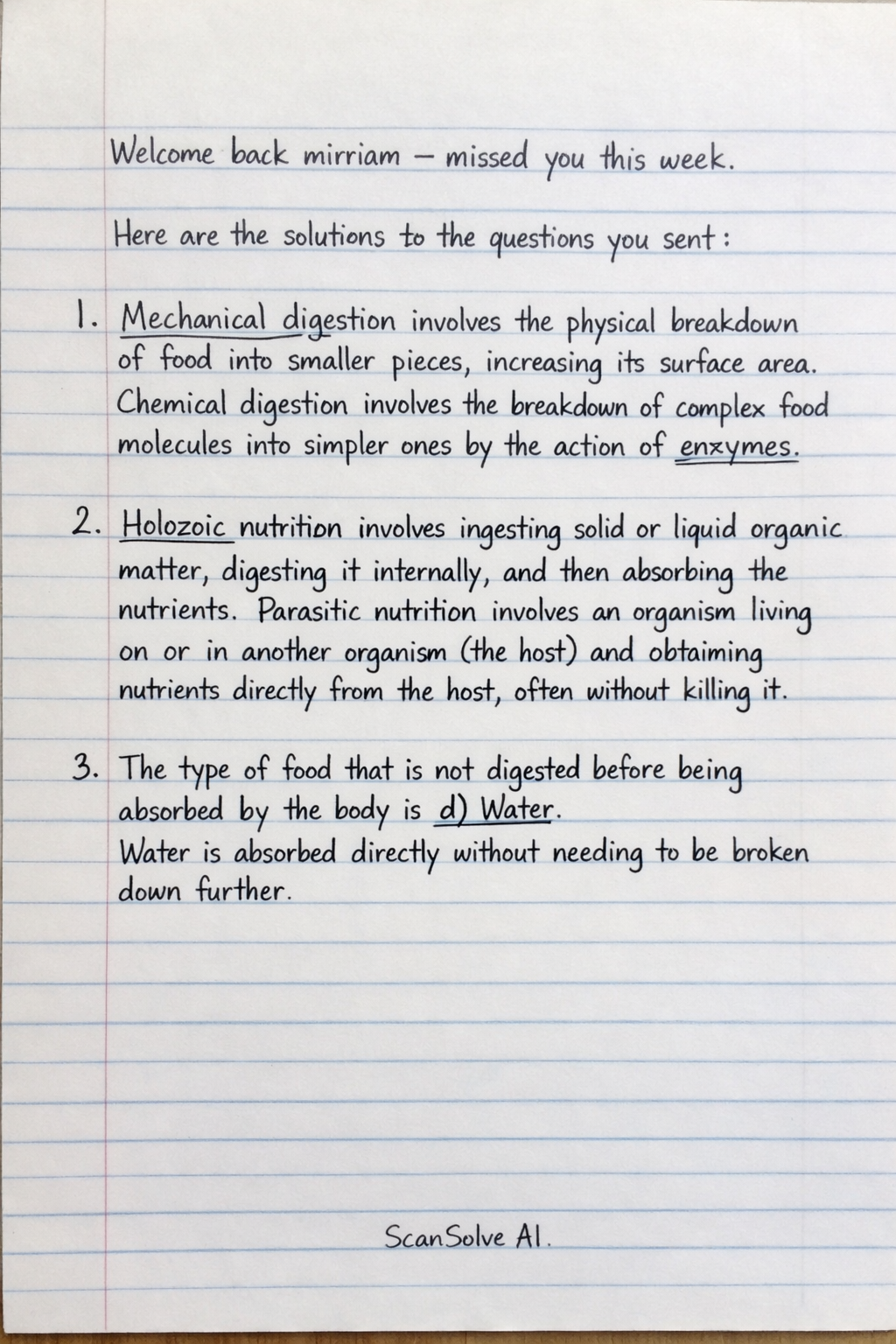
Handwritten Step-by-Step Solution
Get this as a handwritten image on WhatsApp — like a tutor wrote it for you.
Try on WhatsApp