
We read your photo as:
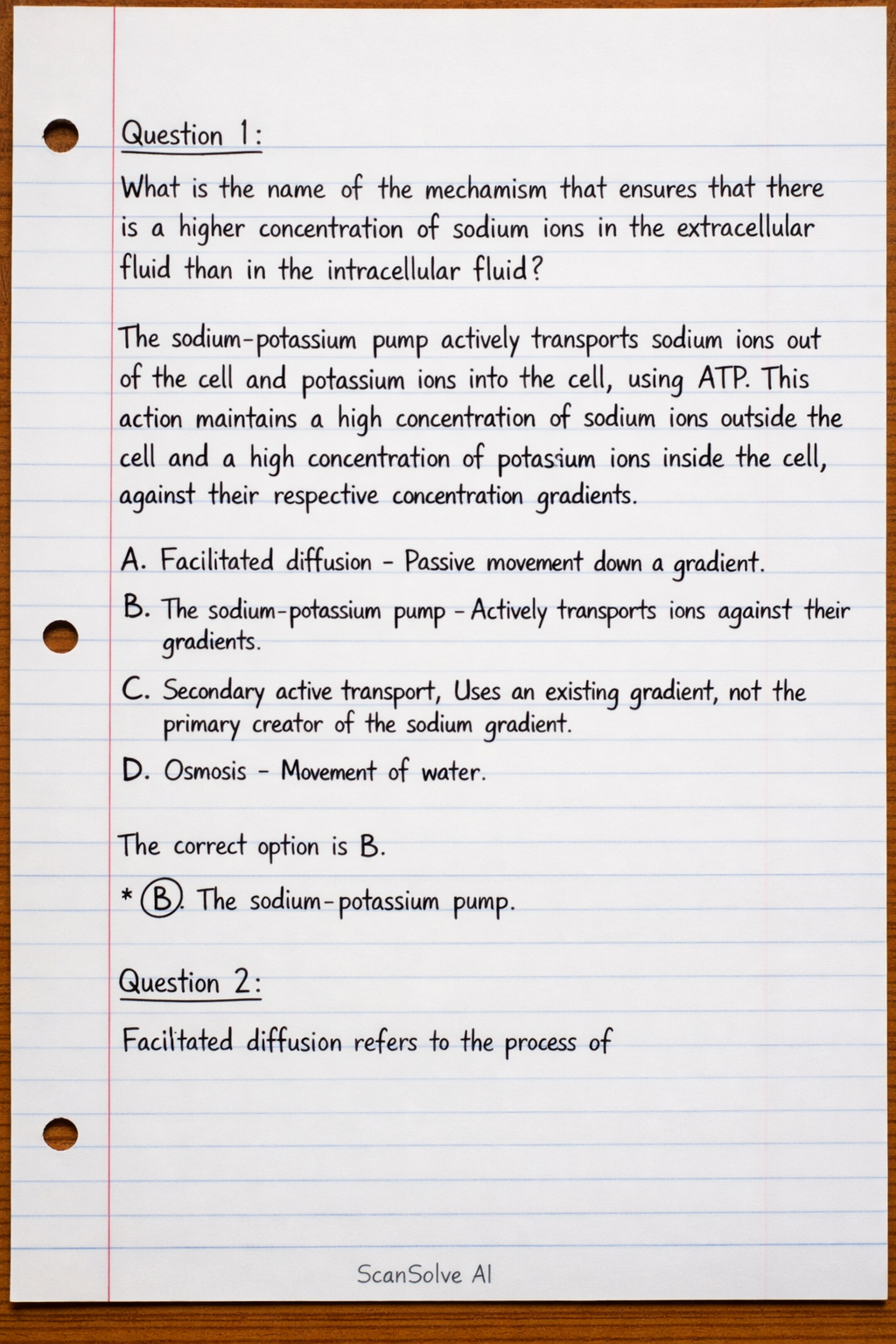
What is the name of the mechanism that ensures that there is a higher concentration of sodium ions in the extracellular fluid than in the intracellular fluid?
ScanSolve AI Answer
Answer
Question 1: What is the name of the mechanism that ensures that there is a higher concentration of sodium ions in the extracellular fluid than in the intracellular fluid?
The sodium-potassium pump actively transports sodium ions out of the cell and potassium ions into the cell, using ATP. This action maintains a high concentration of sodium ions outside the cell and a high concentration of potassium ions inside the cell, against their respective concentration gradients.
- A. Facilitated diffusion - Passive movement down a gradient.
- B. The sodium-potassium pump - Actively transports ions against their gradients.
- C. Secondary active transport - Uses an existing gradient, not the primary creator of the sodium gradient.
- D. Osmosis - Movement of water.
The correct option is B.
- B. The sodium-potassium pump
Question 2: Facilitated diffusion refers to the process of
Facilitated diffusion is a type of passive transport where molecules move across the plasma membrane down their concentration gradient with the assistance of specific membrane proteins (carrier proteins or channel proteins). It does not require direct energy input.
- A. movement along a concentration gradient assisted by protein carrier molecules - This accurately describes facilitated diffusion.
- B. movement of ions and molecules along a concentration gradient - This is too general; it could also describe simple diffusion.
- C. transport of molecules and ions against their concentration gradient - This describes active transport.
- D. water movement through a semi-permeable membrane - This describes osmosis.
The correct option is A.
- A. movement along a concentration gradient assisted by protein carrier molecules
Question 3: Active transport across the plasma membrane may be described by which statement?
Active transport is a process that moves molecules across a cell membrane against their concentration gradient, meaning from a region of lower concentration to a region of higher concentration. This process requires energy, typically supplied by ATP.
- A. active transport requires energy from ATP - This is a defining characteristic of primary active transport.
- B. active transport is also known as endocytosis - Endocytosis is a form of bulk transport, not synonymous with all active transport.
- C. active transport moves molecules along their concentration gradient - This describes passive transport.
- D. active transport is the movement of lipid soluble molecules through the plasma membrane - Lipid-soluble molecules typically move by simple diffusion.
The correct option is A.
- A. active transport requires energy from ATP
Question 4: Which of the following enables ions such as sodium to cross a plasma membrane?
Ions are charged particles and cannot easily pass through the hydrophobic lipid bilayer of the plasma membrane. They require specific integral proteins that span the membrane to form channels or act as carriers.
- A. phospholipid bilayer - Impermeable to ions.
- B. peripheral proteins - Loosely associated with the membrane surface, not typically involved in transmembrane transport.
- C. integral proteins - Span the membrane and can form channels or carriers for ions.
- D. desmosomes - Cell junctions that provide strong adhesion between cells.
The correct option is C.
- C. integral proteins
Question 5: The structure responsible for maintaining consciousness and arousal is mainly the:
The reticular formation, specifically the Reticular Activating System (RAS) within it, plays a crucial role in regulating wakefulness, arousal, and consciousness.
- A. Basal ganglia - Involved in motor control, learning, and emotions.
- B. Reticular formation - Contains the RAS, essential for arousal and consciousness.
- C. Cerebellum - Primarily involved in motor control, coordination, and balance.
- D. Hippocampus - Crucial for memory formation.
The correct option is B.
- B. Reticular formation
Question 6: Which one of the following terms best describes a phospholipid. It consists of a:
A phospholipid is an amphipathic molecule, meaning it has both hydrophilic (water-loving) and hydrophobic (water-fearing) regions. It consists of a polar (hydrophilic) head group and two non-polar (hydrophobic) fatty acid tails.
- A. polar head and polar tail - Incorrect, tails are non-polar.
- B. non-polar head and a polar tail - Incorrect, head is polar.
- C. non-polar head and non-polar tail - Incorrect, head is polar.
- D. polar head and non-polar tail - Correct.
The correct option is D.
- D. polar head and non-polar tail
Question 7: The options for this question are not visible in the provided image.
Try one yourself
A new problem that tests the same skill.
Still stuck on this one?
Ask a follow-up, and the answer starts from this question.
More Biology Questions
Handwritten Step-by-Step Solution
Get this as a handwritten image on WhatsApp — like a tutor wrote it for you.
Try on WhatsApp