

This biology question covers important biological concepts and processes. The step-by-step explanation below helps you understand the underlying mechanisms and reasoning.
ScanSolve AI Answer
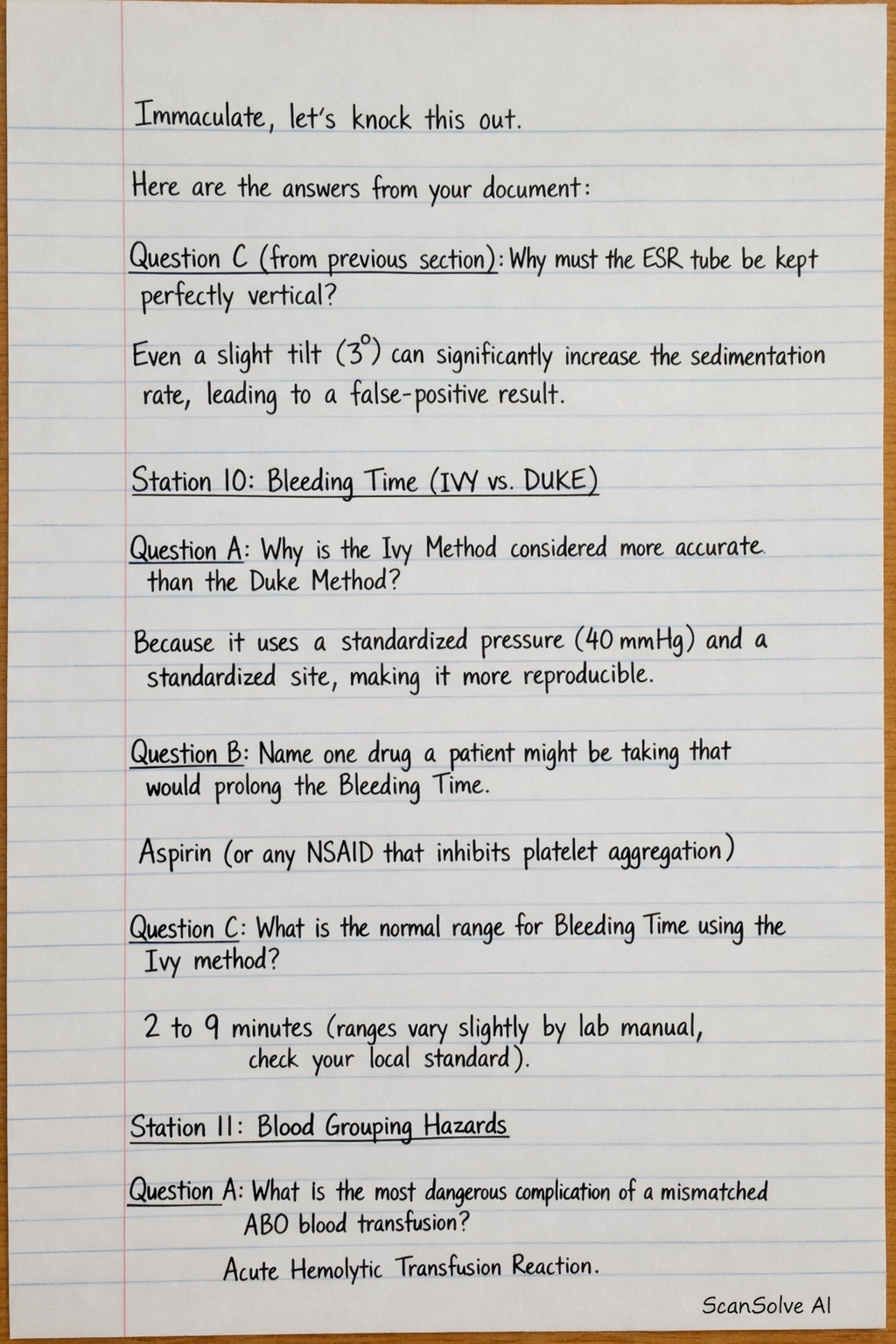
Immaculate, let's knock this out. Here are the answers from your document: Question C (from previous section): Why must the ESR tube be kept perfectly vertical? Even a slight tilt (3^) can significantly increase the sedimentation rate, leading to a false-positive result. Station 10: Bleeding Time (IVY vs. DUKE) Question A: Why is the Ivy Method considered more accurate than the Duke Method? Because it uses a standardized pressure (40 mmHg) and a standardized site, making it more reproducible. Question B: Name one drug a patient might be taking that would prolong the Bleeding Time. Aspirin (or any NSAID that inhibits platelet aggregation). Question C: What is the normal range for Bleeding Time using the Ivy method? 2 to 9 minutes (ranges vary slightly by lab manual, check your local standard). Station 11: Blood Grouping Hazards Question A: What is the most dangerous complication of a mismatched ABO blood transfusion? Acute Hemolytic Transfusion Reaction. Question B: Define "Agglutination" and distinguish it from "Coagulation." Agglutination is the clumping of particles (antigen-antibody reaction). Coagulation is the chemical process of forming a fibrin clot. Question C: Why do we use a white tile for the grouping practical? To provide maximum contrast so that the red clumps (agglutinates) are easily visible against the white background. Send me the next one 📸