
We read your photo as:
What are the parts labelled X and Y? One of the disadvantages of keeping livestock together is that it:
Biology
ScanSolve AI Answer
Answer
A
Step-by-step solution
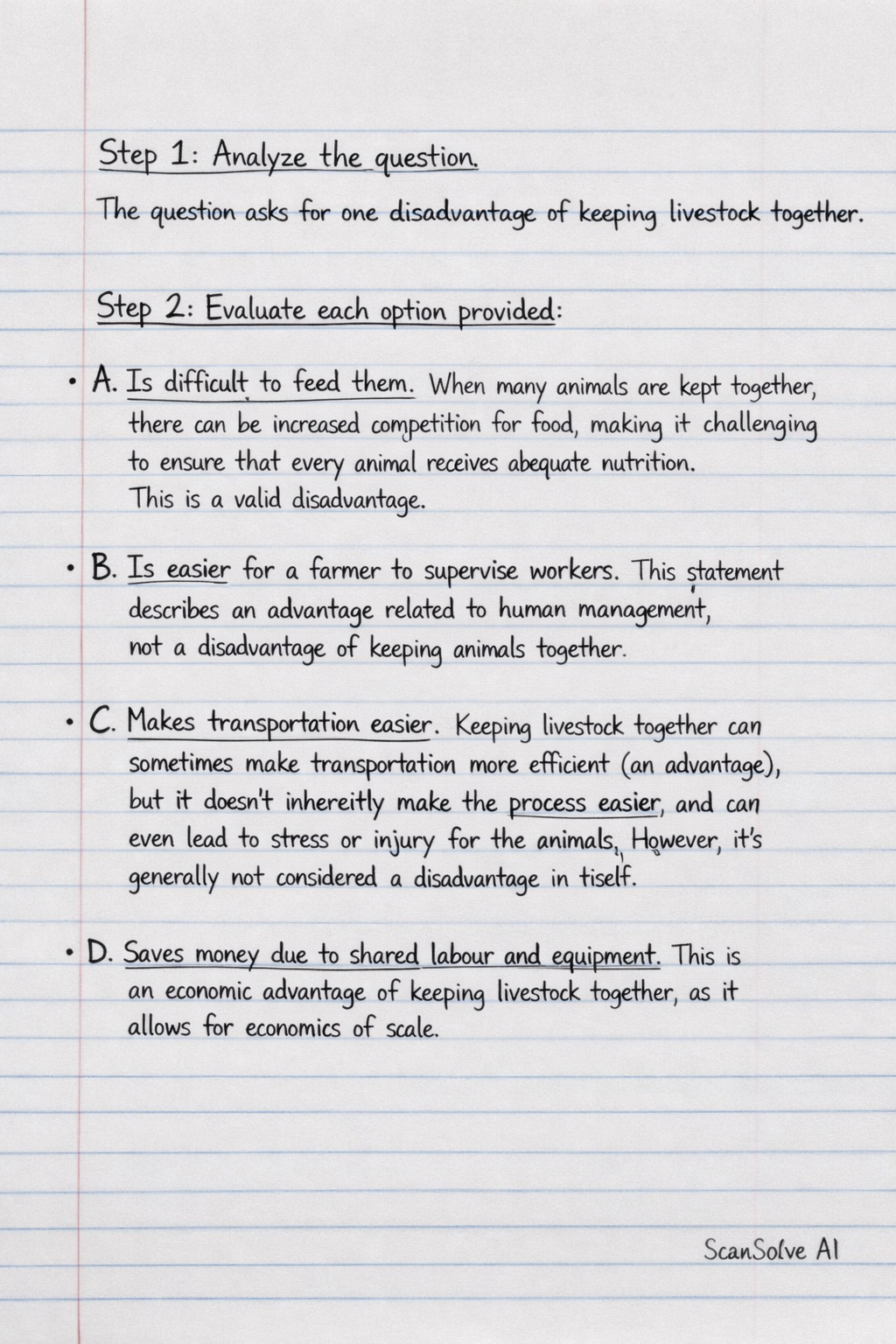
3 stepsAnalyze the question.
The question asks for one disadvantage of keeping livestock together.
Evaluate each option provided.
- A. Is difficult to feed them. When many animals are kept together, there can be increased competition for food, making it challenging to ensure that every animal receives adequate nutrition. This is a valid disadvantage.
- B. Is easier for a farmer to supervise workers. This statement describes an advantage related to human management, not a disadvantage of keeping animals together.
- C. Makes transportation easier. Keeping livestock together can sometimes make transportation more efficient (an advantage), but it doesn't inherently make the process easier, and can even lead to stress or injury for the animals. However, it's generally not considered a disadvantage in itself.
- D. Saves money due to shared labour and equipment. This is an economic advantage of keeping livestock together, as it allows for economies of scale.
Identify the correct disadvantage.
Based on the analysis, the only option that presents a clear disadvantage of keeping livestock together is the difficulty in ensuring all animals are properly fed due to competition or logistical challenges. Other significant disadvantages, such as the rapid spread of diseases, are not listed as options.
The correct option is A.
Was this helpful?
Try one yourself
A new problem that tests the same skill.
Still stuck on this one?
Ask a follow-up, and the answer starts from this question.
Got a different question?Ask your own question
More Biology Questions
QWhich of the following is a major advantage of inbreeding in farm animals?QName the management practice and its advantages for part X (Spur) of a rooster. Name an…QPractical questions about reproductive systems in farm animalsQWhich one of the following is not one of the disadvantages of zoos and captive breeding programmes…QQuestions about chickens: a) Identify parts Y, X, Z. b) Mark a wing with W. c) State functions of Z…
Handwritten Step-by-Step Solution
Get this as a handwritten image on WhatsApp — like a tutor wrote it for you.
Try on WhatsApp