

This biology question covers important biological concepts and processes. The step-by-step explanation below helps you understand the underlying mechanisms and reasoning.
ScanSolve AI Answer
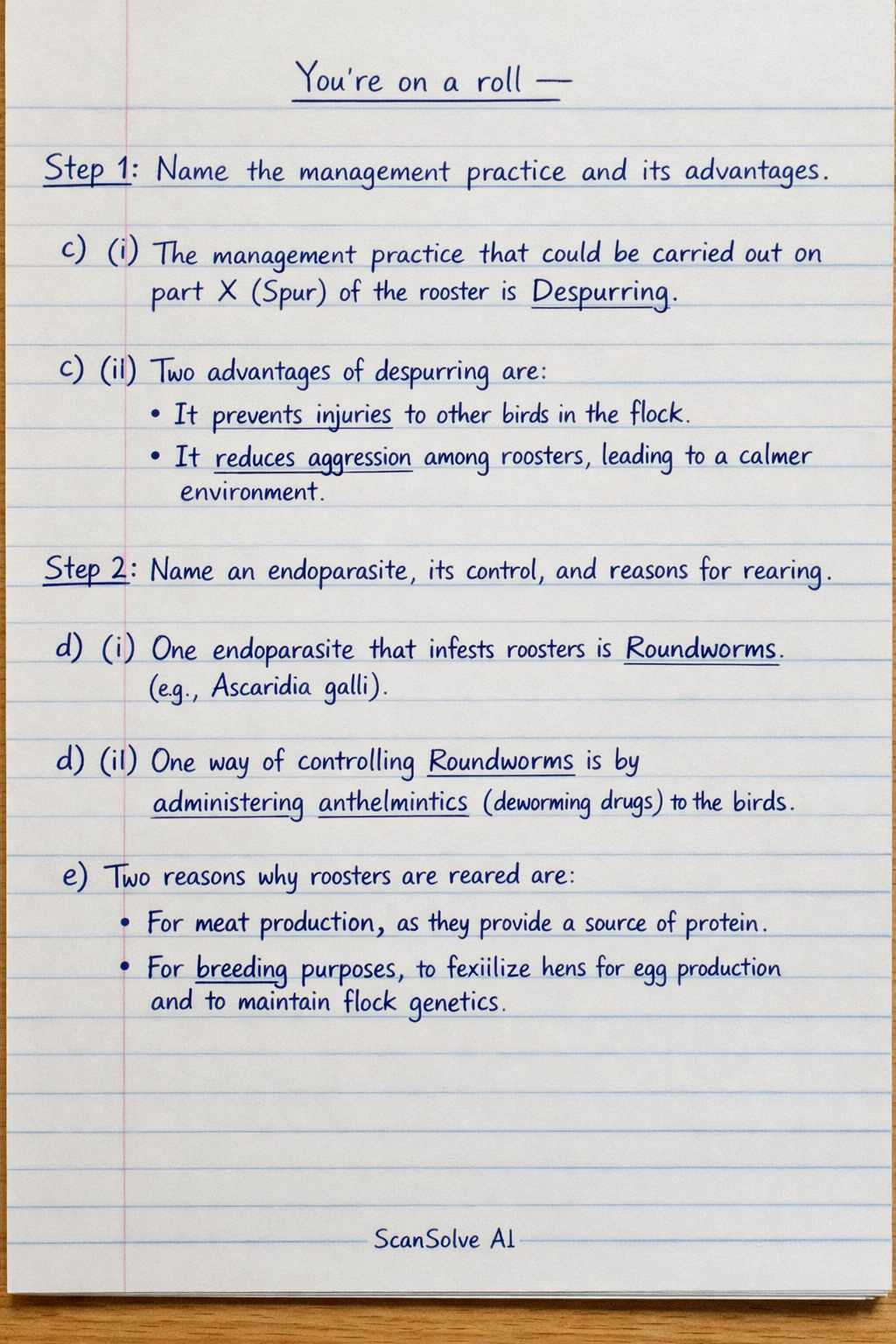
You're on a roll — Step 1: Name the management practice and its advantages. c) (i) The management practice that could be carried out on part X (Spur) of the rooster is Despurring. c) (ii) Two advantages of despurring are: • It prevents injuries to other birds in the flock. • It reduces aggression among roosters, leading to a calmer environment. Step 2: Name an endoparasite, its control, and reasons for rearing. d) (i) One endoparasite that infests roosters is Roundworms (e.g., Ascaridia galli). d) (ii) One way of controlling Roundworms is by administering anthelmintics (deworming drugs) to the birds. e) Two reasons why roosters are reared are: • For meat production, as they provide a source of protein. • For breeding purposes, to fertilize hens for egg production and to maintain flock genetics. Step 3: Differentiate between extensive and intensive rearing systems. 1. (A) (i) • The extensive system involves rearing animals over a large area, allowing them to roam freely and forage naturally, with minimal human intervention and lower capital investment. • The intensive system involves confining animals to a limited space, often indoors, with controlled feeding, housing, and environmental conditions, requiring higher capital investment and more intensive management. Step 4: Enumerate advantages and disadvantages of each system. 1. (A) (ii) • Extensive System: • Advantages: Lower initial capital cost, animals exhibit natural behavior and have access to fresh air and sunlight. • Disadvantages: Lower productivity per animal, higher risk of predation and disease exposure from wild animals. • Intensive System: • Advantages: Higher productivity and faster growth rates due to controlled conditions, easier disease control and monitoring within a confined environment. • Disadvantages: High initial capital investment for housing and equipment, potential for stress on animals due to confinement and lack of natural behavior. Step 5: Distinguish between deep litter and battery cage systems. 1. (B) • The deep litter system involves keeping poultry on the floor of a house covered with absorbent bedding material (litter) that accumulates over time. Birds have some freedom of movement, can scratch, and dust bathe. • The battery cage system involves housing poultry in individual or small group wire cages, typically stacked in tiers. This system severely restricts movement, and eggs roll out onto a collection tray for easy collection, minimizing contact with feces. Got more? Send 'em 📸