
We read your photo as:
The problem states that both parents have sickle cell trait. This means they are heterozygous for the gene.
ScanSolve AI Answer
Answer
Step-by-step solution
4 stepsHere is the working for the sickle cell anaemia question:
Part a· 4 steps
Proportion of offspring with sickle cell anaemia
Identify the genotypes of the parents.
The problem states that both parents have sickle cell trait. This means they are heterozygous for the gene.
Let H represent the gene for normal haemoglobin and S represent the gene for abnormal haemoglobin.
Parent 1 genotype: HS
Parent 2 genotype: HSConstruct a Punnett square to determine the possible genotypes of the offspring.
Determine which genotype results in sickle cell anaemia.
Sickle cell anaemia occurs in individuals who are homozygous for the abnormal haemoglobin gene, which is the SS genotype.
Calculate the proportion of offspring with sickle cell anaemia.
From the Punnett square, there are 4 possible outcomes for the offspring's genotypes: HH, HS, HS, SS.
One out of these four outcomes is SS.
Therefore, the proportion of offspring with sickle cell anaemia is .The proportion of their offspring that have sickle cell anaemia is .
Part b
Explanation for prevalence of sickle cell trait in tropical countries
Sickle cell trait (HS genotype) is more prevalent in tropical countries because it offers a survival advantage against malaria. These regions often have a high incidence of malaria, a parasitic disease. Individuals with the sickle cell trait are resistant to malaria because the presence of some abnormal haemoglobin makes their red blood cells less hospitable for the malaria parasite. This resistance increases their chances of survival and reproduction in malaria-prone areas, leading to a higher frequency of the sickle cell allele in the population through natural selection.
Try one yourself
A new problem that tests the same skill.
Still stuck on this one?
Ask a follow-up, and the answer starts from this question.
More Biology Questions
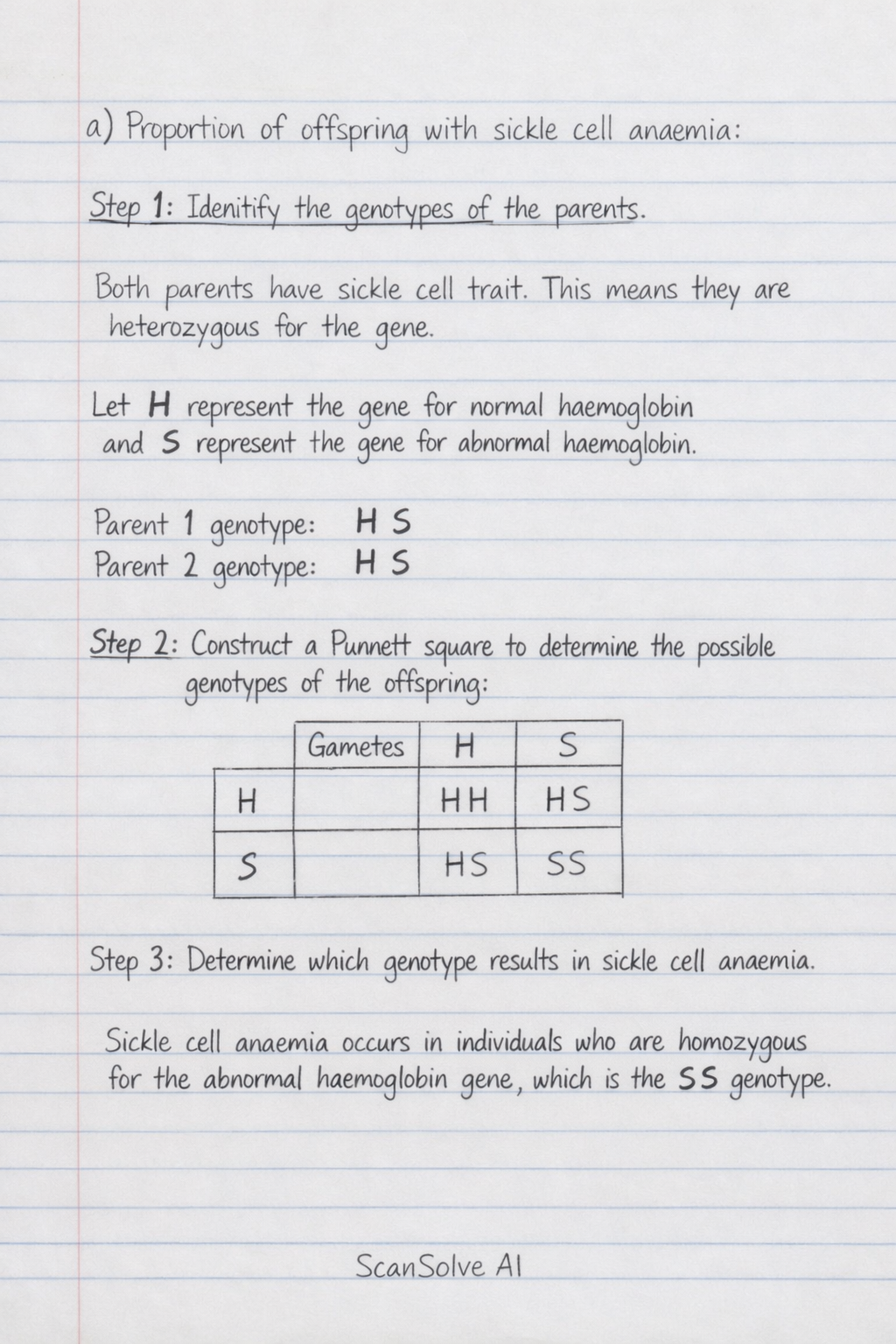
Handwritten Step-by-Step Solution
Get this as a handwritten image on WhatsApp — like a tutor wrote it for you.
Try on WhatsApp