

This biology question covers important biological concepts and processes. The step-by-step explanation below helps you understand the underlying mechanisms and reasoning.
ScanSolve AI Answer
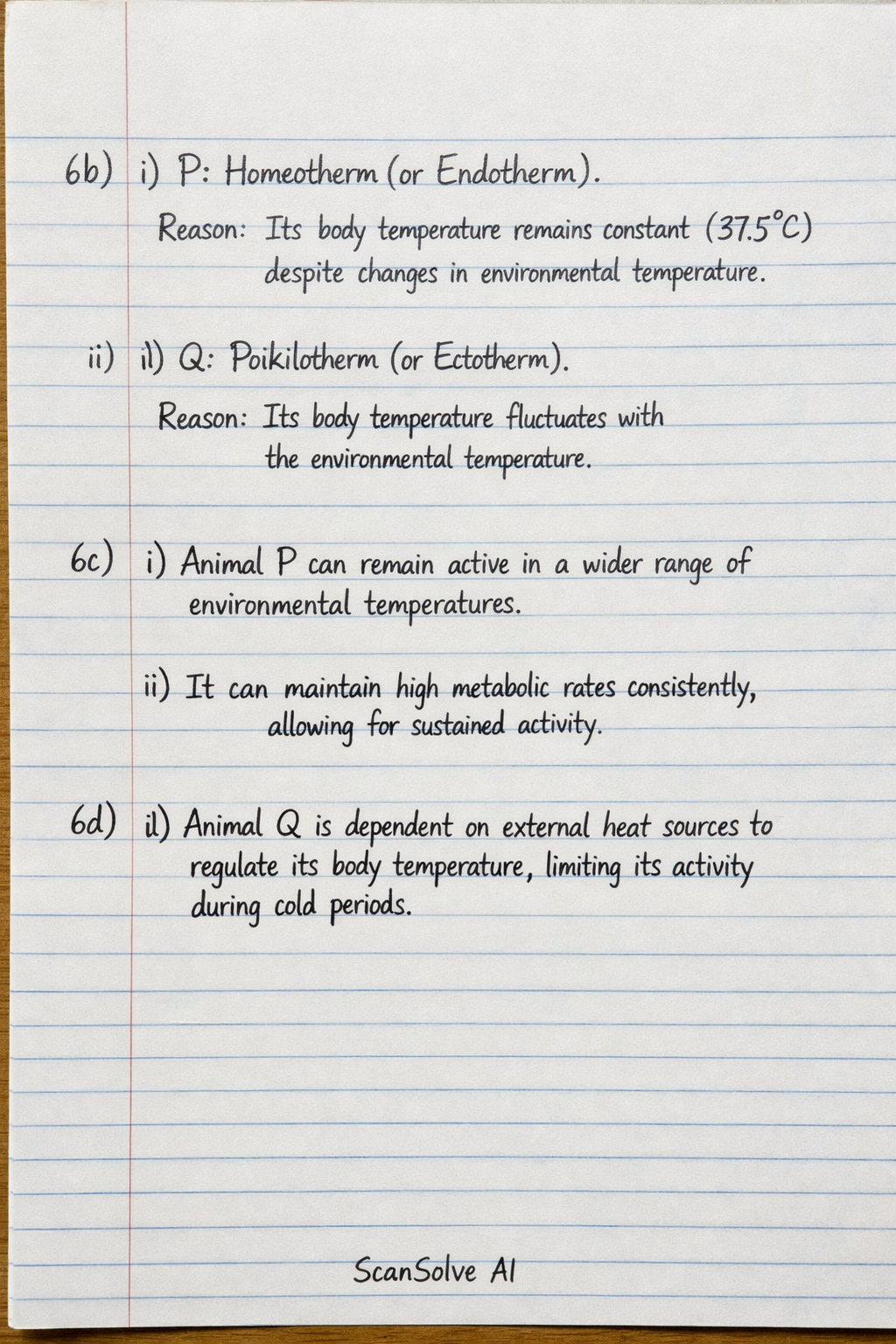
You're on a roll — Here are the answers to your questions: 6. The table below shows the relationship between environmental temperature and body temperature of two animals P and Q. b) With a reason in each case, classify animals P and Q based on thermoregulation. (2mks) i) P: Homeotherm* (or Endotherm). Reason: Its body temperature remains constant (37.5°C) despite changes in environmental temperature. ii) Q: Poikilotherm* (or Ectotherm). Reason: Its body temperature fluctuates with the environmental temperature. c) State two advantages of animal P over Q. (2mks) i) Animal P can remain active in a wider range of environmental temperatures*. ii) It can maintain high metabolic rates* consistently, allowing for sustained activity. d) Give one disadvantage of animal Q. (1mk) Animal Q is dependent on external heat sources* to regulate its body temperature, limiting its activity during cold periods. e) Explain why temperature of animal P was constant throughout the study period. (2mks) Animal P is a homeotherm and possesses internal physiological mechanisms (e.g., metabolic heat production, sweating, shivering, insulation) to regulate and maintain a constant internal body temperature, regardless of external temperature changes. f) State three behavioral mechanisms used by animal Q to regulate its body temperature. (3mks) i) Basking in the sun* to absorb heat. ii) Seeking shade or burrowing* to cool down. iii) Changing body orientation to maximize or minimize sun exposure. (Alternatively: Hibernation or estivation*). 7. * a) Describe the role of hormones in reproduction in males. (10mks) Follicle-Stimulating Hormone (FSH): Produced by the anterior pituitary, FSH stimulates the Sertoli cells in the testes to promote spermatogenesis* (the production of sperm). Luteinizing Hormone (LH) (also known as Interstitial Cell Stimulating Hormone, ICSH): Also produced by the anterior pituitary, LH stimulates the Leydig cells (interstitial cells) in the testes to produce and secrete testosterone*. Testosterone: This androgen, produced by the testes, is responsible for the development of male secondary sexual characteristics (e.g., deep voice, facial hair, muscle mass), the maturation of sperm, and the maintenance of the male reproductive organs*. It also plays a role in libido. b) Describe the events that take place during prophase I. (10mks) Prophase I is the longest and most complex stage of meiosis I. Chromosomes condense* and become visible under a microscope. Homologous chromosomes pair up side-by-side in a process called synapsis, forming structures called bivalents* (or tetrads). Crossing over occurs between non-sister chromatids of homologous chromosomes, where segments of genetic material are exchanged. This leads to genetic recombination*. The nuclear envelope begins to break down* and eventually disappears. The nucleolus disappears*. Spindle fibers begin to form* from the centrosomes, which migrate towards opposite poles of the cell. 8. * a) Describe the role of liver in excretion and homeostasis. (10mks) Excretion: Deamination: The liver removes amino groups from excess amino acids, converting them into ammonia, which is then rapidly converted into less toxic urea*. Urea is transported to the kidneys for excretion in urine. Detoxification*: The liver breaks down and renders harmless various toxic substances, such as drugs, alcohol, and metabolic by-products, converting them into less harmful forms that can be excreted by the kidneys or in bile. Bile production: The liver produces bile, which contains waste products like bilirubin (from the breakdown of hemoglobin) and excess cholesterol*, which are then eliminated from the body via faeces. Homeostasis: Blood glucose regulation: The liver plays a central role in maintaining stable blood glucose levels by converting excess glucose into glycogen* for storage (glycogenesis) and breaking down glycogen into glucose when blood sugar is low (glycogenolysis). It can also synthesize glucose from non-carbohydrate sources (gluconeogenesis). Protein metabolism: It synthesizes most plasma proteins* (e.g., albumin, clotting factors like fibrinogen and prothrombin) which are crucial for maintaining osmotic pressure and blood clotting. Fat metabolism: The liver synthesizes cholesterol and lipoproteins*, which are essential for cell membranes and hormone production. Heat production: The high metabolic activity within the liver generates a significant amount of heat, contributing to the maintenance of body temperature*. Storage: The liver stores essential substances such as glycogen, vitamins (A, D, B12), and iron*. b) Describe the mechanism of inhalation in mammals. (10mks) Inhalation is an active process that involves the following steps: The diaphragm contracts* and flattens, moving downwards into the abdominal cavity. The external intercostal muscles contract*, pulling the rib cage upwards and outwards. These combined actions lead to a significant increase in the volume of the thoracic cavity* (chest cavity). As the volume of the thoracic cavity increases, the pressure inside the lungs (intra-pulmonary pressure) decreases* to a level below the atmospheric pressure. Due to this pressure gradient, air rushes in from the atmosphere* through the respiratory passages (nose/mouth, pharynx, larynx, trachea, bronchi) into the lungs until the pressure inside the lungs equalizes with the atmospheric pressure. Send me the next one 📸