
We read your photo as:
The target organ of FSH (Follicle Stimulating Hormone) in females is the ovary.
ScanSolve AI Answer
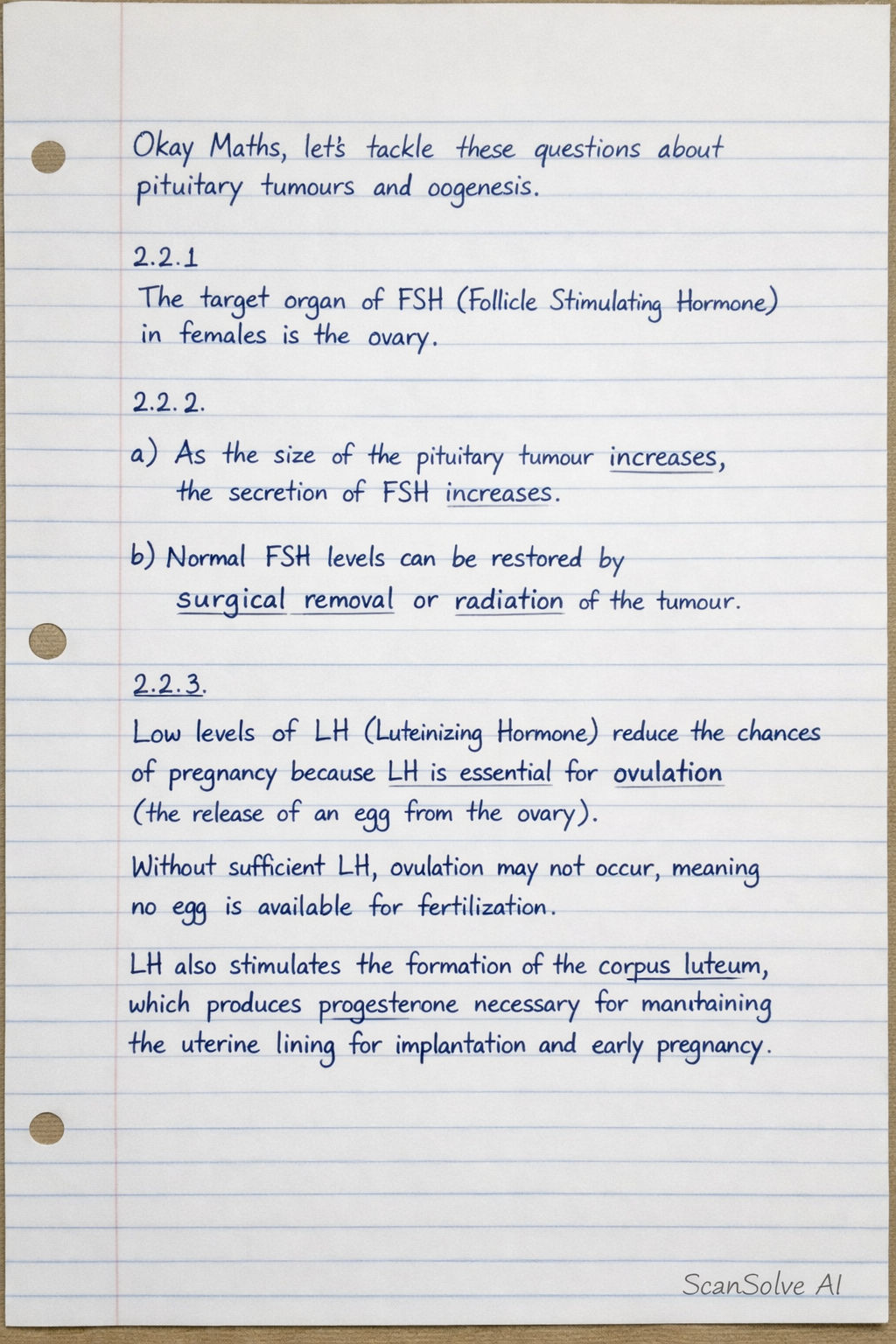
Okay Maths, let's tackle these questions about pituitary tumours and oogenesis.
2.2.1
The target organ of FSH (Follicle Stimulating Hormone) in females is the ovary.
2.2.2
- a) As the size of the pituitary tumour increases, the secretion of FSH increases.
- b) Normal FSH levels can be restored by surgical removal or radiation of the tumour.
2.2.3
Low levels of LH (Luteinizing Hormone) reduce the chances of pregnancy because LH is essential for ovulation (the release of an egg from the ovary). Without sufficient LH, ovulation may not occur, meaning no egg is available for fertilization. LH also stimulates the formation of the corpus luteum, which produces progesterone necessary for maintaining the uterine lining for implantation and early pregnancy.
2.2.4
High levels of FSH are normally controlled in a female through a negative feedback mechanism. As ovarian follicles develop under FSH stimulation, they produce estrogen and inhibin. These hormones then act on the pituitary gland to inhibit further release of FSH, thus regulating its levels.
2.3 Describe the process of oogenesis.
Oogenesis is the process of forming female gametes (ova) in the ovaries.
- Oogonia (diploid stem cells) in the fetal ovary undergo mitosis to increase in number.
- These oogonia develop into primary oocytes, which begin meiosis I but arrest in prophase I before birth.
- From puberty, one primary oocyte per month completes meiosis I, forming a secondary oocyte (haploid) and a first polar body.
- The secondary oocyte begins meiosis II but arrests in metaphase II.
- If fertilization occurs, the secondary oocyte completes meiosis II, forming a mature ovum (haploid) and a second polar body.
Still stuck on this one?
Ask a follow-up, and the answer starts from this question.
More Biology Questions
Handwritten Step-by-Step Solution
Get this as a handwritten image on WhatsApp — like a tutor wrote it for you.
Try on WhatsApp