
We read your photo as:
This image contains notes on Animal Tissues. It is not a question.
Biology
ScanSolve AI Answer
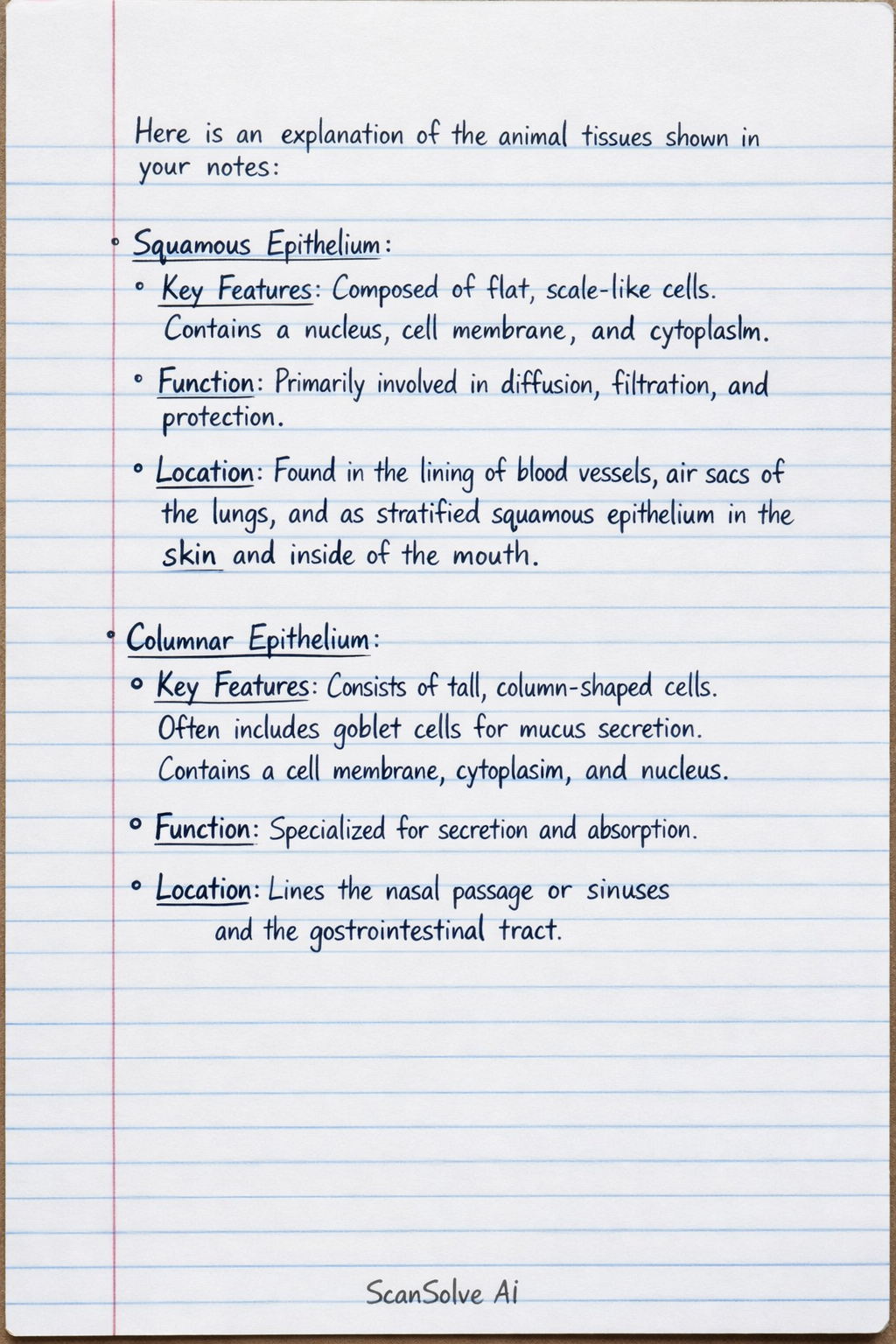
Here is an explanation of the animal tissues shown in your notes:
-
Squamous Epithelium:
- Key Features: Composed of flat, scale-like cells. Contains a nucleus, cell membrane, and cytoplasm.
- Function: Primarily involved in diffusion, filtration, and protection.
- Location: Found in the lining of blood vessels, air sacs of the lungs, and as stratified squamous epithelium in the skin and inside of the mouth.
-
Columnar Epithelium:
- Key Features: Consists of tall, column-shaped cells. Often includes goblet cells for mucus secretion. Contains a cell membrane, cytoplasm, and nucleus.
- Function: Specialized for secretion and absorption.
- Location: Lines the nasal passage or sinuses and the gastrointestinal tract.
-
Ciliated Epithelium:
- Key Features: A type of columnar or cuboidal epithelium characterized by the presence of cilia (hair-like projections) on its surface. Contains a cell membrane and nucleus.
- Function: The cilia beat in a coordinated rhythm to move mucus or other substances along the surface.
- Location: Commonly found in the trachea and bronchi (respiratory tract) to sweep away dust and pathogens, and in the fallopian tubes to move eggs.
-
Cuboidal Epithelium:
- Key Features: Made up of cube-shaped cells. Contains a cell membrane, nucleus, and cytoplasm.
- Function: Primarily involved in secretion and absorption.
- Location: Forms the lining of glands and kidney tubules.
Was this helpful?
Still stuck on this one?
Ask a follow-up, and the answer starts from this question.
Got a different question?Ask your own question
More Biology Questions
QCan you provide answers to these biology questions from an image?QI need lectures notes on tissues in anatomyQFig 1 shows a plant tissue obtained from a stem. Use it to answer the questions that follow.QThe image contains multiple biology questions about animal classification…
Browse by topic:Anatomy
Handwritten Step-by-Step Solution
Get this as a handwritten image on WhatsApp — like a tutor wrote it for you.
Try on WhatsApp