
We read your photo as:
The image contains multiple biology questions about animal classification (vertebrates/invertebrates) and camouflage. What are the specific questions asked?
ScanSolve AI Answer
Answer
Here are the solutions to the questions from the image:
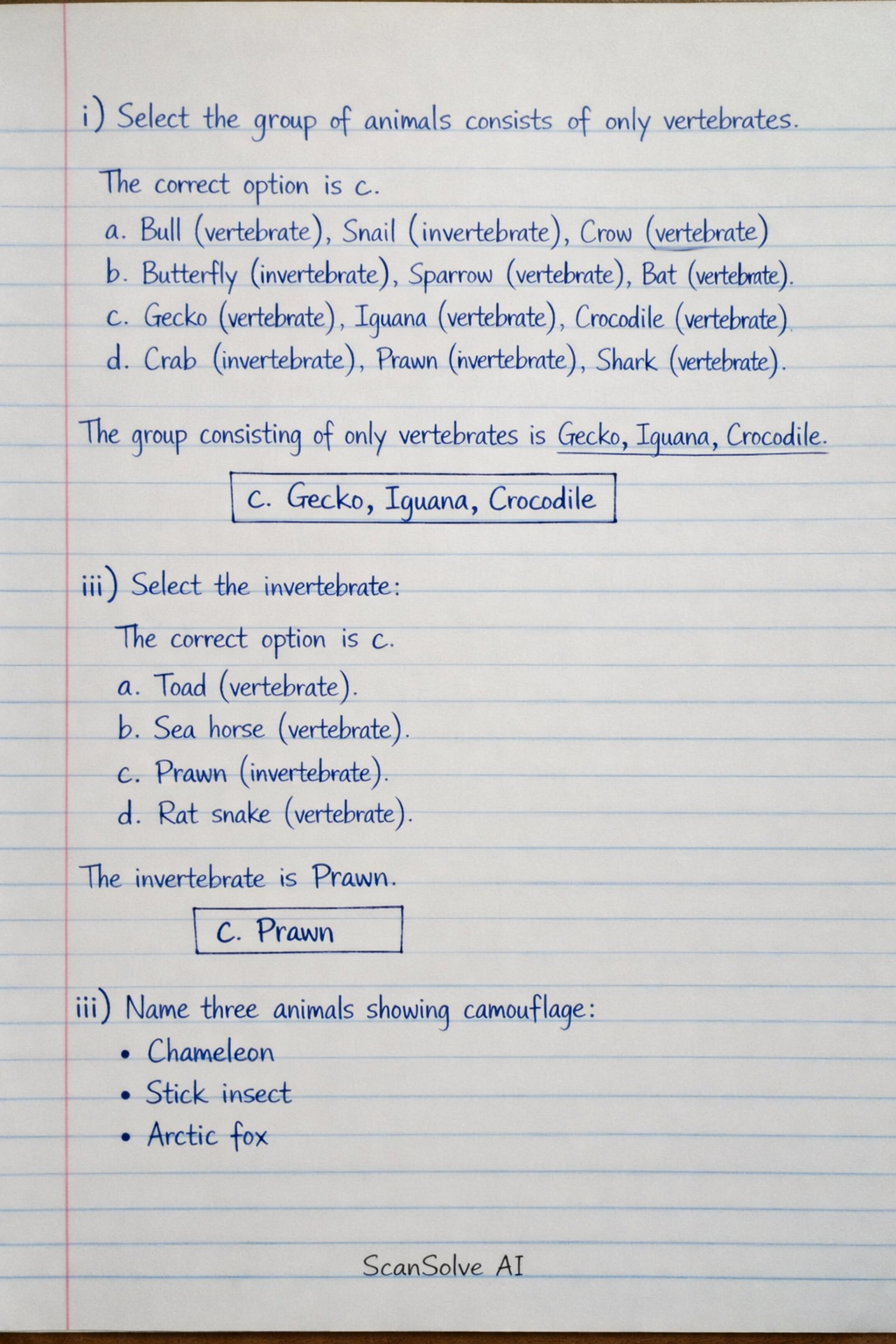
i) Select the group of animals consists of only vertebrates.
The correct option is c.
- a. Bull (vertebrate), Snail (invertebrate), Crow (vertebrate)
- b. Butterfly (invertebrate), Sparrow (vertebrate), Bat (vertebrate)
- c. Gecko (vertebrate), Iguana (vertebrate), Crocodile (vertebrate)
- d. Crab (invertebrate), Prawn (invertebrate), Shark (vertebrate)
The group consisting of only vertebrates is Gecko, Iguana, Crocodile.
ii) Select the invertebrate;
The correct option is c.
- a. Toad (vertebrate)
- b. Sea horse (vertebrate)
- c. Prawn (invertebrate)
- d. Rat snake (vertebrate)
The invertebrate is Prawn.
i) Name three animals showing camouflage.
- Chameleon
- Stick insect
- Arctic fox
ii) State three advantages of camouflage with examples.
- Predator avoidance: Camouflage helps animals blend into their surroundings, making it difficult for predators to spot them.
- Example: A chameleon changes its skin color to match the leaves or branches it is on, hiding from birds of prey.
- Prey capture: Predators use camouflage to hide from their prey, allowing them to ambush or stalk without being detected.
- Example: A polar bear's white fur blends with the snow, enabling it to sneak up on seals.
- Protection of young/nests: Camouflage can protect vulnerable young or eggs by making their nesting sites less conspicuous.
- Example: Many ground-nesting birds have speckled eggs and dull plumage that blend with the surrounding vegetation and soil.
Write two adaptations shown by the below mentioned animals, to their living environment.
-
Fish:
- Presence of fins (for movement and steering in water)
- Streamlined shape (reduces drag for efficient movement through water)
-
Whip snake:
- Long, slender body (allows it to mimic branches and move through foliage)
- Camouflage (green or brown coloration to blend with leaves and twigs)
-
Bird:
- Wings (for flight, enabling movement across large distances and access to food/nesting sites)
- Hollow bones (reduces body weight, making flight more energy-efficient)
-
Millipede:
- Hard exoskeleton (provides protection from predators and prevents water loss in damp environments)
- Many legs (allows for slow, steady movement over uneven surfaces like leaf litter)
-
Mantis:
- Camouflage (body shape and color often mimic leaves or twigs, helping it hide from prey and predators)
- Raptorial forelegs (specialized for quickly grasping and holding prey)
-
Caterpillar:
- Mandibles (strong mouthparts for chewing and consuming plant material)
- Camouflage (green or brown coloration to blend with the plants it feeds on)
Try one yourself
A new problem that tests the same skill.
Still stuck on this one?
Ask a follow-up, and the answer starts from this question.
More Biology Questions
Handwritten Step-by-Step Solution
Get this as a handwritten image on WhatsApp — like a tutor wrote it for you.
Try on WhatsApp