
We read your photo as:
This image displays the components of a Comet 3-Gas Welding, Cutting and Heating Plant.
Biology
ScanSolve AI Answer
This image displays the components of a Comet 3-Gas Welding, Cutting and Heating Plant.
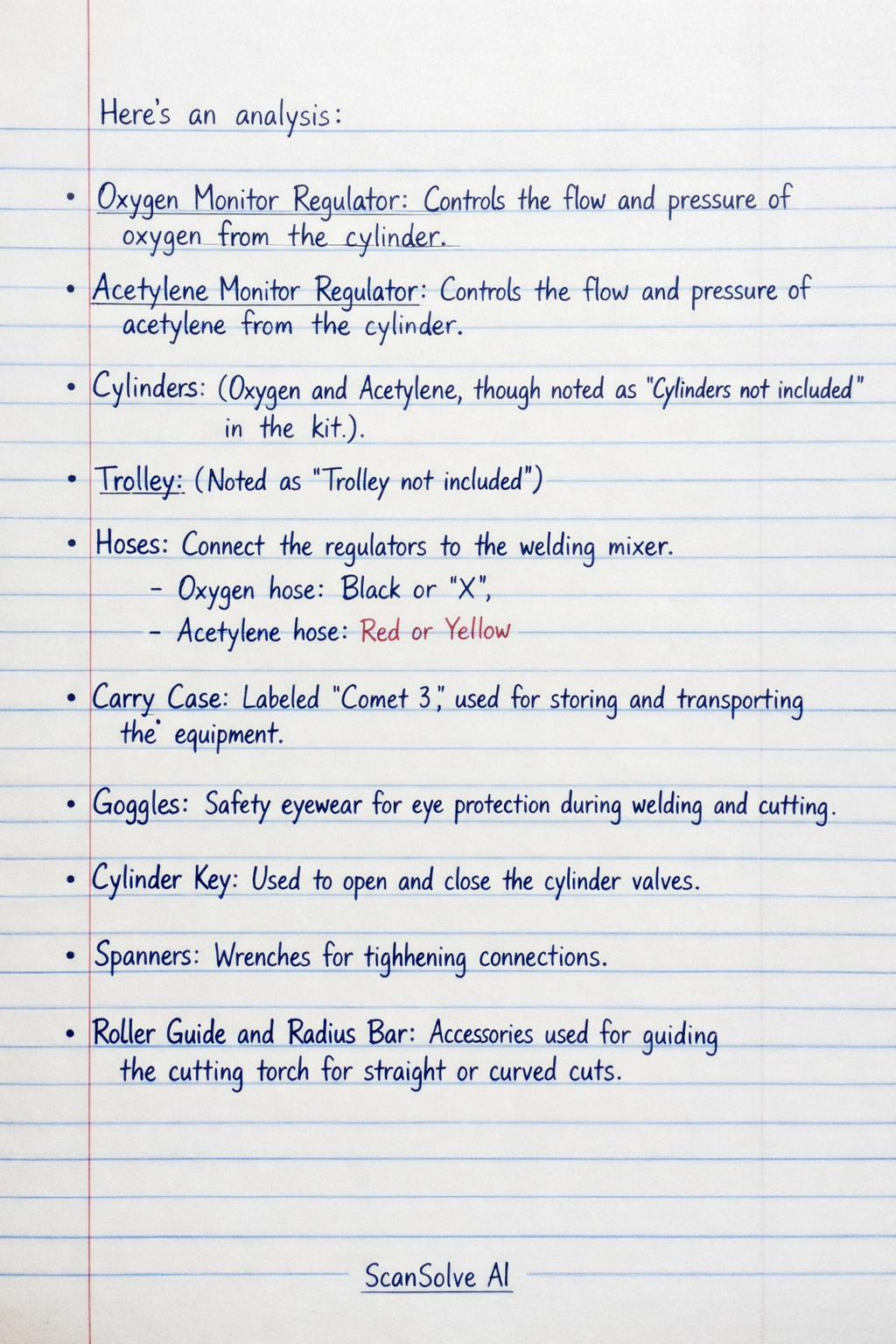
Here are the main components shown and labeled in the diagram:
- Oxygen Monitor Regulator: Controls the flow and pressure of oxygen from the cylinder.
- Acetylene Monitor Regulator: Controls the flow and pressure of acetylene from the cylinder.
- Cylinders: (Oxygen and Acetylene, though noted as "Cylinders not included" in the kit).
- Trolley: (Noted as "Trolley not included").
- Hoses: Connect the regulators to the welding mixer. (Handwritten notes indicate "Oxygen hose Black or X" and "Acetylene hose Red or Yellow").
- Carry Case: Labeled "Comet 3", used for storing and transporting the equipment.
- Goggles: Safety eyewear for eye protection during welding and cutting.
- Cylinder Key: Used to open and close the cylinder valves.
- Spanners: Wrenches for tightening connections.
- Roller Guide and Radius Bar: Accessories used for guiding the cutting torch for straight or curved cuts.
- Piezo Lighter: A spark lighter used to ignite the gas mixture.
- Tip Cleaner: Small tools used to clean the orifices of welding and cutting tips.
- Welding Tips: Various sizes for different welding applications.
- Heating Tip: A specialized tip for heating metal.
- Blowpipe: The main body of the torch, where the gas mixture is delivered to the tip.
- Welding Mixer: The part of the blowpipe where oxygen and acetylene are mixed before combustion.
- Cutting Nozzle: A specialized tip for cutting operations.
- Cutting Attachment: An accessory that converts the blowpipe into a cutting torch.
Was this helpful?
Still stuck on this one?
Ask a follow-up, and the answer starts from this question.
Got a different question?Ask your own question
More Biology Questions
QThis diagram illustrates the various attachments and components of the Comet 3-Gas Welding, Cutting…QThis image outlines important Safety Precautions for using the welding, cutting, and heating plant…QThe components of Air used by welder isQThe Component of air used by welders isQWhat are the labeled parts of this Manual Metal Arc Welding (MMAW) diagram?
Handwritten Step-by-Step Solution
Get this as a handwritten image on WhatsApp — like a tutor wrote it for you.
Try on WhatsApp