

This biology question covers important biological concepts and processes. The step-by-step explanation below helps you understand the underlying mechanisms and reasoning.
ScanSolve AI Answer
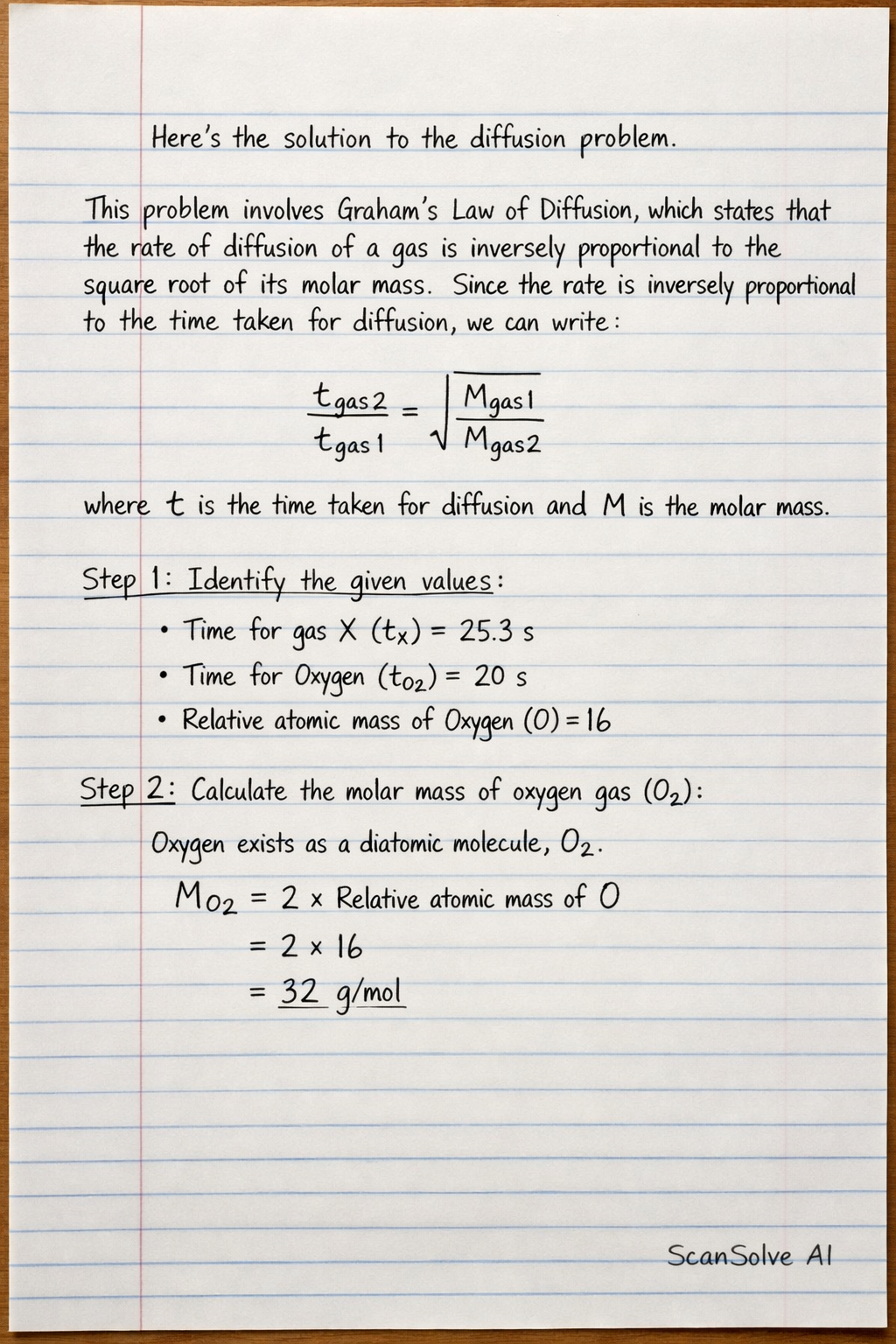
Here's the solution to the diffusion problem. This problem involves Graham's Law of Diffusion, which states that the rate of diffusion of a gas is inversely proportional to the square root of its molar mass. Since the rate is inversely proportional to the time taken for diffusion, we can write: t_gas 2t_gas 1 = sqrt(M)_gas 1M_gas 2 where t is the time taken for diffusion and M is the molar mass. Step 1: Identify the given values. • Time for gas X (t_X) = 25.3 s • Time for Oxygen (t_O_2) = 20 s • Relative atomic mass of Oxygen (O) = 16 Step 2: Calculate the molar mass of oxygen gas (O_2). Oxygen exists as a diatomic molecule, O_2. M_O_2 = 2 × Relative atomic mass of O = 2 × 16 = 32 g/mol Step 3: Apply Graham's Law of Diffusion. Let gas 1 be Oxygen (O_2) and gas 2 be the unknown gas X. t_Xt_O_2 = sqrt(M)_XM_O_2 Substitute the known values into the equation: 25.3 s20 s = sqrt(M)_X32 g/mol Step 4: Solve for the molecular mass of gas X (M_X). First, calculate the ratio of the times: 1.265 = sqrt(M)_X32 Square both sides of the equation to remove the square root: (1.265)^2 = M_X32 1.600225 = M_X32 Now, multiply by 32 to find M_X: M_X = 1.600225 × 32 M_X = 51.2072 g/mol Rounding to three significant figures, the molecular mass of gas X is 51.2 g/mol. The molecular mass of gas X is 51.2 g/mol. That's 2 down. 3 left today — send the next one.