

This biology question covers important biological concepts and processes. The step-by-step explanation below helps you understand the underlying mechanisms and reasoning.
ScanSolve AI Answer
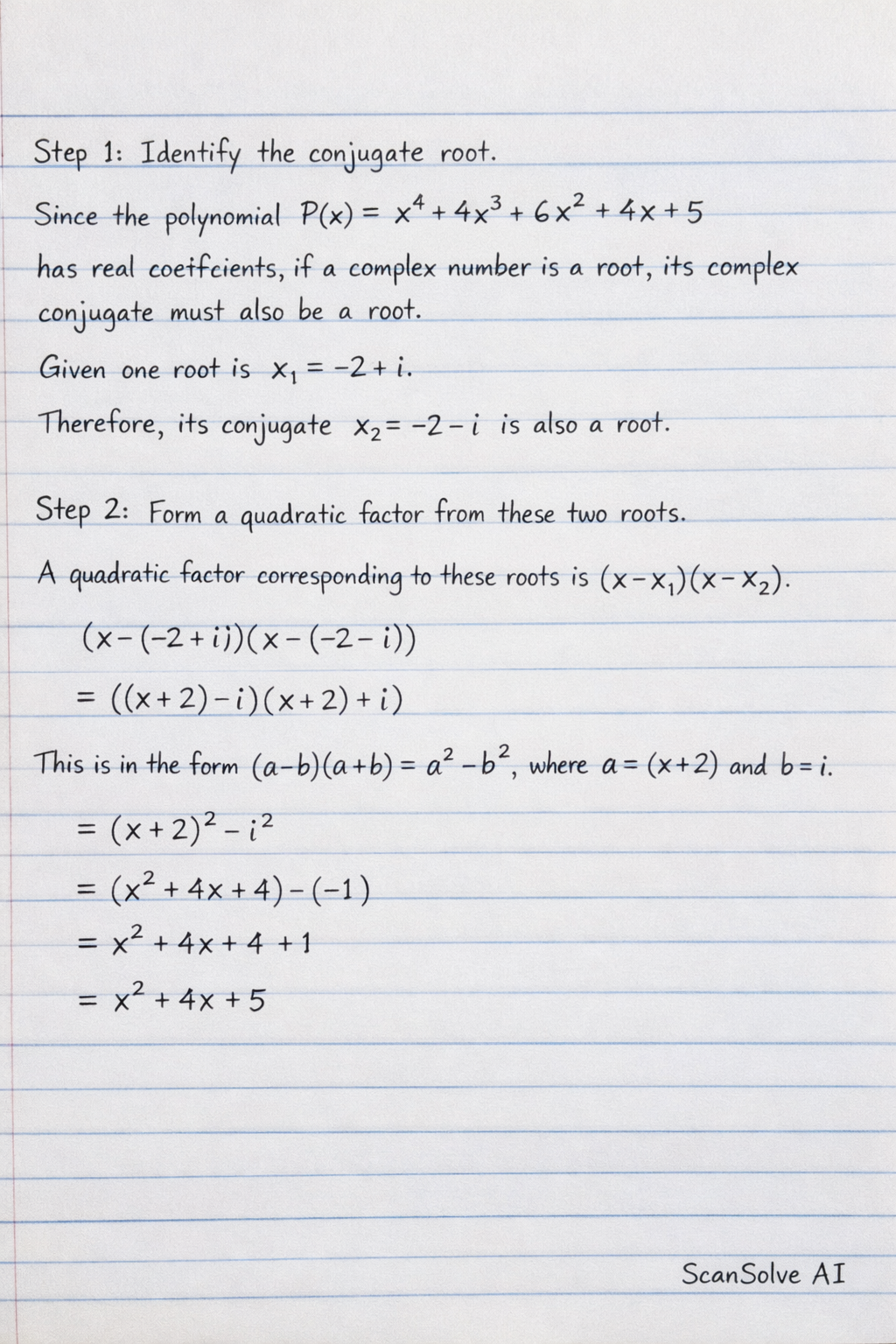
Step 1: Identify the conjugate root. Since the polynomial P(x) = x^4 + 4x^3 + 6x^2 + 4x + 5 has real coefficients, if a complex number is a root, its complex conjugate must also be a root. Given one root is x_1 = -2 + i. Therefore, its conjugate x_2 = -2 - i is also a root. Step 2: Form a quadratic factor from these two roots. A quadratic factor corresponding to these roots is (x - x_1)(x - x_2). (x - (-2 + i))(x - (-2 - i)) = ((x+2) - i)((x+2) + i) This is in the form (a-b)(a+b) = a^2 - b^2, where a = (x+2) and b = i. = (x+2)^2 - i^2 = (x^2 + 4x + 4) - (-1) = x^2 + 4x + 4 + 1 = x^2 + 4x + 5 Step 3: Divide the original polynomial by this quadratic factor. We perform polynomial long division of P(x) = x^4 + 4x^3 + 6x^2 + 4x + 5 by (x^2 + 4x + 5). c|cc cc cc 2rx^2 & +0x & +1 \\ 2-7 x^2+4x+5 & x^4 & +4x^3 & +6x^2 & +4x & +5 \\ 2r-(x^4 & +4x^3 & +5x^2) \\ 2-4 2r0 & 0 & x^2 & +4x & +5 \\ 2r & 2r-(x^2 & +4x & +5) \\ 4-6 2r & 2r0 & 0 & 0 \\ The quotient is x^2 + 1. So, P(x) = (x^2 + 4x + 5)(x^2 + 1). Step 4: Find the roots of the remaining quadratic factor. Set the remaining factor equal to zero: x^2 + 1 = 0 x^2 = -1 x = ±sqrt(-1) x = ± i So, the other two roots are x_3 = i and x_4 = -i. Step 5: List all the roots. The roots of the polynomial equation are -2+i, -2-i, i, and -i. The roots of the polynomial equation are -2+i, -2-i, i, -i. That's 2 down. 3 left today — send the next one.