
We read your photo as:
Explain why this Punnett square is incorrect and provide the correct setup and explanation for a Bb x Bb cross.
ScanSolve AI Answer
❌ Incorrect
The Punnett square shown is incorrect for a standard genetic cross.
Here's why:
-
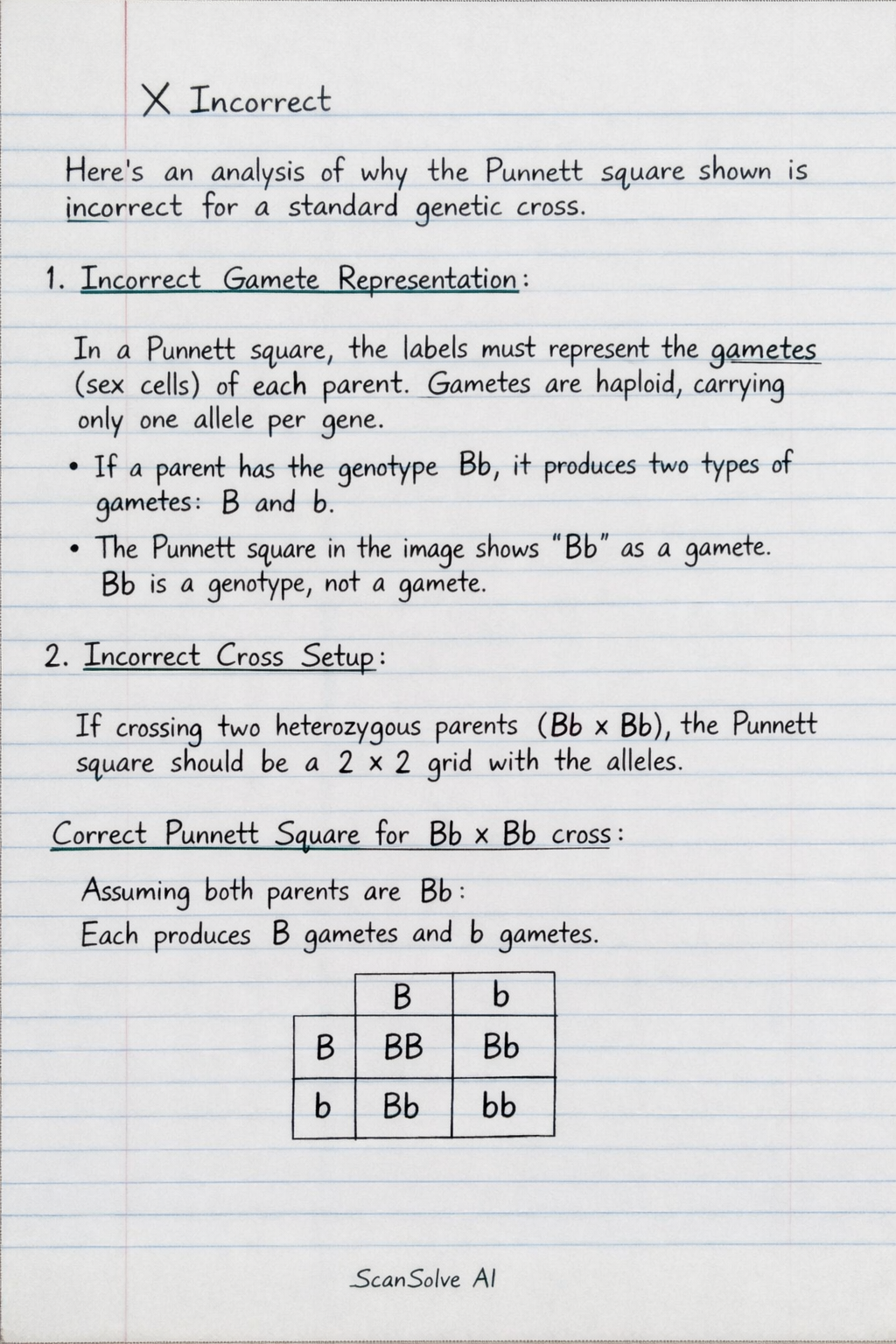
Incorrect Gamete Representation: In a Punnett square, the labels along the top and left side must represent the gametes (sex cells) produced by each parent, not the parent's genotype. Gametes are haploid, meaning they carry only one allele for each gene.
- If a parent has the genotype , it produces two types of gametes: and .
- The Punnett square in the image incorrectly lists "" as a gamete. is a genotype, not a gamete.
-
Incorrect Cross Setup: If we assume the problem intends to cross two heterozygous parents (), the Punnett square should be a grid with the individual alleles ( and ) as the gametes.
Correct Punnett Square for a cross:
Let's assume the parents are both heterozygous, . Each parent produces gametes and gametes.
| Gametes | ||
|---|---|---|
From this correct Punnett square, the offspring genotypes would be:
- 1
- 2
- 1
Regarding "BBbb" (Polyploidy):
The "BBbb" written above the Punnett square might suggest a more complex scenario involving polyploidy (an organism with more than two sets of chromosomes). If an organism has the genotype (tetraploid), it would produce diploid gametes. However, even in this case, the gametes would not simply be "" as a single type. A tetraploid organism would typically produce gametes such as , , and in specific proportions, leading to a Punnett square if crossed with another individual. The setup in the image does not correctly represent this either.
Therefore, the Punnett square as drawn does not accurately represent a biologically plausible genetic cross.
Still stuck on this one?
Ask a follow-up, and the answer starts from this question.
More Biology Questions
Handwritten Step-by-Step Solution
Get this as a handwritten image on WhatsApp — like a tutor wrote it for you.
Try on WhatsApp