
We read your photo as:
Give three adaptations of Ascaris lumbricoides to its habitat and three ways of preventing its spread.
Biology
ScanSolve AI Answer
Here are the answers to your questions:
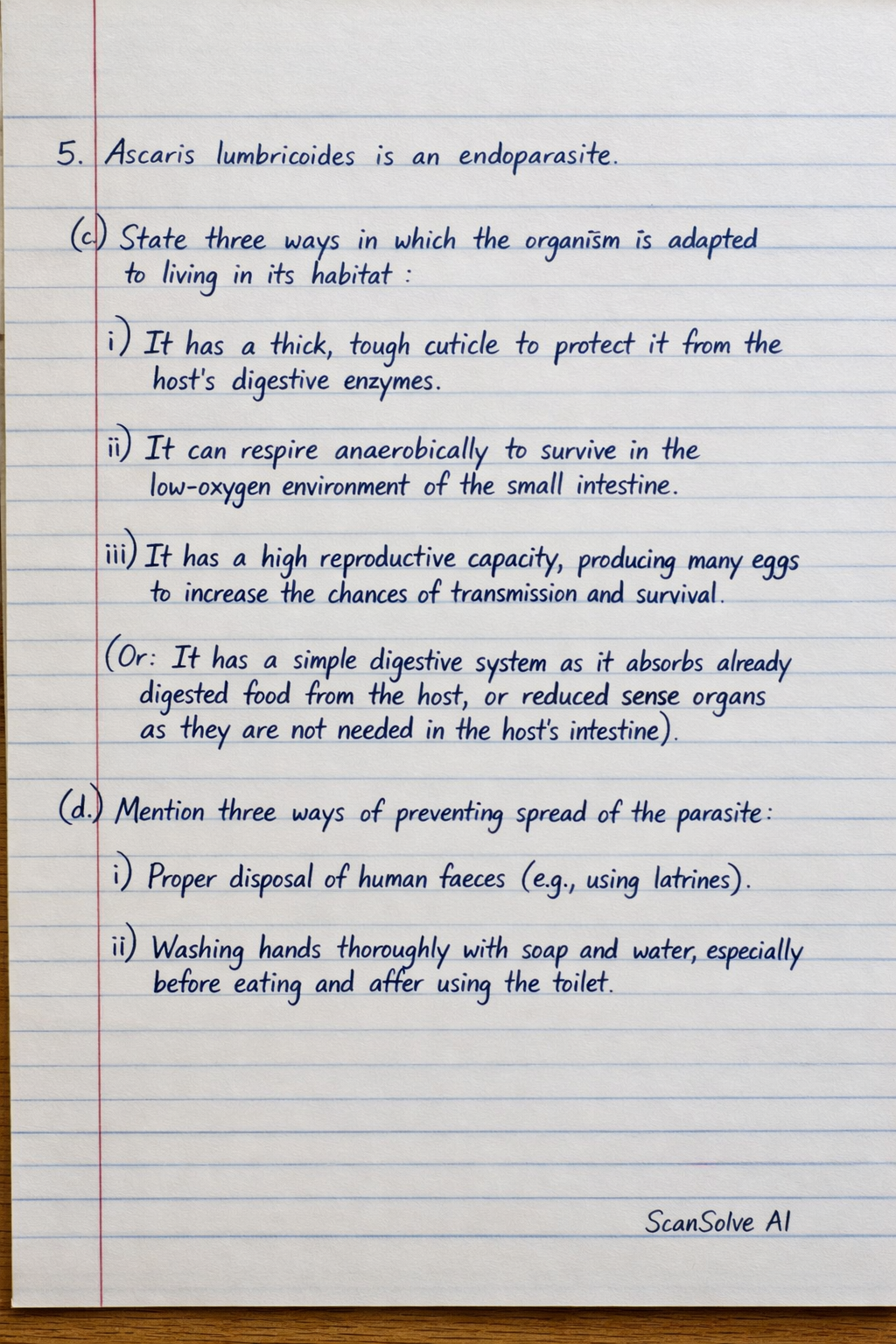
- Ascaris lumbricoides is an endoparasite.
- c) State three ways in which the organism is adapted to living in its habitat. (3mks)
- i) It has a thick, tough cuticle to protect it from the host's digestive enzymes.
- ii) It can respire anaerobically to survive in the low-oxygen environment of the small intestine.
- iii) It has a high reproductive capacity, producing many eggs to increase the chances of transmission and survival. (Alternatively: It has a simple digestive system as it absorbs already digested food from the host, or reduced sense organs as they are not needed in the host's intestine).
- d) Mention three ways of preventing spread of the parasite. (3mks)
- i) Proper disposal of human faeces (e.g., using latrines).
- ii) Washing hands thoroughly with soap and water, especially before eating and after using the toilet.
- iii) Thoroughly cooking food, especially vegetables, and drinking safe, treated water. (Alternatively: Deworming individuals in endemic areas).
- c) State three ways in which the organism is adapted to living in its habitat. (3mks)
SECTION B
-
The table below shows the relationship between environmental temperature and body temperature of two animals P and Q.
- a) Plot a graph of temp of body temperature of animals P and Q against time of the day. (8mks)
Instructions for plotting the graph:
- Axes:
- Label the X-axis as "Time (hours)".
- Label the Y-axis as "Body temperature (°C)".
- Scale:
- For the X-axis (Time): Use the given time intervals (0700, 0900, 1100, 1300, 1500, 1700, 1900, 2100). Ensure equal spacing between these points.
- For the Y-axis (Body temperature): Choose a suitable scale that covers the range from 24°C to 38°C. For example, each major grid line could represent 5°C, and each small square 1°C.
- Plotting Animal P:
- Plot the points for Animal P's body temperature against time: (0700, 37.5), (0900, 37.5), (1100, 37.5), (1300, 37.5), (1500, 37.5), (1700, 37.5), (1900, 37.5), (2100, 37.5).
- Connect these points with a straight horizontal line.
- Plotting Animal Q:
- Plot the points for Animal Q's body temperature against time: (0700, 25), (0900, 28), (1100, 30), (1300, 38), (1500, 35), (1700, 30), (1900, 27), (2100, 24).
- Connect these points with a smooth curve or straight line segments.
- Labeling:
- Clearly label the line for Animal P (e.g., "Animal P Body Temp") and the line for Animal Q (e.g., "Animal Q Body Temp").
- Provide a title for the graph, such as "Body Temperature of Animals P and Q vs. Time of Day".
Was this helpful?
Still stuck on this one?
Ask a follow-up, and the answer starts from this question.
Got a different question?Ask your own question
More Biology Questions
QGive me 3 Examples of Locomotion and Habitat adaptationQSuggest three sustainable prevention strategies that could reduce malaria transmission during the…QState five measures that can be taken to control the spread of malaria in a community.QIdentify the parasite in the schematic, state its negative impact on animal production, name the…QWhich of these is a way diseases spread?
Browse by topic:Ecology
Handwritten Step-by-Step Solution
Get this as a handwritten image on WhatsApp — like a tutor wrote it for you.
Try on WhatsApp