
We read your photo as:
Explain the three fundamental nature of membrane.
ScanSolve AI Answer
Here's the explanation for question 1(c):
c) Explain the three fundamental nature of membrane.
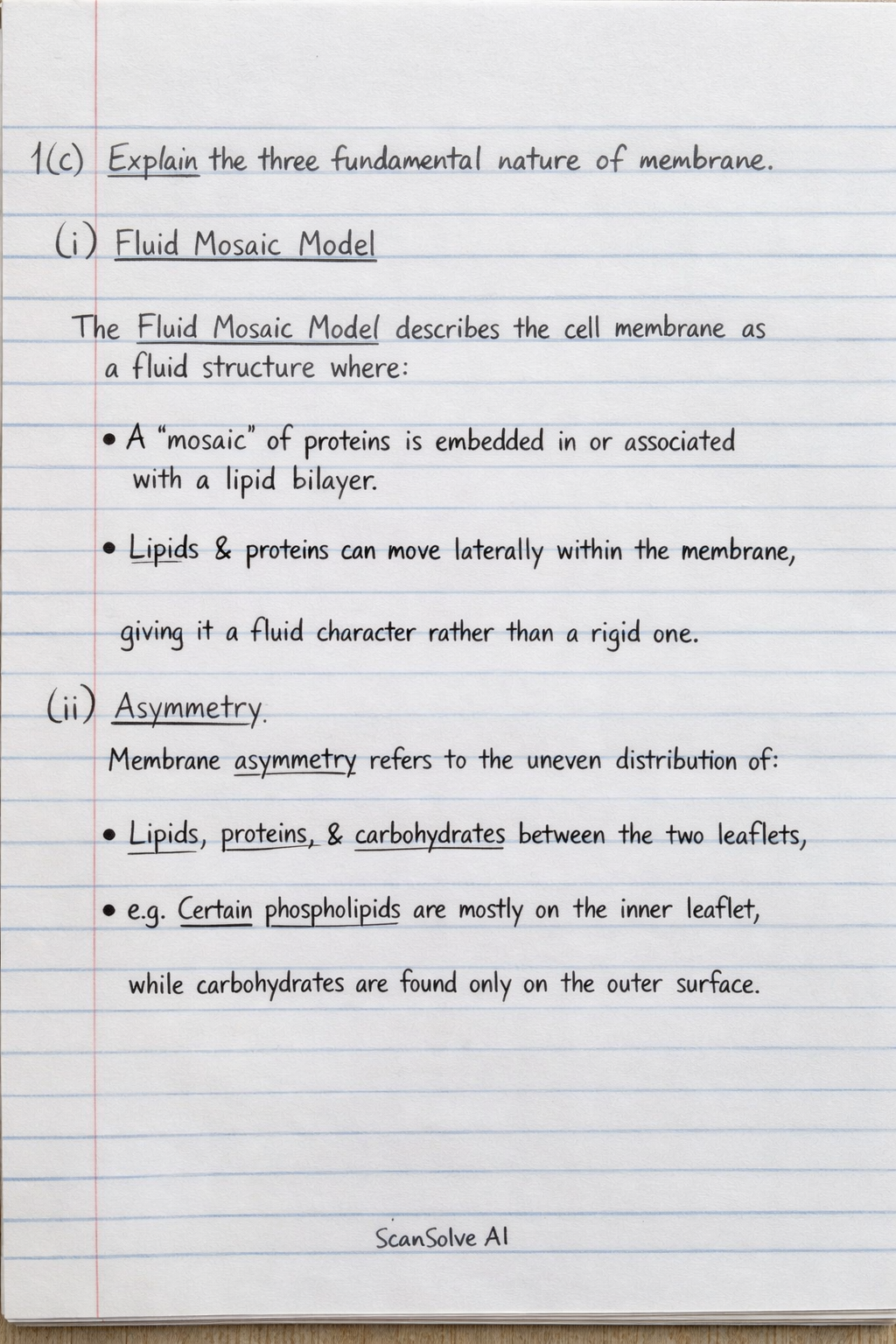
(i) Fluid Mosaic Model
The Fluid Mosaic Model describes the cell membrane as a fluid structure where a mosaic of proteins is embedded in or associated with a lipid bilayer. The lipids and proteins can move laterally within the membrane, giving it a fluid character rather than a rigid one.
(ii) Asymmetry
Membrane asymmetry refers to the uneven distribution of lipids, proteins, and carbohydrates between the two leaflets (sides) of the lipid bilayer. For example, certain phospholipids are preferentially located on the inner or outer leaflet, and carbohydrates are exclusively found on the exterior surface.
(iii) Dynamic
The membrane is dynamic because its components are constantly in motion. Lipids and proteins can undergo lateral diffusion, rotation, and flexion. This fluidity allows the membrane to change shape, fuse, and divide, which is crucial for various cellular processes like cell growth, division, and signaling.
Still stuck on this one?
Ask a follow-up, and the answer starts from this question.
More Biology Questions
Handwritten Step-by-Step Solution
Get this as a handwritten image on WhatsApp — like a tutor wrote it for you.
Try on WhatsApp