
We read your photo as:
Explain tissue culture, its importance, echo and its uses, and weathering.
ScanSolve AI Answer
Answer
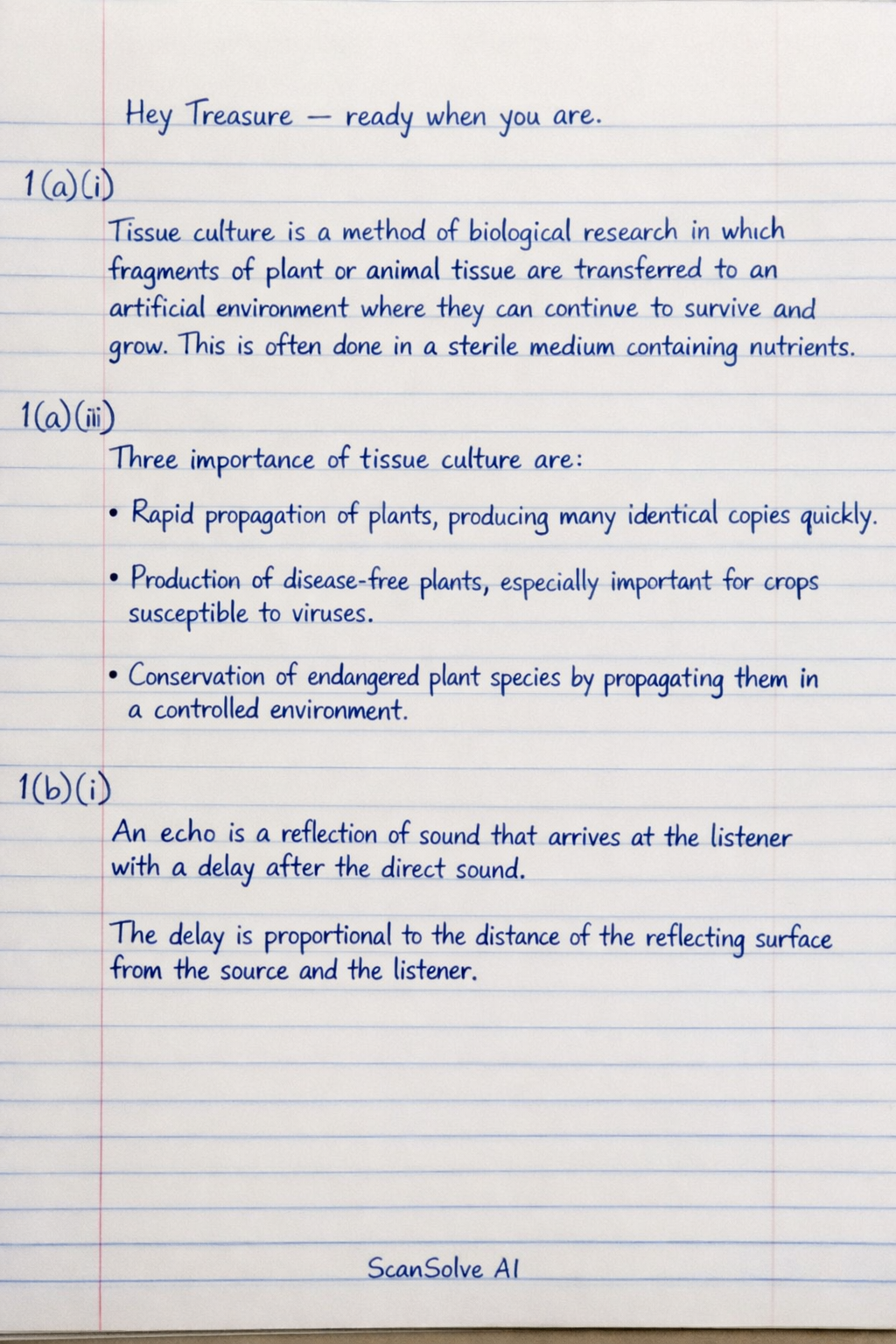
1(a)(i)
Tissue culture is a method of biological research in which fragments of plant or animal tissue are transferred to an artificial environment where they can continue to survive and grow. This is often done in a sterile medium containing nutrients.
1(a)(ii)
Three importance of tissue culture are:
- Rapid propagation of plants, producing many identical copies quickly.
- Production of disease-free plants, especially important for crops susceptible to viruses.
- Conservation of endangered plant species by propagating them in a controlled environment.
1(b)(i)
An echo is a reflection of sound that arrives at the listener with a delay after the direct sound. The delay is proportional to the distance of the reflecting surface from the source and the listener.
1(b)(ii)
Three uses of echo in everyday life are:
- Sonar (Sound Navigation and Ranging) used by ships to detect underwater objects or measure ocean depth.
- Ultrasound imaging used in medicine to visualize internal organs or a fetus during pregnancy.
- Echolocation used by bats and dolphins to navigate and hunt in the dark or murky water.
1(c)(i)
Weathering is the process of breaking down rocks, soil, and minerals as well as wood and artificial materials through contact with the Earth's atmosphere, biota, and waters. It can be physical, chemical, or biological.
1(c)(ii)
Three ways of maintaining fertility on sloppy land are:
- Terracing: Creating level steps or platforms on slopes to reduce runoff and soil erosion.
- Contour ploughing: Ploughing parallel to the contours of the slope to create ridges that slow down water flow.
- Cover cropping: Planting vegetation that covers the soil surface to protect it from the impact of rain and wind, reducing erosion and adding organic matter.
1(d)α
The mass number (also called atomic mass number or nucleon number) is the total number of protons and neutrons (collectively known as nucleons) in an atomic nucleus.
1(d)β
To calculate the relative molecular mass, we use the given atomic masses: C=12, H=1, N=14, O=16.
1(d)β(i)
Paracetamol,
The chemical formula can be written as .
Number of C atoms = 8
Number of H atoms = 9
Number of N atoms = 1
Number of O atoms = 2
Relative molecular mass of Paracetamol:
1(d)β(ii)
Trioxonitrate (V) acid is .
Number of H atoms = 1
Number of N atoms = 1
Number of O atoms = 3
Relative molecular mass of Trioxonitrate (V) acid:
1(d)β(iii)
Carbon dioxide is .
Number of C atoms = 1
Number of O atoms = 2
Relative molecular mass of Carbon dioxide:
2(a)
Here is the completed table:
| PARTICLE | POSITION | MASS | CHARGE |
|---|---|---|---|
| (i) Proton | Inside the nucleus | (v) 1 | +1 |
| Neutron (n) | (ii) Inside the nucleus | 1 | (iv) 0 |
| Electrons (e) | Outside the nucleus | (iii) Negligible (approx. 0) | -1 |
2(b)(i)
Two organisms involved in the nitrogen cycle are:
- Nitrogen-fixing bacteria (e.g., Rhizobium in legume root nodules)
- Denitrifying bacteria (e.g., Pseudomonas)
2(b)(ii)
Three human activities that affect the nitrogen cycle are:
- Use of synthetic nitrogen fertilizers in agriculture, leading to runoff and eutrophication.
- Burning of fossil fuels, which releases nitrogen oxides into the atmosphere, contributing to acid rain and smog.
- Discharge of untreated sewage and industrial waste, adding excess nitrogen compounds to water bodies.
2(c)(i)
A joint is a point where two or more bones meet in the body. They allow for movement and provide mechanical support.
2(c)(ii)
Three functions of the skeleton are:
- Support: Provides a framework for the body, holding it upright.
- Protection: Encloses and protects vital organs (e.g., skull protects the brain, rib cage protects the heart and lungs).
- Movement: Serves as attachment points for muscles, allowing the body to move.
2(d)(i)
Two methods of extinguishing an electric fire:
- Cut off the power supply (e.g., switch off the main circuit breaker).
- Use a carbon dioxide () extinguisher or a dry chemical extinguisher.
2(d)(ii)
Two methods of extinguishing a gas fire:
- Turn off the gas supply at the source.
- If the gas supply cannot be turned off, use a dry chemical extinguisher to smother the flames, but only if the gas flow can be stopped immediately after, otherwise, it can lead to an explosion.
3(a)(i)
One plant adaptation mechanism for water loss is having small or needle-like leaves (e.g., cacti, conifers) to reduce the surface area exposed to the sun and wind, thereby minimizing transpiration.
Try one yourself
A new problem that tests the same skill.
Still stuck on this one?
Ask a follow-up, and the answer starts from this question.
More Biology Questions
Handwritten Step-by-Step Solution
Get this as a handwritten image on WhatsApp — like a tutor wrote it for you.
Try on WhatsApp