
We read your photo as:
Describe the types and functions of nerves, voluntary vs. reflex actions, components of the CNS, brain functions, and kidney functions.
ScanSolve AI Answer
here are the answers for and :
-
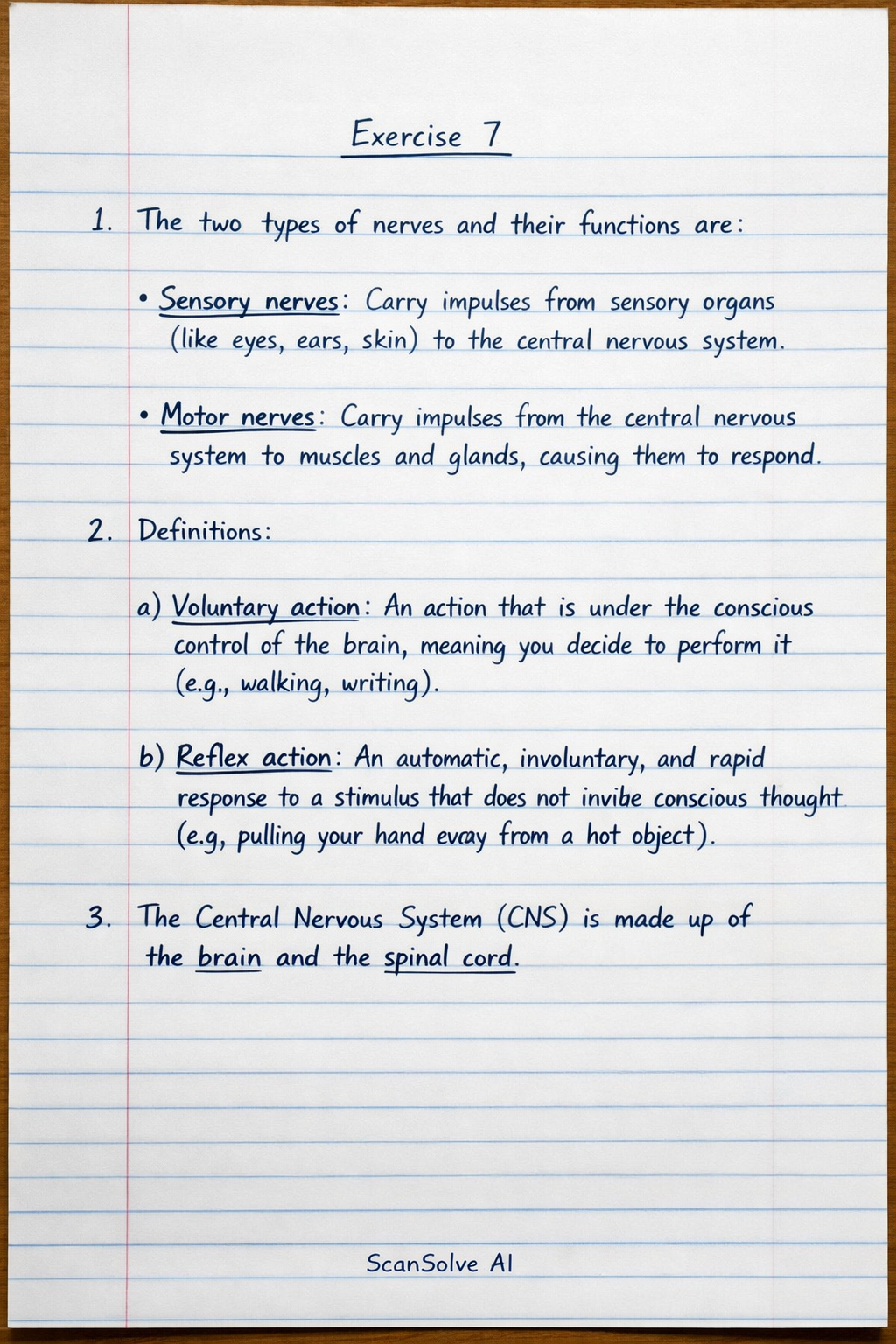
The two types of nerves and their functions are:
- Sensory nerves: Carry impulses from sensory organs (like eyes, ears, skin) to the central nervous system.
- Motor nerves: Carry impulses from the central nervous system to muscles and glands, causing them to respond.
-
Definitions:
- a) Voluntary action: An action that is under the conscious control of the brain, meaning you decide to perform it (e.g., walking, writing).
- b) Reflex action: An automatic, involuntary, and rapid response to a stimulus that does not involve conscious thought (e.g., pulling your hand away from a hot object).
-
The Central Nervous System (CNS) is made up of the brain and the spinal cord.
-
Five functions of the brain include:
- Controlling voluntary movements.
- Processing sensory information (sight, sound, touch, taste, smell).
- Responsible for thought, memory, learning, and emotions.
- Regulating involuntary body functions like breathing, heart rate, and digestion.
- Coordinating balance and posture.
-
I cannot draw diagrams. A diagram of the kidney would typically show the renal artery, renal vein, ureter, cortex, medulla, and renal pelvis.
-
The main nitrogenous substances removed from the blood by the kidneys are urea, uric acid, and creatinine.
-
Water balance refers to maintaining the appropriate amount of water in the body to ensure proper cellular function. Osmoregulation of blood is the process by which the body regulates the water and salt concentration in the blood to maintain a constant osmotic pressure, primarily carried out by the kidneys through processes like reabsorption and excretion.
-
At least two functions of the tongue during digestion are:
- Mixing food with saliva to form a bolus.
- Pushing the food bolus towards the pharynx for swallowing.
- Tasting food.
-
Enzymes are indeed chemical compounds that accelerate the rate of most chemical changes in an organism without changing the end products. They act as biological catalysts.
-
Five characteristics of enzymes are:
- They are biological catalysts (speed up reactions).
- They are specific in their action (each enzyme acts on a particular substrate).
- They are protein in nature.
- They are sensitive to temperature (have an optimal temperature and can denature).
- They are sensitive to pH (have an optimal pH range).
-
I cannot draw diagrams. A diagram illustrating peristalsis would show the rhythmic contraction and relaxation of muscles in the walls of the digestive tract, pushing food along.
-
I cannot draw diagrams. A diagram of a villus would show its finger-like projection, rich blood supply (capillaries), and lacteal for absorption.
-
Here is the completed table:
Class of food digested End products after digestion Starch Glucose Proteins Amino acids Fats Fatty acids and glycerol -
At least five functions of the liver are:
- Detoxification of harmful substances (e.g., drugs, alcohol).
- Production of bile for the emulsification of fats in digestion.
- Metabolism of carbohydrates, including storing glucose as glycogen (glycogenesis) and releasing glucose when needed (glycogenolysis).
- Synthesis of plasma proteins (e.g., albumin, clotting factors).
- Storage of vitamins (A, D, B12) and minerals (iron, copper).
- Breakdown of old red blood cells.
Still stuck on this one?
Ask a follow-up, and the answer starts from this question.
More Biology Questions
Handwritten Step-by-Step Solution
Get this as a handwritten image on WhatsApp — like a tutor wrote it for you.
Try on WhatsApp