
We read your photo as:
Unequal daughter cells are produced in A. Fragmentation B. Sporulation C. Fission D. Budding
Biology
ScanSolve AI Answer
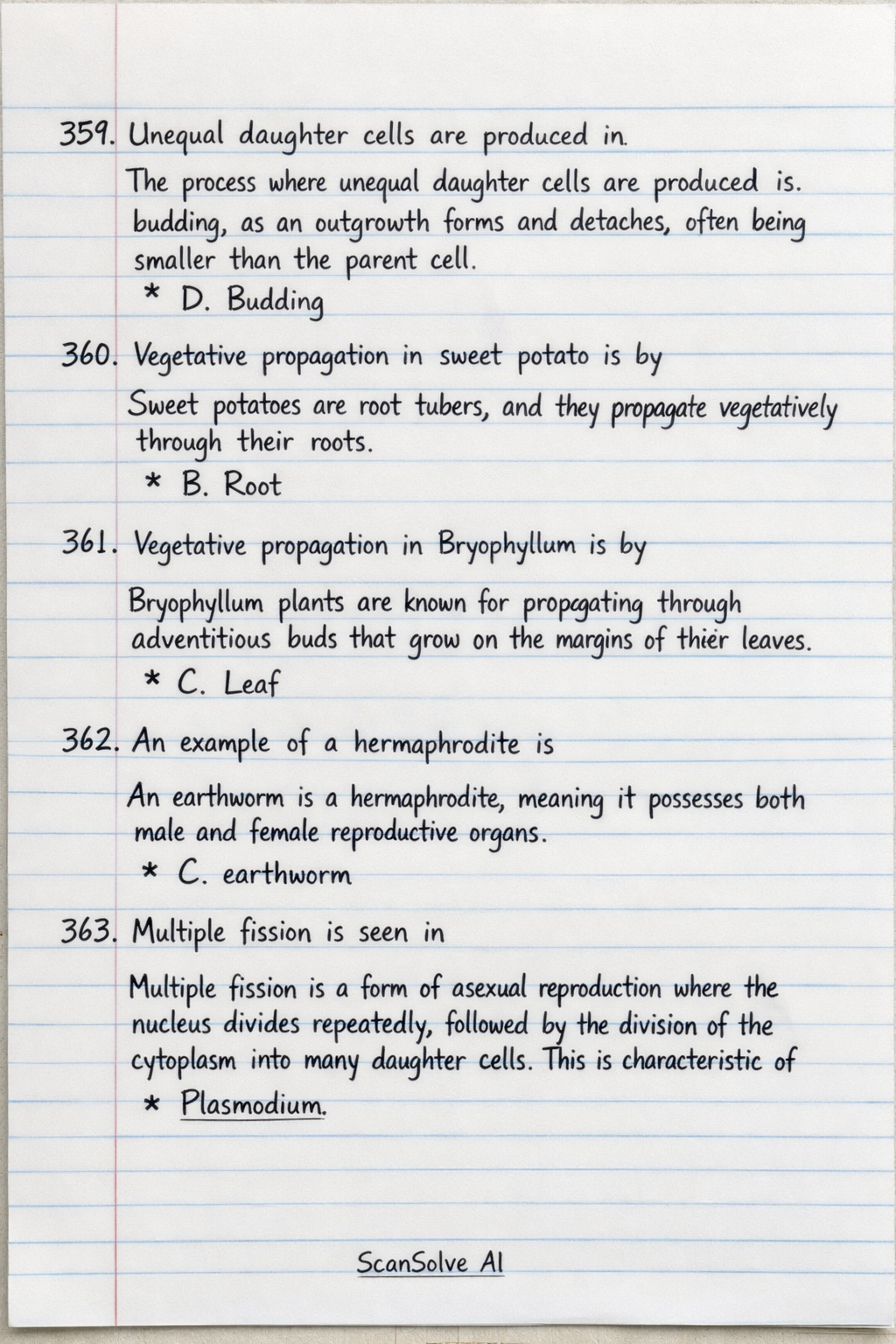
- Unequal daughter cells are produced in The process where unequal daughter cells are produced is budding, as an outgrowth forms and detaches, often being smaller than the parent cell.
- D. Budding
- Vegetative propagation in sweet potato is by Sweet potatoes are root tubers, and they propagate vegetatively through their roots.
- B. Root
- Vegetative propagation in Bryophyllum is by Bryophyllum plants are known for propagating through adventitious buds that grow on the margins of their leaves.
- C. Leaf
- An example of a hermaphrodite is An earthworm is a hermaphrodite, meaning it possesses both male and female reproductive organs.
- C. earthworm
- Multiple fission is seen in Multiple fission is a form of asexual reproduction where the nucleus divides repeatedly, followed by the division of the cytoplasm into many daughter cells. This is characteristic of Plasmodium.
- C. Plasmodium
- Progesterone is secreted by After ovulation, the ruptured ovarian follicle transforms into the corpus luteum, which then secretes progesterone.
- C. Corpus luteum
- The hormone secreted by the pituitary to start the ovulation process is The luteinizing hormone (LH) surge, secreted by the pituitary gland, triggers ovulation.
- B. Luteinizing hormone
- Sperms are produced at a temperature that is ______ the body temperature. Sperm production (spermatogenesis) in mammals requires a temperature slightly lower than the core body temperature, which is why the testes are located outside the abdominal cavity.
- B. lower than
- The part of the sperm that contains the lytic enzymes is The acrosome is a cap-like structure at the head of the sperm that contains enzymes necessary to penetrate the egg's outer layers during fertilization.
- A. acrosome
- The life span of the sperm is In the female reproductive tract, sperm can survive and remain viable for fertilization for up to 5 days, and sometimes even up to 7 days.
- D. 7 days
Was this helpful?
Still stuck on this one?
Ask a follow-up, and the answer starts from this question.
Got a different question?Ask your own question
More Biology Questions
QArrange the following in the correct developmental sequence related to microsporogenesis : A…QMatch the following terms from column A with their correct descriptions in column B: A) Resting…QAssertion (A): Yeasts reproduce by budding. Reason (R): Yeasts are multicellular filamentous…QSteps in cell divisionQWhich stage of meiosis is represented in figure A? Which of the following CANNOT be a gamete…
Handwritten Step-by-Step Solution
Get this as a handwritten image on WhatsApp — like a tutor wrote it for you.
Try on WhatsApp