

This biology question covers important biological concepts and processes. The step-by-step explanation below helps you understand the underlying mechanisms and reasoning.
ScanSolve AI Answer
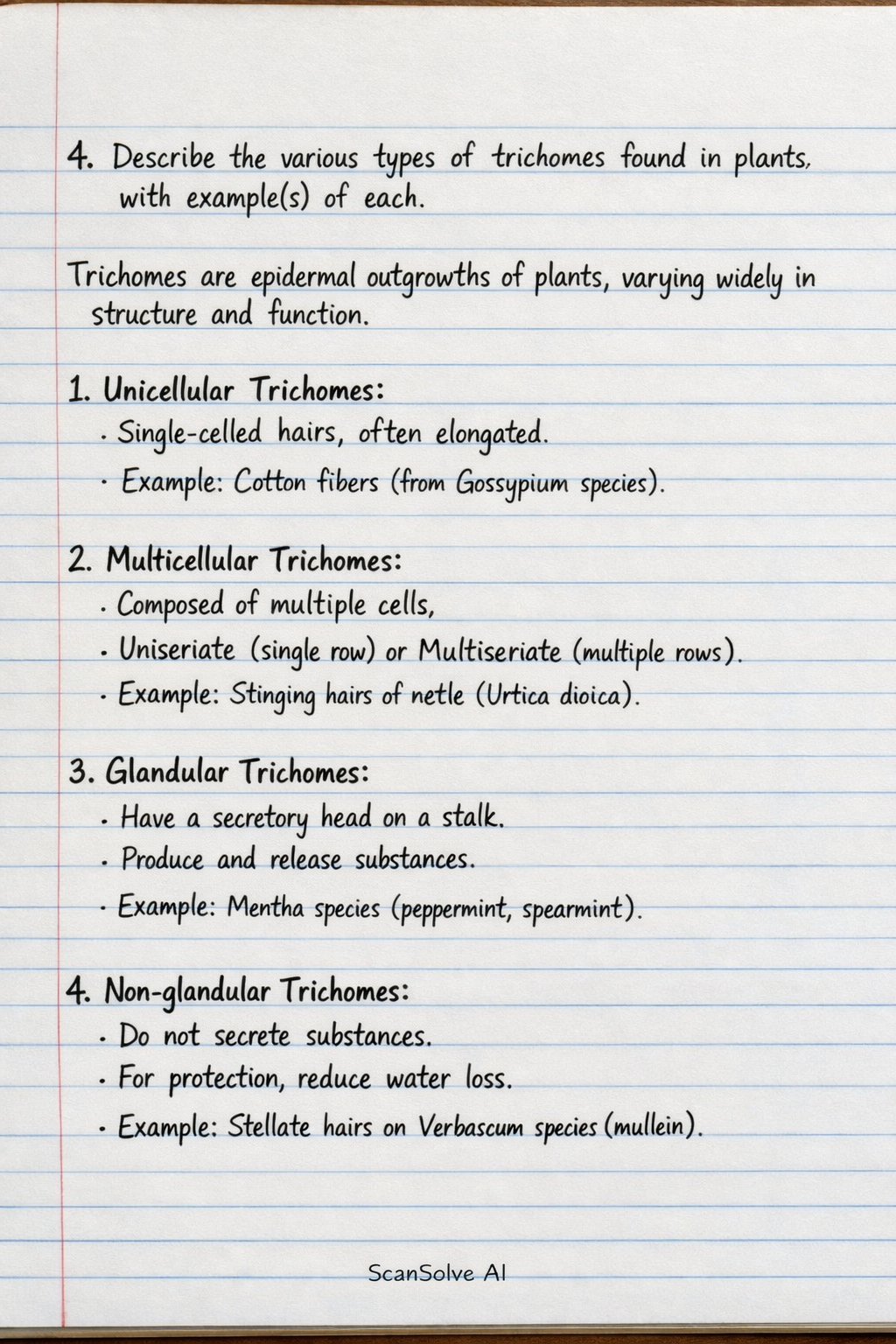
Hey VICMMANUEL👻⭐, good to see you again. Let's go over these questions again. 4. Describe the various types of trichomes found in plants with example(s) of each Trichomes are epidermal outgrowths of plants, varying widely in structure and function. Unicellular Trichomes: Single-celled hairs, often elongated. Example: Cotton fibers (from Gossypium* species). Multicellular Trichomes: Composed of multiple cells, which can be uniseriate (single row of cells) or multiseriate (multiple rows). Example: Stinging hairs of nettle (Urtica dioica*). Glandular Trichomes: Possess a secretory head, often on a stalk, that produces and releases various substances (e.g., essential oils, resins, mucilage). Example*: Mentha species (peppermint, spearmint) which produce menthol. Non-glandular Trichomes: Do not secrete substances; primarily serve protective functions, reducing water loss or deterring herbivores. Example: Stellate (star-shaped) hairs on Verbascum* species (mullein). Branched Trichomes: Hairs that divide into multiple arms or branches. Example: Found in Artemisia* species. Scales (Peltate Trichomes): Flattened, shield-like structures that lie parallel to the epidermal surface. Example: Found on the leaves of Olea europaea* (olive). 5. Explain with an example how to calibrate an eyepiece micrometer Calibrating an eyepiece micrometer (EM) is essential to determine the actual length represented by each of its divisions at different magnifications. Step 1: Place a stage micrometer (SM) on the microscope stage and focus on its scale. The stage micrometer has a precisely known scale (e.g., 1 mm divided into 100 divisions, so each division is 0.01 mm or 10 ). Step 2: Insert the eyepiece micrometer into the microscope eyepiece. Step 3: Align the zero mark of the eyepiece micrometer with the zero mark of the stage micrometer. Step 4: Find a point where another mark on the eyepiece micrometer exactly coincides with a mark on the stage micrometer. Step 5: Count the number of eyepiece micrometer divisions (EMD) and the corresponding number of stage micrometer divisions (SMD) that coincide. Step 6: Calculate the value of one eyepiece micrometer division using the formula: Value of 1 EMD = Number of SMD × Value of 1 SMDNumber of EMD Example*: If 50 divisions of the eyepiece micrometer coincide with 10 divisions of the stage micrometer, and each stage micrometer division is 0.01 mm (10 ): Value of 1 EMD = 10 SMD × 0.01 mm/SMD50 EMD = 0.1 mm50 = 0.002 mm or 2 Step 7: Repeat this calibration for each objective lens (magnification) used, as the value of an EMD changes with magnification. 6. Explain how to prepare a drug sample for microscopical examination The preparation method depends on whether the drug is organized (e.g., leaf, root) or unorganized (e.g., gum, resin) and its physical state (whole, cut, or powdered). Step 1: For organized drugs (e.g., leaves, barks, roots): Cut very thin transverse or longitudinal sections using a sharp razor blade or microtome. The sections should be thin enough for light to pass through. Step 2: For powdered drugs: Place a small amount of the powder (a few milligrams) on a clean microscope slide. Step 3: Add a suitable mounting medium. Common media include: Water*: For general observation. Glycerin*: To prevent drying and improve clarity. Chloral hydrate solution*: To clear plant tissues by dissolving starch and chlorophyll, making internal structures more visible. Gentle heating may be required. Phloroglucinol and concentrated HCl*: To stain lignified tissues red. Sudan III or IV*: To stain oily or fatty substances red/orange. Step 4: Gently lower a coverslip over the sample, avoiding air bubbles. What's next?