

This biology question covers important biological concepts and processes. The step-by-step explanation below helps you understand the underlying mechanisms and reasoning.
ScanSolve AI Answer
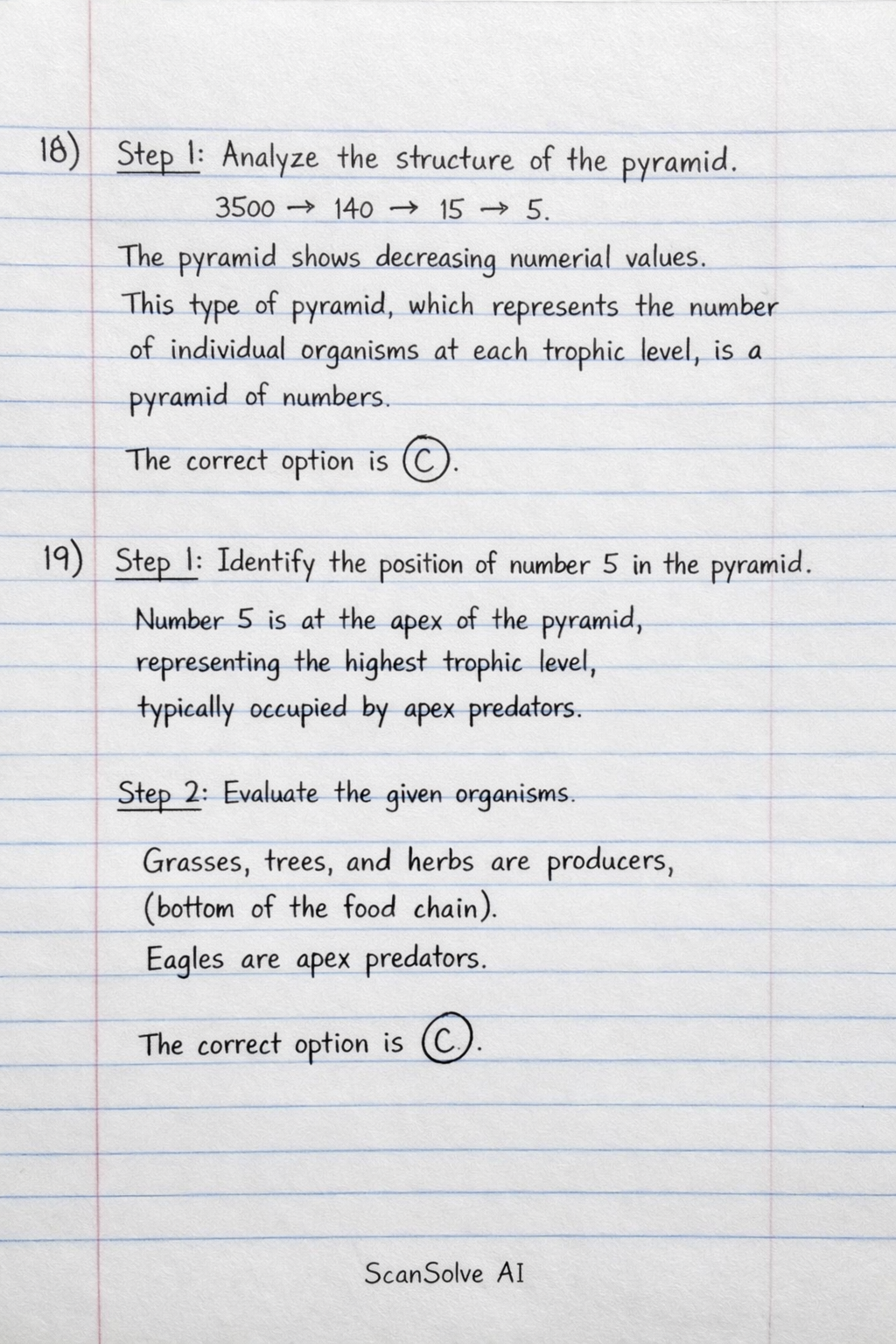
here are the answers to the questions from the image: 18) Step 1: Analyze the structure of the pyramid. The pyramid shows decreasing numerical values (3500, 140, 15, 5) at successive trophic levels. This type of pyramid, which represents the number of individual organisms at each trophic level, is a pyramid of numbers. The correct option is C. 19) Step 1: Identify the position of number 5 in the pyramid. Number 5 is at the apex of the pyramid, representing the highest trophic level, typically occupied by apex predators. Step 2: Evaluate the given organisms. Grasses, trees, and herbs are producers (bottom of the food chain). Eagles are apex predators. The correct option is C. 20) Step 1: Analyze the plant adaptations described. • Sunken stomata reduce water loss by trapping humid air. • Hairy pappus (or hairy leaves/stems) can reduce water loss by trapping air and reflecting sunlight. • Reduced leaves minimize the surface area for transpiration. Step 2: Determine which habitat requires these adaptations. These are all adaptations to conserve water and survive in very dry conditions. The correct option is C. 21) Step 1: Recall the definition of a rhizome. A rhizome is a modified, usually underground, stem that grows horizontally and can produce new shoots and roots. Ginger is a classic example. The correct option is C. 22) Step 1: Understand the characteristic described. An organism with "no definite nucleus" means it is a prokaryote. Step 2: Classify based on the kingdoms. The Kingdom Monera (which includes bacteria and archaea) consists of prokaryotic organisms that lack a membrane-bound nucleus. The correct option is B. 23) Step 1: Recall the primary component of wood. Wood is primarily composed of cellulose, a complex carbohydrate that forms the main structural component of plant cell walls, providing rigidity and strength. The correct option is A. 24) Step 1: Identify the reproductive structure. An antheridium is a male reproductive organ that produces sperm in non-flowering plants. Step 2: Match with plant groups. Bryophytes (mosses and liverworts) are known to possess antheridia and archegonia for reproduction. The correct option is B. 25) Step 1: Identify the labeled part X in the diagram. The diagram shows a unicellular alga (like Chlamydomonas). Part X is a small, dark spot within the chloroplast, which is characteristic of an eyespot (stigma). The correct option is A. 26) Step 1: Identify parts X and Y and their functions. • X is the eyespot, which detects light. • Y represents the flagella, which are used for locomotion. Step 2: Evaluate the given statements. • A. X for locomotion: Incorrect, X detects light. • B. Y for response to light: While Y (flagella) provides the movement, the detection of light (the initial response) is by X. However, the movement itself is part of the organism's overall response to light (phototaxis). Among the given options, this is the most plausible interpretation, as flagella are used to move the organism towards or away from light, thus executing the response. • C. Y for removal of waste: Incorrect, Y is for locomotion. • D. X for reproduction: Incorrect, X detects light. The most appropriate, though slightly imprecise, option is B. 27) Step 1: Recall the definition of osmosis. Osmosis is the net movement of water molecules across a selectively permeable membrane from a region of higher water potential to a region of lower water potential. The correct option is D. That's all for this set! What's next? 📸