1. The loss-minimizing point is where marginal revenue (MR) equals marginal cost (MC).

Business/Management
1. The loss-minimizing point is where marginal revenue (MR) equals marginal cost (MC).

ScanSolve AI Answer

Answer

5000

Here are the answers to your questions based on the graph:

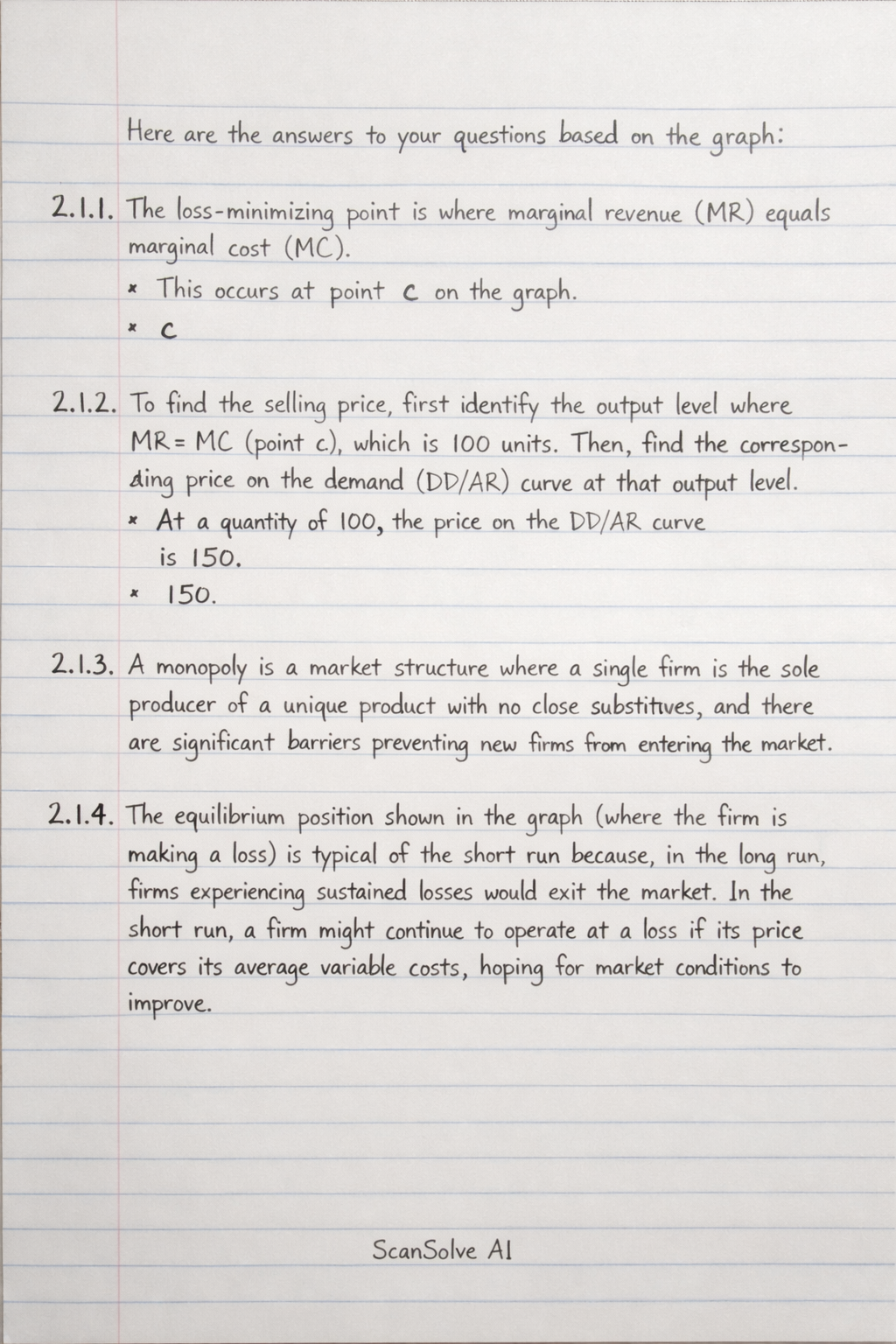
2.1.1. The loss-minimizing point is where marginal revenue (MR) equals marginal cost (MC).

  • This occurs at point c on the graph.
  • c

2.1.2. To find the selling price, first identify the output level where MR = MC (point c), which is 100 units. Then, find the corresponding price on the demand (DD/AR) curve at that output level.

  • At a quantity of 100, the price on the DD/AR curve is 150.
  • 150

2.1.3. A monopoly is a market structure where a single firm is the sole producer of a unique product with no close substitutes, and there are significant barriers preventing new firms from entering the market.

2.1.4. The equilibrium position shown in the graph (where the firm is making a loss) is typical of the short run because, in the long run, firms experiencing sustained losses would exit the market. In the short run, a firm might continue to operate at a loss if its price covers its average variable costs, hoping for market conditions to improve.

2.1.5. To determine the loss, we need the average cost, average revenue (price), and quantity at the equilibrium point.

Step 1: Identify the equilibrium quantity, price, and average cost from the graph.

  • Equilibrium quantity (where MR=MCMR = MC at point c) = 100 units.
  • Selling price (Average Revenue, AR, at quantity 100, point b) = 150.
  • Average Cost (AC, at quantity 100, point a) = 200.

Step 2: Calculate the loss per unit. Lossperunit=AverageCostAverageRevenueLoss per unit = Average Cost - Average Revenue Lossperunit=200150=50Loss per unit = 200 - 150 = 50

Step 3: Calculate the total loss. TotalLoss=Lossperunit×QuantityTotal Loss = Loss per unit \times Quantity TotalLoss=50×100=5000Total Loss = 50 \times 100 = 5000 The loss for this business is: 5000*5000*

Last free one today — make it count tomorrow, or type /upgrade for unlimited.

Was this helpful?

Need help with your own homework?

Get instant step-by-step solutions to any question. Free to start.

Ask Your Question
Handwritten step-by-step solution preview

Handwritten Step-by-Step Solution

Get this as a handwritten image on WhatsApp — like a tutor wrote it for you.

Try on WhatsApp

Still have questions?

Quick Answer

2.1.1. The loss-minimizing point is where marginal revenue (MR) equals marginal cost (MC).

1. The loss-minimizing point is where marginal revenue (MR) equals marginal cost (MC).
Business/Management

This business/management problem is solved step by step below, with detailed explanations to help you understand the method and arrive at the correct answer.

ScanSolve AI Answer
Here are the answers to your questions based on the graph: 2.1.1. The loss-minimizing point is where marginal revenue (MR) equals marginal cost (MC). This occurs at point c* on the graph. c* 2.1.2. To find the selling price, first identify the output level where MR = MC (point c), which is 100 units. Then, find the corresponding price on the demand (DD/AR) curve at that output level. At a quantity of 100, the price on the DD/AR curve is 150. 150* 2.1.3. A monopoly is a market structure where a single firm is the sole producer of a unique product with no close substitutes, and there are significant barriers preventing new firms from entering the market. 2.1.4. The equilibrium position shown in the graph (where the firm is making a loss) is typical of the short run because, in the long run, firms experiencing sustained losses would exit the market. In the short run, a firm might continue to operate at a loss if its price covers its average variable costs, hoping for market conditions to improve. 2.1.5. To determine the loss, we need the average cost, average revenue (price), and quantity at the equilibrium point. Step 1: Identify the equilibrium quantity, price, and average cost from the graph. Equilibrium quantity (where MR = MC at point c) = 100 units. Selling price (Average Revenue, AR, at quantity 100, point b) = 150. Average Cost (AC, at quantity 100, point a) = 200. Step 2: Calculate the loss per unit. Loss per unit = Average Cost - Average Revenue Loss per unit = 200 - 150 = 50 Step 3: Calculate the total loss. Total Loss = Loss per unit × Quantity Total Loss = 50 × 100 = 5000 The loss for this business is: 5000 Last free one today — make it count tomorrow, or type /upgrade for unlimited.