

This business/management problem is solved step by step below, with detailed explanations to help you understand the method and arrive at the correct answer.
ScanSolve AI Answer
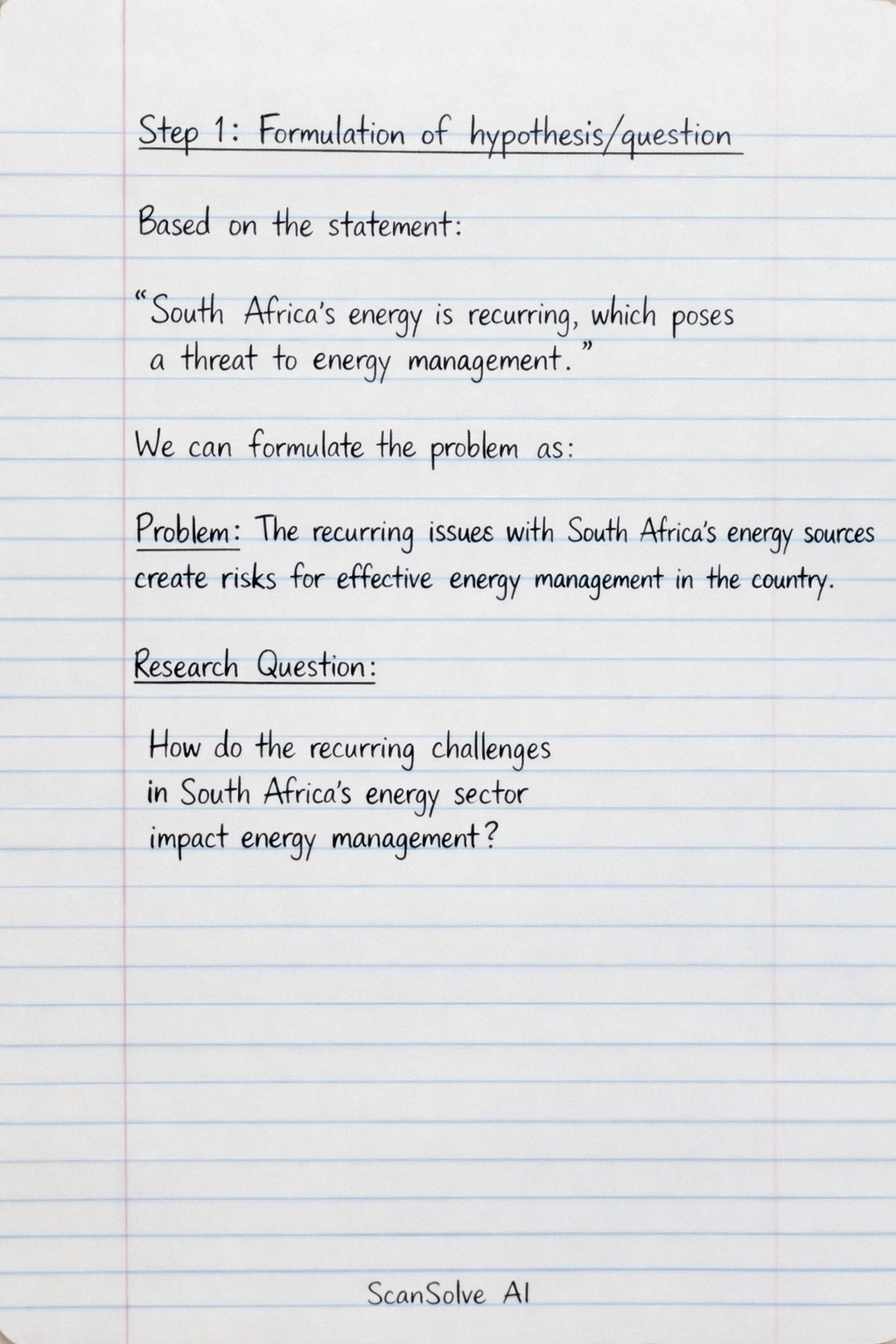
Here's how to approach each step of your research project based on the provided guide: Step 1: Formulation of hypothesis/question Based on your statement, "South Africa's energy is recurring, which poses a threat to energy management," we can formulate a clear problem description and research question. The term "recurring" is interpreted here as referring to the characteristics of South Africa's energy sources (e.g., intermittency of renewables, or the persistent challenges with existing infrastructure). Problem Description and Research Question (Not more than 50 words): South Africa's energy sector, characterized by a mix of coal dependency and intermittent renewable sources, presents a significant geographical problem for national energy management. This leads to widespread load shedding and environmental degradation. The research question is: How do these energy source characteristics geographically impact the stability and sustainability of South Africa's energy supply? South Africa's energy sector, characterized by a mix of coal dependency and intermittent renewable sources, presents a significant geographical problem for national energy management. This leads to widespread load shedding and environmental degradation. The research question is: How do these energy source characteristics geographically impact the stability and sustainability of South Africa's energy supply? Step 2: Geographical Mapping of research area For this step, you need to create a map (A4 size or smaller) that visually represents your research area and problem. Map Description: The map should be titled "Geographical Impact of Energy Sources on Management in South Africa." It must include a clear scale, a legend detailing different energy generation types (e.g., coal power plants, solar farms, wind farms), major transmission lines, and potentially areas most affected by load shedding or environmental issues. A north arrow and a coordinate grid (latitude and longitude) are essential cartographic elements. The map should visually illustrate the distribution of energy resources and infrastructure across South Africa, highlighting regions of high energy production and areas experiencing significant energy management challenges. A map titled "Geographical Impact of Energy Sources on Management in South Africa" should be created. It must include a scale, legend (showing coal plants, solar farms, wind farms, transmission lines), north arrow, and coordinates. The map will visually represent the distribution of energy resources and infrastructure, highlighting areas of production and those affected by energy management challenges like load shedding. Step 3: Background Information This section requires a paragraph of eight lines (75 to 100 words) describing the location, historical context, and geographical scope of the problem. Background Information (75 to 100 words): South Africa, situated at Africa's southern tip, has historically relied on its extensive coal reserves, predominantly in Mpumalanga, for energy. This legacy has shaped a carbon-intensive grid, contributing to environmental issues and infrastructure strain. Geographically, the energy management problem, characterized by frequent load shedding, impacts all provinces and economic sectors nationwide. The country's transition towards renewable energy, leveraging solar in the Northern Cape and wind along its coasts, introduces new challenges related to intermittency and grid integration. This complex interplay of historical energy choices, diverse geographical resource distribution, and modern demands defines the scope of South Africa's energy management dilemma. South Africa, situated at Africa's southern tip, has historically relied on its extensive coal reserves, predominantly in Mpumalanga, for energy. This legacy has shaped a carbon-intensive grid, contributing to environmental issues and infrastructure strain. Geographically, the energy management problem, characterized by frequent load shedding, impacts all provinces and economic sectors nationwide. The country's transition towards renewable energy, leveraging solar in the Northern Cape and wind along its coasts, introduces new challenges related to intermittency and grid integration. This complex interplay of historical energy choices, diverse geographical resource distribution, and modern demands defines the scope of South Africa's energy management dilemma. Send me the next one 📸