
This business/management problem is solved step by step below, with detailed explanations to help you understand the method and arrive at the correct answer.
ScanSolve AI Answer
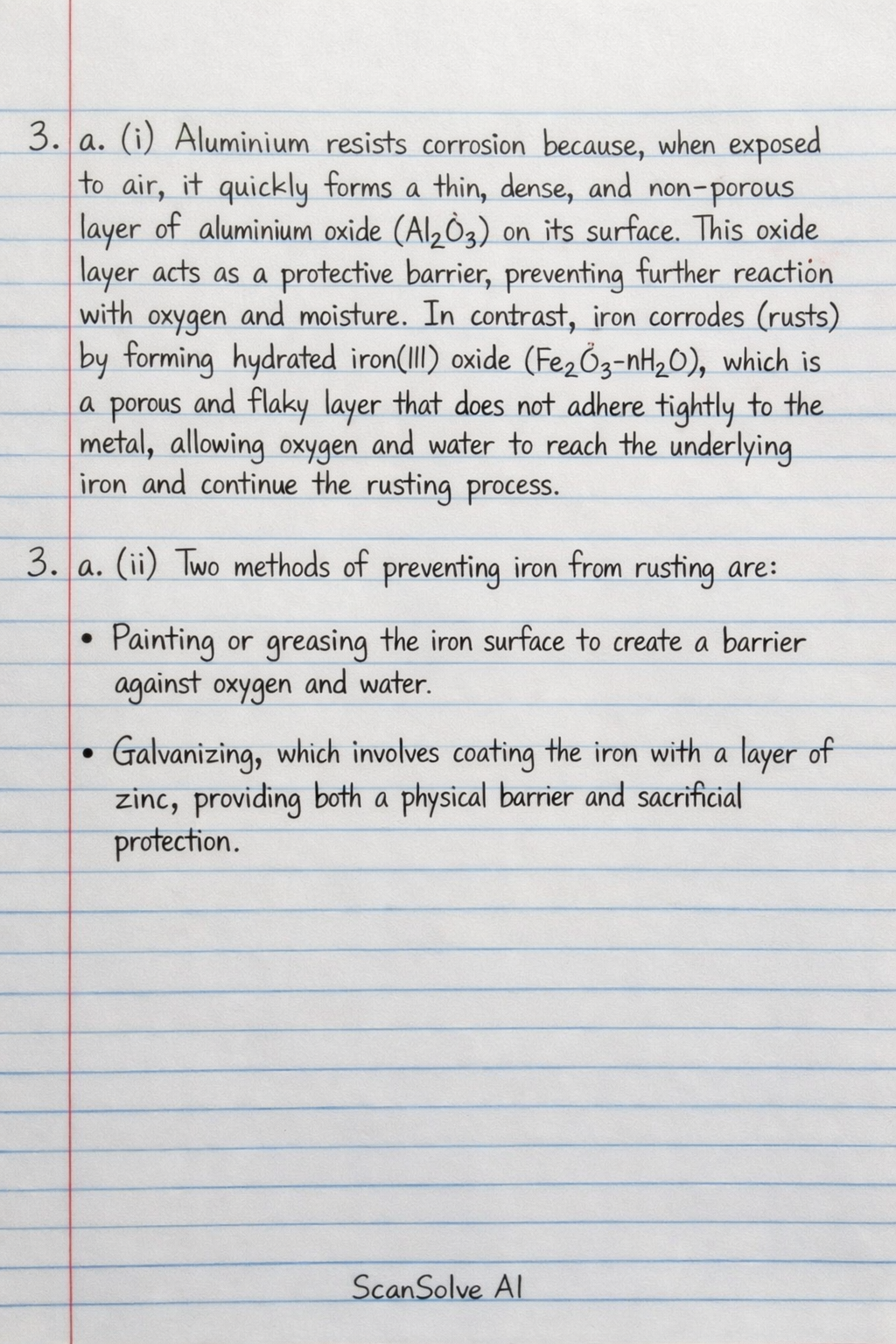
3. a. (i) Aluminium resists corrosion because, when exposed to air, it quickly forms a thin, dense, and non-porous layer of aluminium oxide (Al_2O_3) on its surface. This oxide layer acts as a protective barrier, preventing further reaction with oxygen and moisture. In contrast, iron corrodes (rusts) by forming hydrated iron(III) oxide (Fe_2O_3 · nH_2O), which is a porous and flaky layer that does not adhere tightly to the metal, allowing oxygen and water to reach the underlying iron and continue the rusting process. 3. a. (ii) Two methods of preventing iron from rusting are: Painting or greasing* the iron surface to create a barrier against oxygen and water. Galvanizing*, which involves coating the iron with a layer of zinc, providing both a physical barrier and sacrificial protection. 3. b. (i) Culling in livestock management refers to the process of selectively removing animals from a herd or flock that are deemed undesirable or unproductive. This decision is typically based on factors such as poor health, low productivity (e.g., milk yield, egg production), old age, or undesirable genetic traits. 3. b. (ii) Three benefits of practising culling are: It improves the overall productivity and profitability* of the herd/flock by retaining only the most efficient animals. It helps to control the spread of diseases* by removing sick or infected animals, thus protecting the healthy ones. It optimizes the use of resources like feed and space, as unproductive animals are no longer consuming them. 3. c. (i) Grafting* is a horticultural technique where parts of two plants are joined together so that they grow as one. It typically involves joining a scion (a shoot or stem with multiple buds) from one plant onto the rootstock (the root system or lower part of another plant). Budding* is a specific type of grafting where only a single bud (the scion) from one plant is inserted into the bark of a rootstock. 3. c. (ii) Three reasons for grafting and budding are: To combine desirable characteristics of two plants, such as the disease resistance of a rootstock with the high fruit quality of a scion. To propagate plants that do not readily root from cuttings or produce viable seeds. To repair damaged trees or to change the variety of an existing tree (topworking). 3. d. (i) The principle of conservation of energy states that energy cannot be created or destroyed, but it can be transformed from one form to another. The total amount of energy in an isolated system remains constant. 3. d. (ii) The energy transformations that occur in each device are: (a) A moving motorcycle: Chemical energy (from fuel) → Heat energy → Kinetic energy (of the motorcycle) + Sound energy + Heat energy*. (b) A television set in operation: Electrical energy → Light energy (from the screen) + Sound energy (from speakers) + Heat energy*. 3 done, 2 left today. You're making progress.