
We read your photo as:
A) i) Define food poisoning. ii) Explain two causes of food poisoning. b) State two methods of soil conservation. c) i) Define light energy. ii) Explain two ways light energy is useful to living organ
Biology
ScanSolve AI Answer
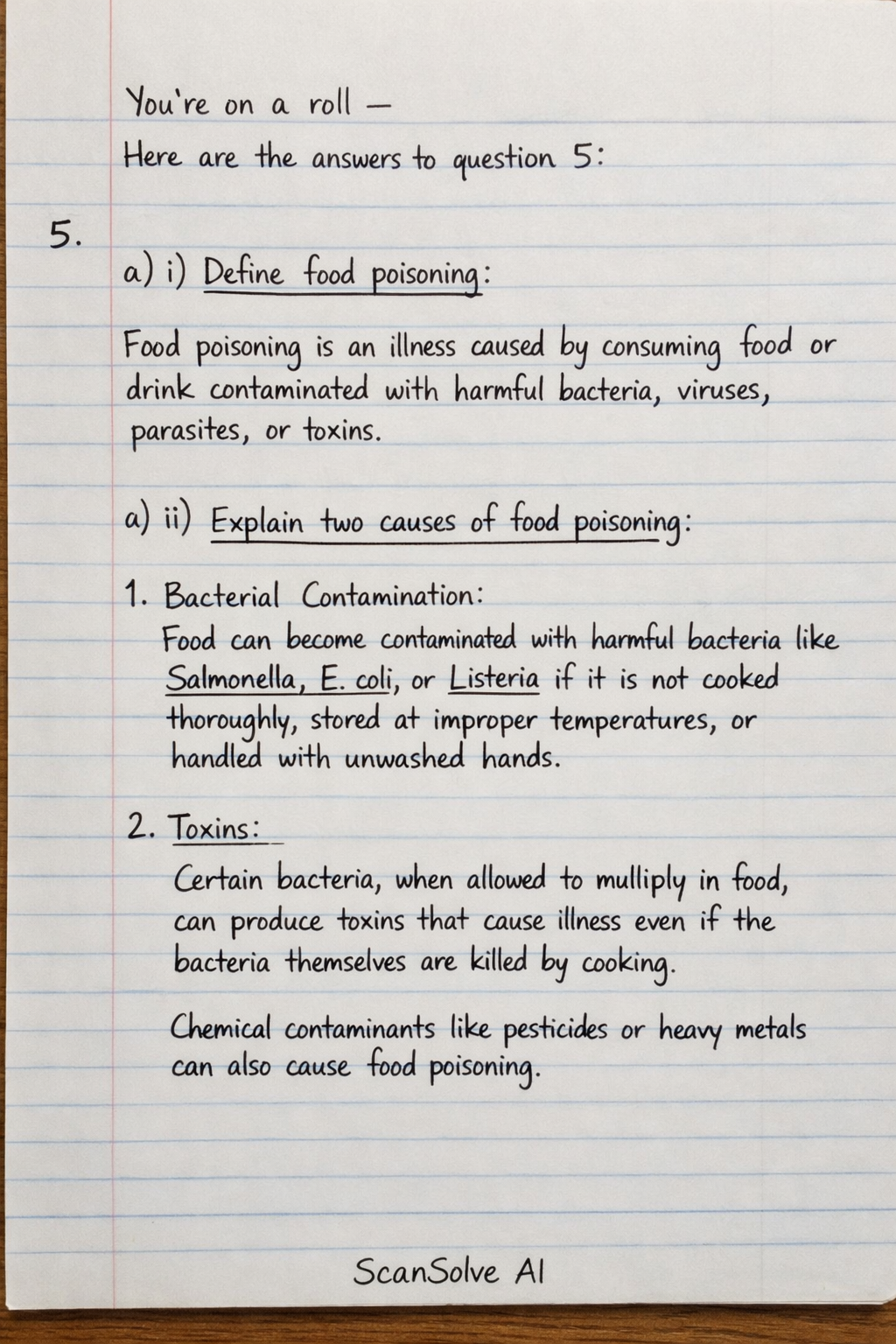
Here are the answers to question 5:
5.
-
a) i) Define food poisoning.
- Food poisoning is an illness caused by consuming food or drink contaminated with harmful bacteria, viruses, parasites, or toxins.
-
a) ii) Explain two causes of food poisoning.
-
- Bacterial Contamination: Food can become contaminated with harmful bacteria like Salmonella, E. coli, or Listeria if it is not cooked thoroughly, stored at improper temperatures, or handled with unwashed hands.
-
- Toxins: Certain bacteria, when allowed to multiply in food, can produce toxins that cause illness even if the bacteria themselves are killed by cooking. Chemical contaminants like pesticides or heavy metals can also cause food poisoning.
-
-
b) State two (2) methods of soil conservation.
-
- Contour plowing: Plowing across the slope of a hill rather than up and down it, which helps to slow down water runoff and reduce soil erosion.
-
- Crop rotation: Growing different crops in succession on the same land to maintain soil fertility and prevent the depletion of specific nutrients.
-
-
c) i) Define light energy.
- Light energy is a form of electromagnetic radiation that is visible to the human eye, traveling in waves and consisting of photons.
-
c) ii) Explain two (2) ways in which light energy is useful to living organisms.
-
- Photosynthesis: Green plants and other photosynthetic organisms use light energy from the sun to convert carbon dioxide and water into glucose (food) and oxygen, forming the base of most food chains.
-
- Vision: Many animals, including humans, use light energy to see and perceive their surroundings, enabling them to find food, avoid predators, and navigate.
-
-
d) i) Define an atom.
- An atom is the smallest unit of an element that retains the chemical properties of that element.
-
d) ii) An atom has 11 electrons.
-
α) Draw the electronic configuration of the atom.
- The electronic configuration is . (This atom is Sodium, Na).
-
β) Type of bond the element will form with chlorine.
- The element (Sodium) will form an with chlorine.
-
γ) Give two (2) reasons for the type of chemical bond stated in (β) above.
-
- Electron Transfer: The bond forms due to the complete transfer of the single valence electron from the metal atom (sodium) to the non-metal atom (chlorine).
-
- Formation of Ions: This transfer results in the formation of positively charged sodium ions () and negatively charged chloride ions (), which are then held together by strong electrostatic forces of attraction.
-
-
Was this helpful?
Still stuck on this one?
Ask a follow-up, and the answer starts from this question.
Got a different question?Ask your own question
More Biology Questions
QA. i. What is digestion? ii. State five part of the digestive system and with one function each of…QA) Define digestion and egestion. b) Draw the human alimentary canal. c) State three reasons for…QA. (i) Explain briefly how solar energy is used to generate electricity. (ii) State two other uses…QA. (i) Explain why aluminium resists corrosion but iron does not. (ii) State two methods of…QWhat is energy? (b) Give the name of the process which: (i) converts light energy into chemical…
Browse by topic:Anatomy
Handwritten Step-by-Step Solution
Get this as a handwritten image on WhatsApp — like a tutor wrote it for you.
Try on WhatsApp