

This biology question covers important biological concepts and processes. The step-by-step explanation below helps you understand the underlying mechanisms and reasoning.
ScanSolve AI Answer
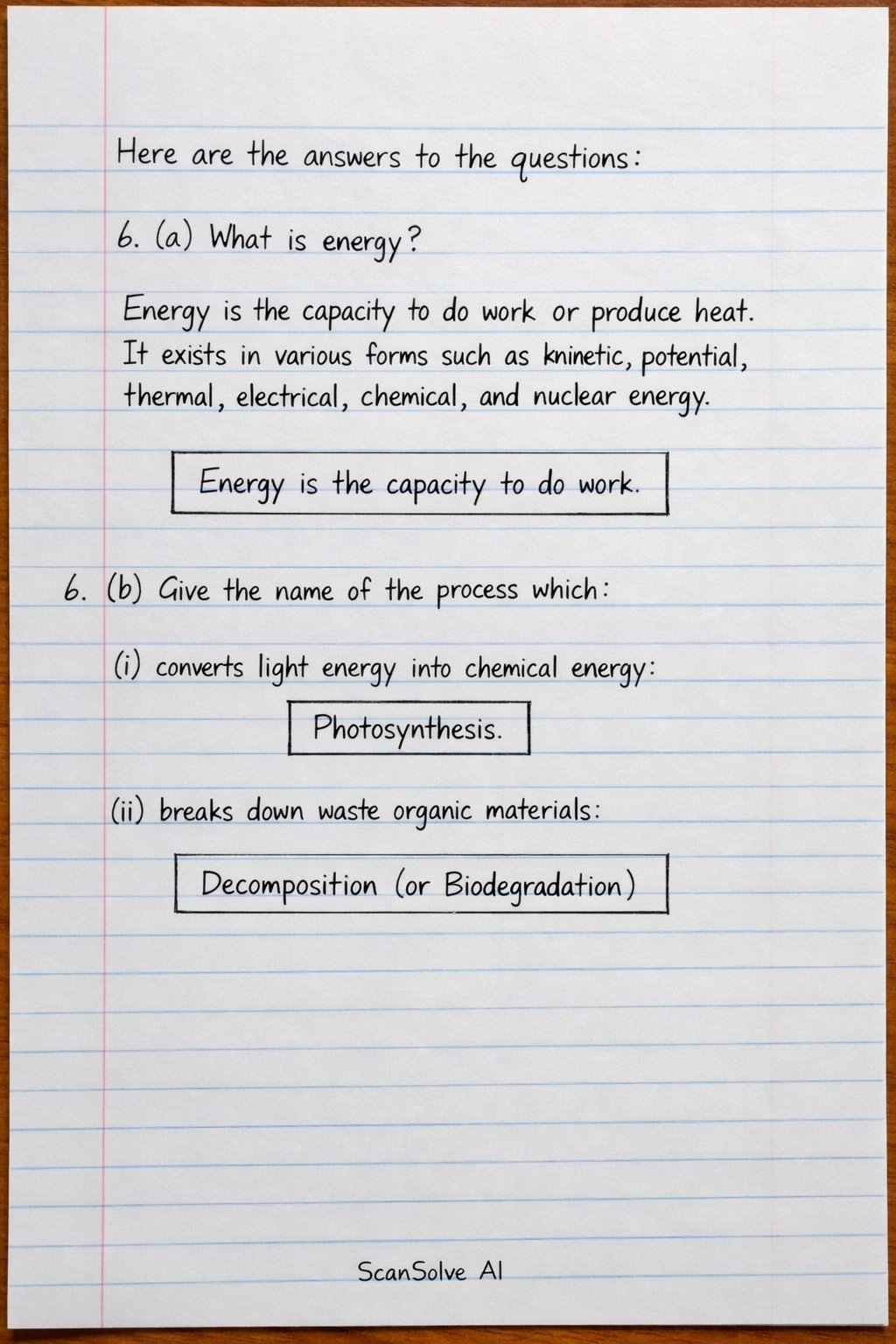
Here are the answers to the questions: 6. (a) What is energy? Energy is the capacity to do work or produce heat. It exists in various forms such as kinetic, potential, thermal, electrical, chemical, and nuclear energy. Energy is the capacity to do work. 6. (b) Give the name of the process which: (i) converts light energy into chemical energy; Photosynthesis (ii) breaks down waste organic materials. Decomposition (or Biodegradation) 6. (c) (i) What is evolution? Evolution is the process by which different kinds of living organisms are thought to have developed and diversified from earlier forms during the history of the Earth. It involves changes in the heritable characteristics of biological populations over successive generations. Evolution is the gradual change in the heritable characteristics of biological populations over successive generations. (ii) Give two evidences to support evolution. 1. Fossil records: Show transitional forms and changes in organisms over geological time. 2. Comparative anatomy: Similarities in the bone structures of different species (homologous structures) suggest a common ancestor. 3. Molecular biology: Similarities in DNA and protein sequences among different species indicate common ancestry. 4. Embryology: Similar developmental stages in embryos of different species. 1. Fossil records, 2. Comparative anatomy 6. (d) (i) Explain the term wildlife. Wildlife refers to all undomesticated animals, plants, and other living things that grow or live wild in an area without being introduced by humans. It encompasses all non-cultivated flora and non-domesticated fauna. Wildlife refers to all undomesticated animals, plants, and other living things that live in their natural habitat. (ii) Give two reasons for conserving wildlife. 1. Ecological balance: Wildlife plays crucial roles in ecosystems, such as pollination, seed dispersal, and pest control, maintaining the health and stability of the environment. 2. Biodiversity: Conserving wildlife helps preserve the variety of life on Earth, which is essential for ecosystem resilience and potential future discoveries (e.g., new medicines). 3. Economic value: Wildlife provides resources like food, timber, and medicinal plants, and supports industries like ecotourism. 4. Ethical reasons: Many believe humans have a moral responsibility to protect other species and natural habitats. 1. Maintaining ecological balance, 2. Preserving biodiversity 6. (e) (i) Define electromotive force. Electromotive force (EMF) is the electrical potential produced by an energy source, such as a battery or generator, per unit of charge. It is the maximum potential difference across the terminals of a source when no current is flowing. EMF is measured in volts (V). Electromotive force (EMF) is the maximum potential difference across the terminals of a power source when no current is drawn. Send me the next one 📸