
We read your photo as:
Define energy. List four (4) forms of energy. What is germination? List two (2) types of germination you know. Define soil. List any four (4) types of soil you know. What is erosion? Mention four (4) causes of erosion. Define the following terms: Electricity, Atom, Technology, Food, Friction.
Physics
ScanSolve AI Answer
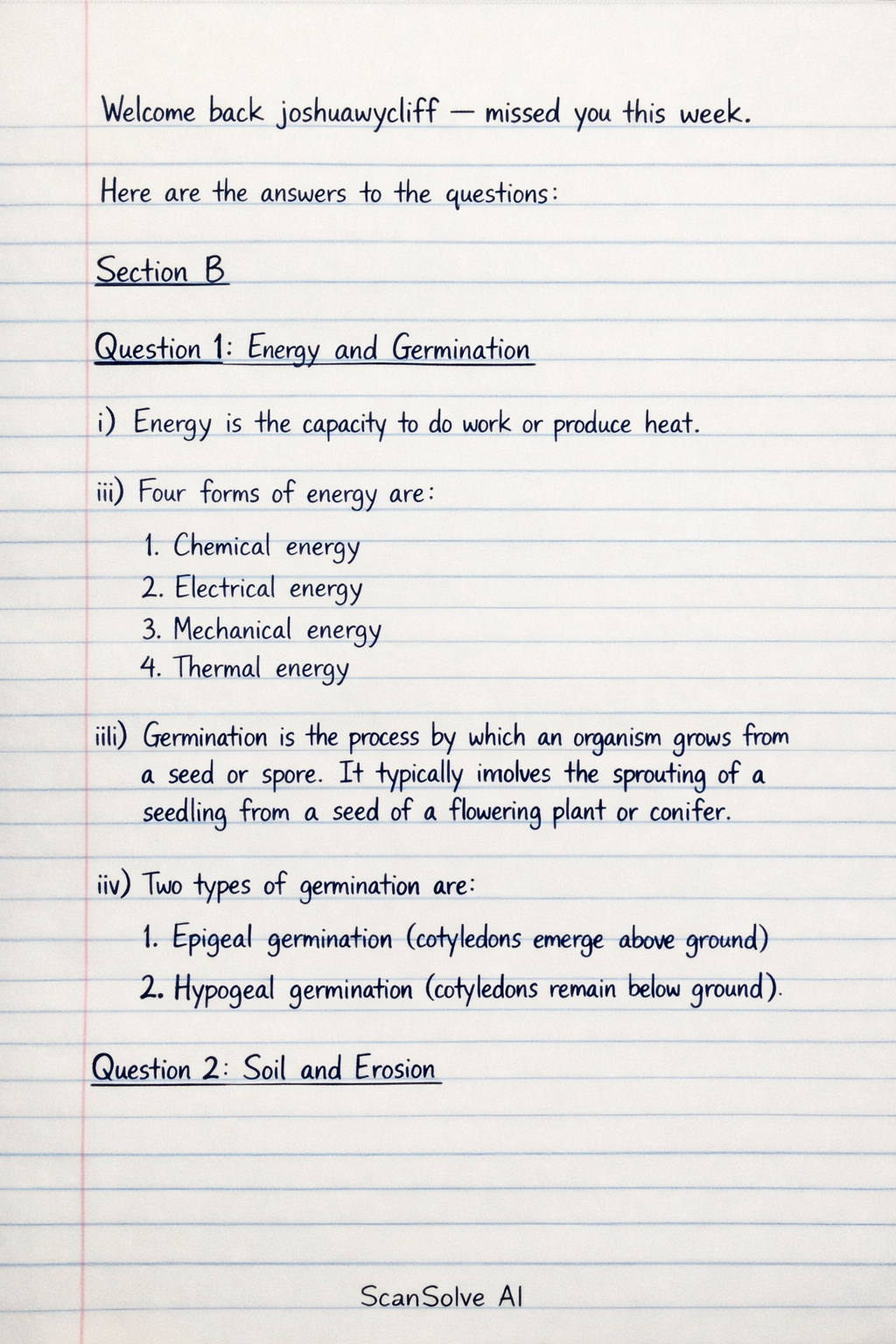
Here are the answers to the questions:
Section B
Question 1: Energy and Germination
- i) Energy is the capacity to do work or produce heat.
- ii) Four forms of energy are:
- 1. Chemical energy
- 2. Electrical energy
- 3. Mechanical energy
- 4. Thermal energy
- iii) Germination is the process by which an organism grows from a seed or spore. It typically involves the sprouting of a seedling from a seed of a flowering plant or conifer.
- iv) Two types of germination are:
- 1. Epigeal germination (cotyledons emerge above ground)
- 2. Hypogeal germination (cotyledons remain below ground)
Question 2: Soil and Erosion
- i) Soil is the loose surface material of the Earth, composed of organic matter, minerals, gases, liquids, and organisms, that supports plant life.
- ii) Four types of soil are:
- 1. Sandy soil
- 2. Clay soil
- 3. Loamy soil
- 4. Silty soil
- iii) Erosion is the process by which natural forces like water, wind, ice, or gravity wear away and transport soil and rock from one location to another.
- iv) Four causes of erosion are:
- 1. Wind
- 2. Water (rain, rivers, waves)
- 3. Ice (glaciers)
- 4. Gravity (landslides, mass wasting)
Question 3: Define the following terms
- i) Electricity is a form of energy resulting from the existence of charged particles (such as electrons or protons), either statically as an accumulation of charge or dynamically as a current.
- ii) An atom is the smallest unit of ordinary matter that forms a chemical element, consisting of a nucleus (containing protons and neutrons) surrounded by electrons.
- iii) Technology is the application of scientific knowledge for practical purposes, especially in industry, or the machinery and equipment developed from such scientific knowledge.
- iv) Food is any nutritious substance that people or animals eat or drink, or that plants absorb, in order to maintain life and growth.
- v) Friction is the force that opposes motion between two surfaces in contact.
Was this helpful?
Still stuck on this one?
Ask a follow-up, and the answer starts from this question.
Got a different question?Ask your own question
More Physics Questions
QWhat is energy? (b) Give the name of the process which: (i) converts light energy into chemical…QDefine the following terms i. Electricity ii. Atom iii. Technology iv. Food v. FrictionQMention all the types of energyQWhat is energy? Give the name of the process which converts light energy into chemical energy…QWhat is energy and fertilization? List types of energy, sources of energy, and types of pollination.
Browse by topic:Mechanics
Handwritten Step-by-Step Solution
Get this as a handwritten image on WhatsApp — like a tutor wrote it for you.
Try on WhatsApp