
A train starts from rest with uniform acceleration for 20 seconds. It travels with uniform velocity for another 30 seconds the brakes are applied and then the train comes to rest in a further 10 seconds Sketch the velocity time graph and use it to calculate the total distance covered by the train
ScanSolve AI Answer
Answer
Step-by-step solution
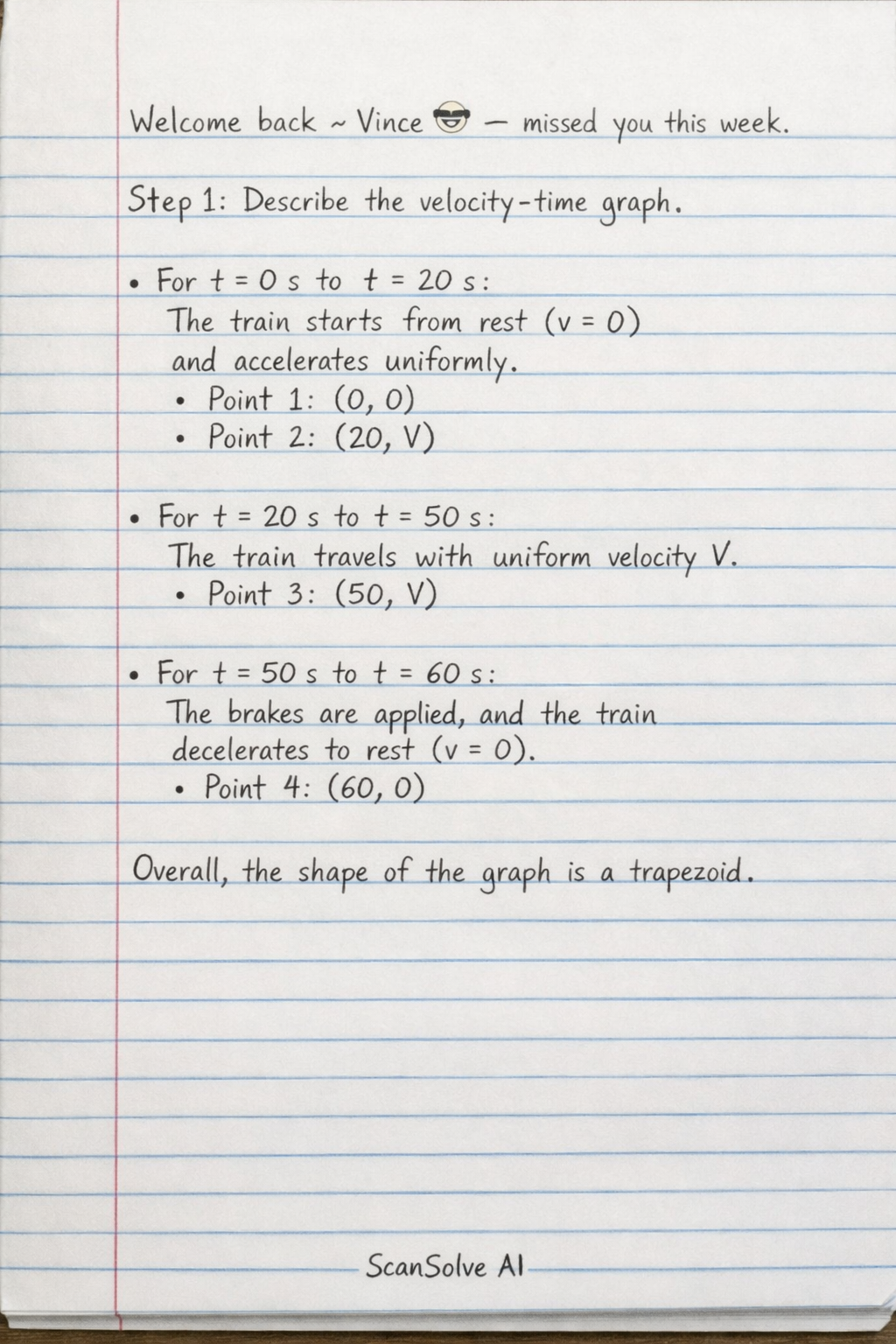
3 stepsDescribe the velocity-time graph.
The velocity-time graph will consist of three segments:
- From s to s: The train starts from rest () and accelerates uniformly. This is represented by a straight line segment starting from the origin and rising to a maximum velocity, let's call it , at s. So, the first point is and the second point is .
- From s to s: The train travels with uniform velocity . This is represented by a horizontal straight line segment from to .
- From s to s: The brakes are applied, and the train decelerates uniformly to rest () in 10 seconds. This is represented by a straight line segment from down to .
The overall shape of the graph is a trapezoid.
Calculate the total distance covered.
The total distance covered by the train is equal to the area under the velocity-time graph. This area can be divided into three parts: a triangle (acceleration), a rectangle (uniform velocity), and another triangle (deceleration).
Area of the first triangle (acceleration phase):
Area of the rectangle (uniform velocity phase):
Area of the second triangle (deceleration phase):
Sum the areas to find the total distance.
Total distance
Since the maximum velocity is not given, the total distance is expressed in terms of .
The total distance covered by the train is .
Try one yourself
A new problem that tests the same skill.
Still stuck on this one?
Ask a follow-up, and the answer starts from this question.
More Physics Questions
Handwritten Step-by-Step Solution
Get this as a handwritten image on WhatsApp — like a tutor wrote it for you.
Try on WhatsApp