
We read your photo as:
3.7 How does this investigation help you understand how to build the alarm system?
ScanSolve AI Answer
Step-by-step solution
7 steps9.3.1
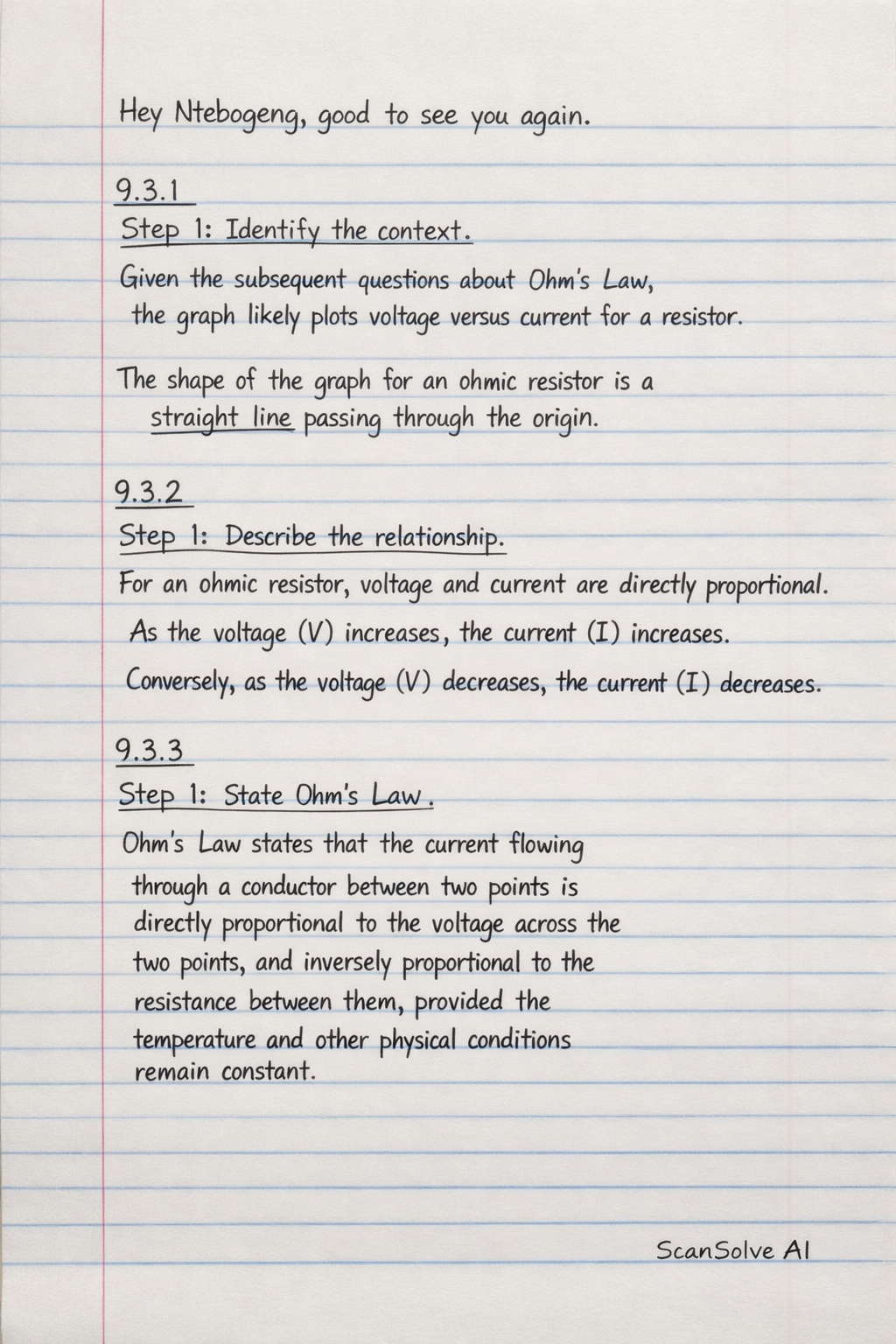
Identify the context.
Given the subsequent questions about Ohm's Law, the graph likely plots voltage versus current for a resistor.
The shape of the graph for an ohmic resistor is a straight line passing through the origin.9.3.2
Describe the relationship.
For an ohmic resistor, voltage and current are directly proportional.
As the voltage (V) increases, the current (I) increases. Conversely, as the voltage (V) decreases, the current (I) decreases.9.3.3
State Ohm's Law.
Ohm's Law states that the current flowing through a conductor between two points is directly proportional to the voltage across the two points, and inversely proportional to the resistance between them, provided the temperature and other physical conditions remain constant.
9.3.4
Write the formula and explain symbols.
Ohm's Law in symbols is:
Where:
- represents voltage (measured in volts, V).
- represents current (measured in amperes, A).
- represents resistance (measured in ohms, ).
9.3.5
Address the missing information and explain how to answer.
This question requires specific results, a hypothesis, a graph, and a table, which are not provided.
To answer, you would compare your experimental data (from the graph/table) to your initial hypothesis. For example, if your hypothesis was that "voltage is directly proportional to current," you would look for evidence like a straight-line graph passing through the origin, or a constant ratio of in your table, to support it.9.3.6
Explain the purpose of a series resistor with an LED.
It is necessary to connect a resistor in series with an LED to limit the current flowing through the LED. LEDs are sensitive to current and can be damaged or burn out if too much current passes through them. The resistor ensures the current stays within the LED's safe operating limits.
9.3.7
Explain the application of the investigation.
This investigation, likely involving Ohm's Law and basic circuit principles, helps in understanding how to build an alarm system by teaching about:
- Component selection: Choosing appropriate resistors to protect sensitive components like LEDs.
- Circuit design: Understanding series and parallel connections for different parts of the alarm.
- Current and voltage control: Ensuring all components receive the correct voltage and current for proper and safe operation.
Still stuck on this one?
Ask a follow-up, and the answer starts from this question.
More Physics Questions
Handwritten Step-by-Step Solution
Get this as a handwritten image on WhatsApp — like a tutor wrote it for you.
Try on WhatsApp